 |
|||||||
Wednesday, December 17, 2025 |
|||||||
| |||||||



British Governors and Governor Generals (continued...)
Cornwallis
The
 court of Directors sent Cornwallis in 1786 to
carry out the policy of peace outlined in Pitts in India Act , to reorganise the
administrative set up of the country. He had to find a satisfactory land revenue
system, reform the judicial machinery and reorganise the commercial set up of the
company. Lord Cornwallis introduced several judicial reforms. He set up the
criminal courts. The lowest was the Darogas followed by the district
courts headed by an European magistrate. Civil courts were also setup. The
distinction between revenue and civil case was abolished. The Diwani courts
could try all civil cases. At the lowest level was the Munsiff court presided
over by Indian officers. Above the district courts were the four provincial
courts of Appeal at Calcutta, Murshidabad, Dacca and Patna. Cornwallis brought
about reforms introducing a police system. Each district had a Daroga,the
district was
divided in to areas under a Superintendent of police. In the matter of revenue Cornwallis
divided the provinces of Bengal in 1787,each under a collector. The committee of
Revenue was renamed as Board of Revenue. In 1790 Cornwallis got the
approval of the Board of Directors who recognised the Zamindars as the owners of
land.They were subjected to annual payment of land revenue. In 1793 the
settlement was declared permanent. This Permanent Settlement introduced by
Cornwallis on the basis of an enquiry conducted by Sir John Shore had its positive
and negative implications.
court of Directors sent Cornwallis in 1786 to
carry out the policy of peace outlined in Pitts in India Act , to reorganise the
administrative set up of the country. He had to find a satisfactory land revenue
system, reform the judicial machinery and reorganise the commercial set up of the
company. Lord Cornwallis introduced several judicial reforms. He set up the
criminal courts. The lowest was the Darogas followed by the district
courts headed by an European magistrate. Civil courts were also setup. The
distinction between revenue and civil case was abolished. The Diwani courts
could try all civil cases. At the lowest level was the Munsiff court presided
over by Indian officers. Above the district courts were the four provincial
courts of Appeal at Calcutta, Murshidabad, Dacca and Patna. Cornwallis brought
about reforms introducing a police system. Each district had a Daroga,the
district was
divided in to areas under a Superintendent of police. In the matter of revenue Cornwallis
divided the provinces of Bengal in 1787,each under a collector. The committee of
Revenue was renamed as Board of Revenue. In 1790 Cornwallis got the
approval of the Board of Directors who recognised the Zamindars as the owners of
land.They were subjected to annual payment of land revenue. In 1793 the
settlement was declared permanent. This Permanent Settlement introduced by
Cornwallis on the basis of an enquiry conducted by Sir John Shore had its positive
and negative implications.
Sir John Shore
Sir John Shore succeeded Cornwallis. He looked after the affairs of the company till 1798 when he was recalled due to failure in tackling with the mutiny of army officials of Bengal in 1785. Sir John Shore followed a policy of non-intervention in the affairs of the native states. This resulted in the Nizam employing French officers to train his army thus decreasing the English influence. The Marathas and Tipu Sultan also sought the help of the French thus undermining the British.
Lord Wellesley (1789-1805)
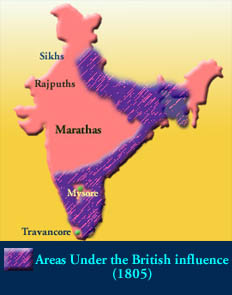
Lord Wellesley is considered to be one of the most brilliant Governor General of Bengal. Under his rule from 1798 the extended the dominions of the British. During his early period the French influence in Mysore, Hyderabad Gwalior was the first task to be tackled. He introduced the Subsidiary Alliance system to undo with the French influence and bring the Indian states within the purview of the British power of Jurisdiction. This was a very advantageous system that asserted British supremacy in India besides expansion of the company's dominion. Under the subsidiary system the ruler who accepted the sustem had to recognise the company ,who in return would ensured protection of the territory. In 1798 the Nizam of Hyderabad accepted it, followed by the Nizam of Oudh and Mysore. Pehwa Baji Rao also accepted this treaty after his defeat at the hands of Holkar. The rulers of the Baroda and many Rajputs accepted this system. This system increased the resources of the company besides increasing the territory of the company too . The company had the right to exercise its military power in the affairs of the native states. This made the native states dependent on the company and ended foreign influence on the native rulers. Lord Wellesley gave up the policy of the non invention followed by sir John Shore. By 1805 the East India company territory in India extended from Sind to the west coast of Cape comorin and, to the north east along the Bay of Bengal to Burma. In northern India the company exercised control over Bengal, upper Sind and Punjab. The princely states of Oudh, Nagpur, Gwalior, Indore, Baroda. Hyderabad, and Mysore formed parts of the East India company's territories.
Lord Cornwallis(1805)
In 1805 Lord Cornwallis came back as the Governor General for the second time. The directors of the company who were not in support of the policy of extension of British dominions followed by Wellesley aspired to follow the policy of non-intervention.
SirGeorge Barlow
After his death in 1805 Sir George Barlow a senior member of the Governor general council became the Governor-General. He followed a policy of non intervention and withdrew the company protection for the Rajputs.
Lord Minto
George Barlow was followed by Lord Minto who was the president of the Board of control before he became the governor general of the company. Lord Minto intervened in the affairs of Berar in 1809 when it was attacked by Amir Khan. He also took strong steps to put down the French and Dutch.
| Back | More |
| |||||||||||||
|
| |||||||||||||
| Updated on 03/08/2015 |


