 |
|||||||
Friday, April 26, 2024 |
|||||||
| |||||||



PERIOD FROM (647 A.D. TO 1200 A.D. )
The history of the Kingdom of Kannauj after the death of Harshavardhana can be said to have been uncertain till the year 730AD, when Yashovarman is said to have ruled till 752AD. This was followed by the Ayudha dynasty which comprised three kings. The first was Yajrayudha who is said to have (accee) ruled in about 770AD. He was defeated by Jayapida Vinayaditya of Kashmir who ruled from (779 to 810AD). The next ruler was Chakrayudha. The influence of the Rashtrakutas increased gradually in the north. Kannauj was annexed by a new class of rulers called the Prathiharas.
The Pratiharas
The Pratiharas were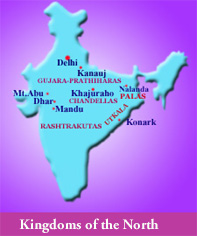 one of the thirty six clans of the
Rajputs. They are said to have come to India during the invasion of the Huns and
settled in the Punjab Rajputana region. They advanced to the Aravalli region and
advanced till Ujjain. Harichandra, a brahmin is said to have laid the foundation
of this dynasty in the 6th century AD near Jodhpur.
one of the thirty six clans of the
Rajputs. They are said to have come to India during the invasion of the Huns and
settled in the Punjab Rajputana region. They advanced to the Aravalli region and
advanced till Ujjain. Harichandra, a brahmin is said to have laid the foundation
of this dynasty in the 6th century AD near Jodhpur.
The Pratiharas were said to be from the Agnikula family. Harichandra had two wives one of whom was a Brahmin and the other was a Kshatriyas. A branch of the Pratiharas who ruled in the (Jodhpur) Gurjaratra was known as Gurjara.
Nagabhatta I was the first ruler of the Pratiharas who ruled from (730-756AD) over Broach and Jodhpur, and extended his dominion till Gwalior. He is also well known for repulsing the invasion of the Melcchas, Arabs of Sind to the east and checking their expansion.
Nagabhatta I was succeeded by two weak successors. They were succeeded by Vatsraja from (775-800AD). He was an ambitious ruler who desired to dominate the whole of North India. His intention to control Kannauj brought him into conflict with the Pala ruler Dharampala. When he waged a war with the Rashtrakuta ruler Dhurva and was defeated. He died in 805AD.
Vatsraja was succeeded by Nagabhatta II who ruled from (805-833AD) with his able military capability and administrator ship. The internal problems among the Rashtrakutas helped his victory over rulers of Andhra, Sindhu, Vidharba and Kalinga. He also attacked Kannauj and occupied it. He also checked the Muslim advancement in the west and defeated the Matsayas in the north. He also defeated the Vatsas.
The Pala ruler Dharmapala who's father was defeated by Nagabhatta's father sought revenge. Thus started an allied struggle against Dharmapala assisted by the ruler of Jodhpur, Kalhiwar and Mewar. Dharmapala was defeated and his territories up to Bihar were annexed. Nagabhatta had to fight Govinda III who was supported by the vanquished Dharmapala and in 809AD Nagabhatta was defeated. He then diverted his attention away from the Rashtrakuta authority. He was succeeded by an incapable successor Rambhadra.
Rambhadra was succeeded by Mihirbhoj who ruled from 840 to 890AD. His period of rule was divided into two parts. In the first period of his reign he suffered losses and defeats. The second period marks a period of his regaining of his lost prestige and position. His expansionist policy in the east was checked by the ruler of Bengal Devapala. Mihirbhojs idea of taking advantage of the internal conflict of the Rashtrakutas in the south did not succeed . His defeat made him weak and some of his subordinates declared independence.
After the death of Devapala , and because of the weak successors after him, Mihirbhoj established himself in the east. With no resistance from the Rashtrakuta ruler he defeated the Pala King Narayanapala and expanded his territory to the west. After defeating the Rashtrakuta ruler Krishna II he expanded towards Malwa and Kathiawar. KrishnaII avenged his defeat against Mihirbhoj near Ujjain. He thus carved out a large empire for himself with many rulers accepting his supremacy.He was succeeded by his son Mahendrapala I who ruled from (885AD to 910AD).
Mahendrapala I successfully maintained the territories he inherited besides adding to it parts of North Bengal, Magadha, and western Assam. Mahendrapala was succeeded by Bhoja II he was overthrown by Mahipala, who ruled from 912 to 914. This was the period when the Rashtrakuta power was on the rise. The weak position of Mahipala was taken as an opportunity by the Chandelas, the Chedis and the Paramaras who declared themselves independent. After the attack by Indra II of the Rashtrakuta Kingdom, the Kingdom of the Pratiharas were divided into various principalities. Gujarat was under the Chalukyas, Gwalior was under the Kachhaghals, the Kalachuris ruler over central India. The Chandelas ruled over Jajakabhukti and the Paramaras ruled over Malwa. The process of the disintegration of the Pratihara empire continued , by the 10th Century AD the empire shrunk into a small kingdom. In 1018AD when Mahmud Ghaznavi invaded Kannauj the ruler Rajapala decided not to face him but fled the city. This caused resentment in the Chandela ruler Gauda, who sent his son Vidydhar to invade Kannauj. He defeated and killed Rajyapala but placed Trilochanpala Rajyapala's son on the throne. The last ruler of the dynasty was Jasapala who ruled up to 1036 AD before Pratihara dynasty came to an end. Contemporary to the Pratiharas were the Palas and Senas of Bengal.
The Palas
Before the coming of the Palas to power in Bengal, and after the death of Sasanka Bengal reflected a picture of disorder. The pala dynasty was founded by Gopala in about 750AD. His ruler lasted for about 25 years. The dynasty remained in power for about 300 years Gopala was succeeded by Dharma Pala in 775 and ruled till 810AD. He had inherited a consolidated kingdom, but to keep his supremacy he had to fight both the Pratiharas and the Rashtrakutas. Both these powers managed to suppress Dharmapala ,but owing to differences among them Dharmapala took advantage of this. In a war with Nagabhatta II, Dharamapala was defeated.
Dharmapala was a good administrator had contributed to change Bengal into a prestigious and prosperous empire.
Devpala succeeded Dharamapala and ruled for about 40 years. After ascending the throne he fought against the Pratiharas and spread his kingdom upto the Himalayan region in the north the Vindhyas in the south.
The Pratiharas and Rastrakutas failed to check the advancement of Devapala. He was known for his diplomatic skill which he pursued to maintain his over lordship in areas which could not be conquered. The role of Bengal in the North Indian politics was very significant during this period. Devapala was succeeded by Mahipala I. He ruled form 988 to 1033 AD. He is said to be the founder of the second Pala kingdom. The immediate successors of Devapala were weak and incompetent. Thus for a period of forty years there was chaos in Bengal. Mahipala I had to rebuilt their empire. Even their homeland Bengal had to be recovered.
The Palas were in power for about 400 years. During this period their rulers proved their capable administration, military skill, and capacity to protect North India from the onslaught of the Pratiharas and Rastrakutas. The rulers also had shone religious toleration towards Buddhist art, literature and learning. Bengali art, literature and paintings flourished under the royal patronage of the rulers of the Pala dynasty.
| |||||||||||||
|
| |||||||||||||
| Updated on 03/08/2015 |


