 |
|||||||
Thursday, April 25, 2024 |
|||||||
| |||||||



THE GUPTA PERIOD
After the downfall of the Kushana empire in about
the third century and at the beginning of the 4th century AD, many i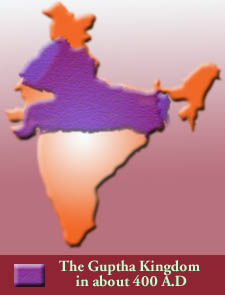 ndependent
states emerged in North India. One of these states was of the Lichchahavis of
Vaisali who dominated portions of North Bengal and South Bihar. This clan obtained
possession of Pataliputra, the Capital of the Kushans. Sri Gupta was the first
ruler of this dominion. After him his son Ghatokacha ruled with the title of
Maharaja. In the fourth century a Lichchavi princess got married to a king in
the Magadha who was called Chandragupta I. The reign of Chandragupta I is said
to have come to an end in about 330AD. The importance of the rule Chandragupta
I centres around the influence of Kumaradevi the Lichchavi princess, coins bearing
the figures of the princess speaks of the extent of her influence. Chandragupta
became the king of Pataliputra and established a kingdom along the Ganges.
ndependent
states emerged in North India. One of these states was of the Lichchahavis of
Vaisali who dominated portions of North Bengal and South Bihar. This clan obtained
possession of Pataliputra, the Capital of the Kushans. Sri Gupta was the first
ruler of this dominion. After him his son Ghatokacha ruled with the title of
Maharaja. In the fourth century a Lichchavi princess got married to a king in
the Magadha who was called Chandragupta I. The reign of Chandragupta I is said
to have come to an end in about 330AD. The importance of the rule Chandragupta
I centres around the influence of Kumaradevi the Lichchavi princess, coins bearing
the figures of the princess speaks of the extent of her influence. Chandragupta
became the king of Pataliputra and established a kingdom along the Ganges.
Samudragupta
Chandragupta I was succeeded by Samudragupta is about 330AD. He reigned for
about fifty ye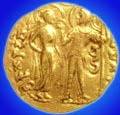 ars. Inscriptions on a pillar erected by Ashoka gives an
account of Samudragupta. After succeeding to the throne of the empire he subdued
the powers revolting against his authority in the
Gangetic plains and brought their dominions to his kingdoms. He is said to have
commanded a military campaign across the Deccan, and also subdued the forest
tribes of the Vindhya region. He performed the Ashvamedha sacrifice to establish
and proclaim his supremacy. His kingdom also included Lower Bengal, upper Assam
and
Nepal. Tributes and homage was paid by the rulers and clans including the
Malwas, the Yaudheyas, Arjunayansas, the Madras, the Abhiras in Punjab and
Rajasthan and others in Madhya Pradesh. Samudragupta led an expedition to the
south through the forest tracts of Madhya Pradesh to Orissa, Vishakapatnam,
Godavari, Krishna and Nellore district. He is also said to have intruded into
Kanchi the capital of the Pallavas.
ars. Inscriptions on a pillar erected by Ashoka gives an
account of Samudragupta. After succeeding to the throne of the empire he subdued
the powers revolting against his authority in the
Gangetic plains and brought their dominions to his kingdoms. He is said to have
commanded a military campaign across the Deccan, and also subdued the forest
tribes of the Vindhya region. He performed the Ashvamedha sacrifice to establish
and proclaim his supremacy. His kingdom also included Lower Bengal, upper Assam
and
Nepal. Tributes and homage was paid by the rulers and clans including the
Malwas, the Yaudheyas, Arjunayansas, the Madras, the Abhiras in Punjab and
Rajasthan and others in Madhya Pradesh. Samudragupta led an expedition to the
south through the forest tracts of Madhya Pradesh to Orissa, Vishakapatnam,
Godavari, Krishna and Nellore district. He is also said to have intruded into
Kanchi the capital of the Pallavas.
Samudragupta maintained diplomatic relations with the Kushana King of North west and the ruler of Ceylon. His friendly relation with Ceylon is proved by the fact that King Meghavarna of Ceylon sent an embassy to Samudragupta. With gifts, seeking permission to erect a splendid monastery near the holy tree at Bodh Gaya for the pilgrims from Ceylon. This structure constructed with the permission of Samudragupta was known as Mahabohi Sangharvama. Samudragupta's personal skill was exceptional especially in music and song. He was also well known for his poetry and had composed many work which had a reputation of a professional author. He was a devotee of Vishnu and thus can be called a Brahmanical Hindu. All these and his role as a monarch qualifies him to be called a hero of hundred battle by a court poet in the Allahabad inscriptions.
Vincent Smith has elevated Samudragupta in Indian history as the Napoleon of India. His tradition of (Milito) religious toleration reflects in the Allahabad inscription and speaks thus " put to Shama the preceptor of the lord of the gods. Brahaspati by his sharp and polished intellect and Tamburu and Narad by lovely performance." Samudragupta had several sons. His rule is presumed to have been till about 375AD.
Samudragupta was succeeded by his elder son Ramagupta who was said to have been murdered by Chandragupta II, who did so owing to his brother Ramaguptas uncouth act of surrendering his queen Dhruvadevi to the Saka ruler who subdued him.
 Thus
Chandragupta ascended the throne of Patilaputra in about 375AD. On assuming
the throne of the Gupta empire he took to the title of Vikramaditya. Chandragupta
II was a conquerer like his father Samudragupta. His diplomatic tactics in
giving his daughter in marriage to Rudrasena II. TheVakattaka king of Deccan
helped greatly in securing the vital territory for himself which could prove
advantageous in the event of an attack upon the saka satraps of the west from
the north. Chandragupta Vikramaditya's miltary conquests includes the conquest
of Malwa, Gujarat and Saurashtra which were under the Saka rule. He defeated
Rudrasimha III the last of the western satrap ruler and annexed his territories.
This provided exceptional wealth which added to the prosperity of the Guptas.
The Guptas at his period had sea trade with the countries of the west. Broach,
Sopara, Cambay were ports that facilitated trade. During this period, Ujjain
appears to have been the inland centre upon which most of the trade routes
converged. Chandragupta occupied the throne for nearly forty years. Pataliputra
was a flourishing city. The Gupta administration at this period was mild.
Under the Guptas the King assumed a divine character. Chandragupta II was
also identified with Vikramaditya of Ujjain. Raja Bikram of popular legend
was also a patron of the nine gems including Kalidsa and Varahamihira.
Thus
Chandragupta ascended the throne of Patilaputra in about 375AD. On assuming
the throne of the Gupta empire he took to the title of Vikramaditya. Chandragupta
II was a conquerer like his father Samudragupta. His diplomatic tactics in
giving his daughter in marriage to Rudrasena II. TheVakattaka king of Deccan
helped greatly in securing the vital territory for himself which could prove
advantageous in the event of an attack upon the saka satraps of the west from
the north. Chandragupta Vikramaditya's miltary conquests includes the conquest
of Malwa, Gujarat and Saurashtra which were under the Saka rule. He defeated
Rudrasimha III the last of the western satrap ruler and annexed his territories.
This provided exceptional wealth which added to the prosperity of the Guptas.
The Guptas at his period had sea trade with the countries of the west. Broach,
Sopara, Cambay were ports that facilitated trade. During this period, Ujjain
appears to have been the inland centre upon which most of the trade routes
converged. Chandragupta occupied the throne for nearly forty years. Pataliputra
was a flourishing city. The Gupta administration at this period was mild.
Under the Guptas the King assumed a divine character. Chandragupta II was
also identified with Vikramaditya of Ujjain. Raja Bikram of popular legend
was also a patron of the nine gems including Kalidsa and Varahamihira.
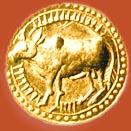
Kumaragupta I was successor of Chandragupta II known as Mahendraditya Kumargupta I, he ruled from 415 AD to 455 AD. He reigned for about 40 years. His empire extended from North Bengal to Kathiawar and from the Himalayas to the Narmada. To the south his kingdom extended as far as the Satara district of the Deccan. He also performed the Ashwameda sacrifice. Towards the end of his rule, the Pushyamitras who were people located near Mekala in the Nerbudda valley became powerful and wealthy. The Pushamitras brought about a temporary eclipse of the Gupta power.This attack on the Guptas were repulsed by Skandagupta who is considered as the last great Gupta ruler. After the succession of Skandagupta he had to subdue the Huns, Skandagupta assumed the title of Vikramaditya. During his campaign against the Huns Skandagupta had to meet great expenses which resulted in the reduction in the issue of gold coins. The Gupta period in Indian history is termed as the Golden Age of India. This period extends from 320 to 480 AD. It extends through the reigns of Chandragupta I, Samudragupta, Chandragupta II, Vikramaditya, Kumaragupta and Skandagupta.The Gupta dynasty continued its existence after the death of Skandagupta. He was succeeded by his son Narasimhagupta followed by Kumaragupta II. Kumaragupta II was followed by Budhagupta. His territory extended from Bengal to central India. The last Gupta ruler was Bhanugupta. During his reign the Hunas wrested Malwas from the Guptas. After his decline in 467Ad the succeeding rulers were weak and could not check the invasion of the Huns and other tribes. After the death of Bhanugupta in 570AD the Gupta empire declined and broke off.
The Gupta period has been described as the golden age of Indian history. It extended from the period of 320AD to 480AD. During this period literature, art and science flourished. Religious toleration and freedom of worship speaks greatly of the Guptas. The great writings of Kalidasa which include Ritusamhara and Meghauta in Sanskrit literature at its highest quality.
The Gupta period is also regarded as a period of Hindu renaissance. Ashoka had succeeded in making Buddhism as the religion as the majority people in Northern India. On doing this neither Brahmanical Hinduism of Jainism died out owing to Ashokas religious toleration propagated by Ashoka. After Ashoka all the rulers that followed showed religious toleration which only added to the prosperity of the territories they ruled. The Guptas though showed a preference to their family deity Vishnu pursued the policy of perfect freedom of worship.
Music, architecture, sculpture and painting was at its best during the period of Gupta rule. The stoner temples of which one at Deogarh in Jhansi, a t Bhitergaon in the kanpur district are few specimens depicting gupta excellence in architecture and sculpture Another area of Gupta excellence was their metallurgical skill. Various copper statues images of Buddha reflects the craftsmanship of the gupta period. The pillar at Delhi made of iron in the time of Samudragupta is also another piece of excellence The Guptas also excellent in the filed of fine arts. All fields of fine arts received royal patronage. Another area of outmost importance during the Gupta reign is the exchange of intellectual ideas which is attributed to the royal patronage and contacts with foreign people of both east and west. Buddhism which was introduced in China from India fostered religious relations promoting constant communication. Chinese missionaries visited India to do reverence to the sacred spots of faith . These visits helped to the sacred spots of faith. These visit helped the Chinese pilgrims knowledge of Sanskrit. Besides China contacts with various islands of South Asia, Indonesia, Persia, Greece and Rome also proves the sound Gupta rule and their diplomatic tactics to provide the best of administration. All these adds to the statement that defines the Gupta period as the Golden age of India.
Contemporary with the rule of the Guptas their existed various other dynastic of which the Vakatakas of Bundelkhand of Berar was one. They were Brahmanas and they dominated the entire Bundelkhand country, Central provinces, Berars, Northern Deccan up to the sea.
Vindyakasthi was its first ruler. His son was Paravasena who performed numerous sacrifices along with four Ashwamedha sacrifices. Gautamiputrra was his son., Paravasena's grandson Rudrasena I. After his defeat by the Samudragupta he vacated central India and moved to the Deccan. Rudradeva's first son Rudradeva II married the daughter of ChandraguptanII , Prabhadevigupta , thus the alliance of the two families proved advantageous against the Shakas of western India. After the Death of Prabhavati. RudrasenaII Prabhavati ruled on behalf of her minor son.
Harisena Vakataka came to the throne in about fifth century AD. He was well known for his conquests from the Malwa to Andhra.
In about the second quarter of the sixth century AD the Vakataka power was subdued by Kalachuris of the south.
| |||||||||||||
|
| |||||||||||||
| Updated on 03/08/2015 |


