 |
|||||||
Tuesday, March 10, 2026 |
|||||||
| |||||||



British Governors and Governor Generals (continued...)
Lord Warren Hastings
Lord Minto was followed by Lord Hastings who governed from 1813 to 1823. When he took up charge the prestige of the company was low. The Indian rulers were not ready to cooperate with the company. The company faced threats from the Gorkhas of Nepal. The Pindaris expanded their territories and activities by plundering, the Marathas wanted to expand their territory by recovering their lost territories. The company faced the threats of Holkar, the Sindia's, Bhonsle, the Peshawa and the Pindaris. Warren Hastings concluded that the policy of non intervention had to be done with . He involved the Gorkhas in a war from 1814 to 1816. The Treaty of Saguali was signed in 1816 and a friendly relation with the Gorkhas was established which in due course of time proved very advantageous for the company. The Pindaris were exterminated from central India. The Marathas were also defeated in the Third Maratha war . The Maratha confederacy was dissolved and their territories became the company's area of administration.
Warren Hastings brought reforms in the social, economic and political affairs of the people. In this he was assisted by John Malcolm, Sir Thomas Murnroe, Elphinstone and Sir Charles Metcalfe. In the area of Judicial reforms William Hastings suggested the setting up of more courts to dispose the cases quickly. In 1814 Lord Hastings provided a Munsif for every Thana appointed by the Judges of the Diwani Adalat. sardar Amins were appointed in every district. The power of the registrars were increased and magistrates were given the power of imprisonment. In the matters of Revenue he suggested a permanent settlement in the North western Provinces. The representatives of each village community had to adjust the share of the individual cultivators. Besides this the Bengal Tenancy Act was passed in 1822 by which the cultivators had hereditary right of possession of the land as long as they paid the rent. In 1820 Sir Thomas Monroe who became the Governor of Madras and he introduced the Ryotwari system by which the ryots became the direct payers of revenue without the intervention of the Zamindars or other middle men. For the promotion of the Education many schools were established. A college for promotion of English language was established in Calcutta. This was followed in Bombay and Madras. Warren Hastings ensured the liberty of the press which was restricted during the time of Wellesley The first Vernacular paper was published called 'Samachar Darpan' In the year 1823 William Hastings resigned and for a period of seven months a senior member of the Calcutta Council took charge in 1823.
Lord Amherst
After this period Lord Amherst took charge as Governor general. During his reign he was compelled by the force of circumstances to wage war against Burma. The first Burmese war started in 1824 and continued till 1826. The treaty of Yandaboo was concluded in 1826 was of great advantage for the British as they could now penetrate deep into North east.
Lord William Bentick (1828-1835)
William Cavendish Bentick succeeded Lord Amherst as
Governor-General of India in 1828. He was appointed Governor of Madras in 12803.
William Bentick pursued a liberal attitude. To improve the financial state of
the company and the territories under the British he undertook many steps.. Firstly the
sinecure jobs were abolished. Secondly Bhatta
of the military personals were reduced. He abolished the provioncial court
of Appeal. In 1823 the collectors were directed to check the validity of rent
free lands . The opium trade of Malwa was regulated . The land revenue
settlement of North west province was made in 1833. Lord William Bentick removed
the ban on employing Indians, and started employing Indians to government jobs. To improve the
Judicial system the provincial court of Appeal set up by Cornwallis were
abolished. The power of the Magistrates were enhanced. A system of jury was
introduced. The use of Vernaculars as court languages and codification of laws
were introduced. In the administrative field Indians were re-employed based on
the charter Act of 1823 and separate Board of revenue was set up at
Allahabad. The educational
reforms brought about by William Bentick was a milestone. He
supported western education through English medium.This was supported by Indian
social reforms like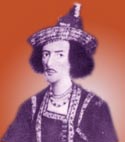 Raja Ram Mohan Roy. In 1835 a medical college was started at Calcutta.
In the matters of social reforms Williams Bentick abolished the practice of
Sati with the support of Raja Ram Mohan Roy.
Raja Ram Mohan Roy. In 1835 a medical college was started at Calcutta.
In the matters of social reforms Williams Bentick abolished the practice of
Sati with the support of Raja Ram Mohan Roy.
The suppression of the Thuggee ,a band of robbers was another remarkable
achievement. The prohibition of female infanticide was another social reform
which was declared punishable. Besides this William Bentick took up Public
works. Relations with the Indian states during the time of Wiliam Bentick
extended to the taking over of the administration of Mysore in 1831. In 1832,
Cachar on the North east frontiers of Bengal was annexed and the plantation of
tea was introduced. In 1834 Coorg was annexed and plantation of coffee was also
started. Lord William Bentick established friendship with Maharaj Ranjit
Singh at Rupar in 1831.A treaty with the Amirs of Sind was signed in
1832 for commercial purpose.
Charles Metcalfe
After William Bentick Charles Metcalfe became the Governor General from 1835 to 1836. During his rule the restriction on the press was removed. He was recalled by the Board of Directors and the Governor Generalship was conferred on Lord Auckland who governed from 1836-1842.
Lord Auckland
It was during his period that the First Afghan War was fought in which the English suffered reverses. He was succeeded by Lord Ellenborough who governed from 1842-44.
Lord Ellenborough
His period witnessed the end of the Anglo Afghan relations, annexation of Sind in 1843. He was also recalled by the Board of directors because his relation with them was not satisfactory. He was succeeded by Lord Hardinge.
Lord Hardinge
Lord Hardinge governed from 1844 to 1848. During this period first Sikh was fought from (1845 -1846).
| Back | More |
| |||||||||||||
|
| |||||||||||||
| Updated on 03/08/2015 |


