 |
|||||||
Sunday, August 31, 2025 |
|||||||
| |||||||



| Vijayanagar Kingdom |
SOUTH INDIA
Contemporary to the history of North India that witnessed several dynasties invasions reorganization and the consolidation there existed beyond the Vindhyas and the Deccan Plateau the home land of the Dravidians or Dakshinapath. This part of the country also witnessed the rule by various dynasties many of whom ventured into the northern boundaries thus resulting in the study of the Indian history (vague) without a study of the South Indian dynasties vague.
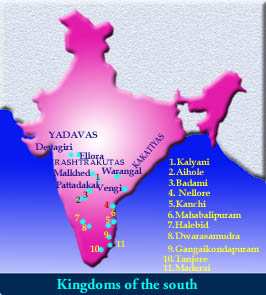
The term South India refers to that parts of India South of the Narmada beyond the Vindhya and Satpura. An extensive forest called Mahankantra lay between the two parts of the mainland and was less ventured into by Early Aryans. The first Aryan establishment is credited to Sage Agasthya who is said to have spread the Aryan religion, language. This was followed by migrations to Dandkaranya (Maharashtra) Vidarbh (Berar) and indeed this affected other parts of the South. The Andhras had established a strong kingdom in the Deccan. After the decline of the Andhras petty kingdom was under the influence of the Guptas. This was under the influence of the Guptas. This empire declined in the early sixth century.
The Vakakakas were followed by the Kadambas. This was a dynasty of Brahmana descent who enjoyed independent power from third to the sixth century. It extended from north to south of Kanara and Mysore. The Kadambas were followed by the Gangas, also called Anhilwada. The Chalukyas are also known as Solankis. Mularaja I besides interested in conquests also was a devout Saiva and had vacated the throne to his son Chamudraja when he had to compromise between religion and conquests and administration. Chamudraja too abdicated the throne and Vallabharaja came to rule over the Chalukyas. After his death his second son Durlabrja who in turn transferred his power to Bhimaraja I, his nephew. Bhimaraja I ruled for about forty years from 1021AD. During this period he had to face the onslaught of Mahand of Ghaznavi in Gujarat. Unable to face him Bhimaraja I fled from his capital Bhimaraja I recovered his capital and revived the Chalukya rule. He was followed by Karna who ruled fro 1063-1093AD. He is said to have fought some battles against the Paramaras and Chauhans. He was succeeded by Jayamimha Siddharaja. He ruled for over fifty years from 1093-1143AD. During his rule he defeated the Chauhans of Nadol (Jodhpur) and also annexed Saurashtra. After his death Kumarapala a distant relative of Siddharaja seized the throne. Amongst his various military victories over the Paramara princes Abu defeat of Maleikarjuna of Konkan was a remarkable achievement . His rebuilt the Temple of Somnath plundered, and looted by Mahmud of Ghaznavi. He died in 1172AD. In 1178AD Bhimadeva II ruled for about sixty years. This period witnessed the invasion by Muslim sultan of Ghor, then Qutubuddin led another invasion. In 1297AD Allauddin Khilji dispatched a strong army which subdued the Chalukya power in Gujarat. With this came to an end the Hindu rule in Gujarat.
Kalachuris of Chedi
Kalachuris had their kingdom in Madhya Pradesh with their capital at Tripuri near Jablapur. These people had come into conflict with the ruler of Kannauj, Malwa, Chalukyas and the Rashtrakutas. They also faced the palas and Kalinga rulers. Kokalla I was the founder of this dynasty.
The most important rulers of this dynasty included Gangeyadeva. He tried to make the Chedis the paramount power of Northern India. He was followed by his son Karandeva. The Kalachuris history is said to have become insignificant by 1181 AD.
This was the political situation that prevailed in Northern India before the advent of the Muslims who made this country as their homeland. Unlike the early rulers who came to loot and plunder the wealth of Indian Kingdoms, many of these invaders settled in various parts of these Indian subcontinent and contributed politically, socially economically besides adding to the Hinduistic cultural heritage in India. With the seeds of Buddhism and Jainism sown on its soil India was to witness a heaven of culture, language and intermixed populace.
Chalukyas
This was one of the most prominent of the dynasties in the Deccan founded by Pulakesin I . He established his power at Valabi (Badami) in the district of Bijapur and built a strong fortress.
Pulakesin I was followed by Kirtivarman I, whose policy of conquest brought Konkan into his empire. His influence extended till Magadha and Bengal. Kirtivarman I was succeeded by Mangalesa assumed the crown. He extended the kingdom of the Chalukyas by conquering the Kalachuris of Northern Decccan and Malwa. A civil war result in Mangalesa's attempt to secure the crown for his son. In this Pulakesin II the son of Kirtivarman defeated and killed Mangalesa in 608AD. Pulakesin II was a contemporary of Harshavardhana of Kannauj and he ruled from 609 to 642AD. He is considered to be the greatest of the Chalukya rulers. The early years of his reign was spent in consolidating his empire. He followed a policy of conquest to subdue the neighbouring powers which formed a danger to his rule. He defeated the Kadambas, subdued the Maurayas of North Konkan, the Malwas and Gujars also. The most striking achievement of his was against that of Harshavardhana who was defeated and compelled to retire beyond Narmada. The Kosala and Kalinga kingdom to came under his influence.
To the south he competed with the Pallavas. Pulakesin's diplomatic effort also deserves praise as he maintained friendly relations with the king of Persia, China. His power was done to its fate by Narasimhavarman I who had allied with the other southern states beyond the Kaveri. The death of Pulakesi II was followed by a decline in the Chalukya power. In the year 656AD his son Vikramaditya I defeated the Pallavas and captured their capital Kanchi. His rule was followed by Vikramaditya II who is said to have defeated the Cholas, the Pandyas and Keralas.
Besides being mere conquerors the Chalukyas were patrons of Art and religion. Though they tolerated other religious like Buddhism and Jainism yet they promoted Hinduism. The Chalukya power declined with the coming of the Rastrakutas led by a Rastrakuta Chief Dantidurga.
Rashtrakutas
The Rashtrakutas empire was founded by Dantidurga. The empire extended from South Gujarat, Malwa and Baghelkhand in north to Tanjore in the south. He was succeeded by his son Krishna I. Besides being a warrior he was a patron of art and architecture. The rock cut temples at Ellora is such a piece of marvelous art that alone speaks of his patronage. Krishna I was succeeded by Govinda II also called Prabhuta Varsa, who was an established warrior swooned to pleasure seeking after he ascended the throne. His younger brother Dhruva Nirupama who administered the territories for Govinda II eventually overthrew him in 779AD. Dhurva increased the prestige of the Rashtrakutas. He crossed the Vindhyas and threatened the Gujarat Vatsaraja of Malwa driving him to the desert. He defeated Dharampala of Bengal in the Ganga. Doab, Jamuna region. The Pallava ruler Dhantivarman was defeated by him and both the Pallavas and Gangas accepted his over lordship. He is also said to have defeated the Pratiharas and Palas. Of his four sons Dhurva nominated Govinda III as his successor. GovindaIII also was a powerful ruler. He involved himself in the activities of the northern powers defeating the Pratihara King Nagabhatta II. Both the Palas and ruler of Kannauj submitted to his protection. Govinda III was followed by Amoghavarsha I who ruled from 815 to 877AD. He shifted his capital to Mayankheta in the Nizams dominions in the Hyderabad state. He was involved with the Chalukyas of Vengi, successfully restrained the progress of Bhoja I of Kannauj towards south. Amoghavarsha is compared to fourth greatest monarchs of the world, besides Khalifa of Baghdad, the emperor of China, and the Emperor of Constantinople.
He was a patron of Digambar sect of Jainism. He abdicated in favour of his son Krishna II.
Krishna III was the last greatest ruler of the Rashtrakutas. He succumbed to the attacks by the Chalukyas of Kalyani.
Chalukyas of Kalyani
This dynasty was founded in 973 AD by Tailapa II who overthrew the Rashtrakuta and ruled for about twenty four years. The kings of this dynasty was constantly engaged in wars with their neighbours, the Paramaras of Malwa in the north and the Cholas in the south. The invasion by Rajaraja Chola caused much harm to the Chalukya rule.
Vikramaditya was the most important King of the dynasty who ruled from 1076 to 1126 AD. He resisted the Cholas occupying their capital number of times. The Chalukya power declined after him and the throne was usurped by a rebel general Bijala Kalachuria. It was during his reign that his Brahmin minister founded the Lingyat sect. Someshwara IV succeeded in getting the ancestral dominions from the successor of Bijala in 1183 AD.
He was defeated by the Yadhavas of Devgiri and the Hoyashalas of Mysore.
Yadhavas of Devgiri
The Yadhavas are said to have descended from the Mahabharat hero Krishna. In 1187 AD. Bhilame II is said to have wrested the territories to the north of the Krishna from the hands of Someshwara IV. Singhana was one of the most famous ruler of this dynasty. He pushed his authority beyond the Krishna.
The attack by Allauddin Khilji made its king to pay tribute. In 1309 AD Ram Chandra the last independent King of Deccan submitted to Malik Kafur and became a feudatory. With the execution of Harvala who attempted a revolt in 1318 AD the dynasty of the Yadhavas came to a close.
Hoyasalas of Dwarasamudra
They are said to have descended from the western Ghats. The founder of this dynasty was Vishnu Vardhana. He ruled from 1110 to 1140AD. He was a Jain and later converted to Vaishnavism by the famous religious reformer Ramanuja. The next important ruler was Vira Ballala I who ruled from 1172-1215 AD. The Hoyasala's are well known for their style and art of building temples and monuments at Halebid. The ornamentation and sculpture of statues are of high quality. The Hoyasalas succumbed to the attacks of Malik Kafur and Khwaja Haji who plundered the kingdom and its capital turning the Hoyasala to mere local rulers.
The Pallavas
The origin of the Pallavas as claimed by historians are varied and numerous. Some of them relate them to the Persian tribe. Some attribute them to the Parthians of North Western India. Others opine that they were Brahman aristocrats from the north who rendered military service. Other scholars attribute the Pallavas as feudatories of the Satavahnas of the Deccan who belonged to the Naga family. After the dissolution of the Andhras the Pallavas established their supremacy. The Pallavas claimed Brahmana ancestry and patronised Sanskrit learning and also performed the Aswamedha sacrifice.
The first great ruler of the Pallavas was Siva Skandvarman. He is said to have extended the Kingdom southward. Thus the Pallava empire extended between the river Krishna and the Bellary district.
Vishnugopa was the next ruler. He was a contemporary of Samudragupta.
He was succeeded by Simhavishnu who was followed by Mahendra Varman I in about the beginning of the seventh century AD. He was involved a struggle between the Chalukyas for establishing supremacy in the south. Though Mahendra Varman I professed Jainism initially later he turned into a staunch Saiva. He was well known for his construction of rock cut temples. This proving him to be a patron of art learning, painting, dance and music.
Mahendra Varman I was succeeded by his son Narasimha Varman I who ruled from (625-45AD). In 642 AD he took over Vatapi (Badami ) from the Chalukyas defeating Pulakesin II. He is said to have sent naval expeditions to Ceylon in support of Manavamna. Pallava art had a boost during his rule the reign of NarasimhaVarman I. He was a great builder and founded the town of Mamallapuram or Mahabalipuram which is adorned with the seven rock cut Pagodas. It was during his reign that Hieun-Tsang visited Kanchi in about 642AD. He wrote a remarkable account on the Pallava Kingdom.
NarasimhaVarman I was succeeded by Mahdendra Varman II. He ruled from 645to 670AD. He was succeeded by Parmeshvara Varman I who ruled for about twenty five years. Narasimha Varman II succeeded him to 695 AD and ruled for about 27 years upto 722 AD. He built the shore temple of Mahabalipuram and also the Kailashnath temple at Kanchi. The defeat of NarasimhaVarman II at the hands of the Chalukya King Vikramaditya II marked the downfall of the Pallava power.
The last Pallava King was Aparajitha. He was defeated by Aditya Chola towards the end of the 9th century AD.
The Cholas
The Chola Kingdom extended along the coromandel coast from Nellore to Pudukottai. It also included the areas of Mysore and Madras. The Cholas rose to power in the ninth century AD defeating the last Pallava King. This rise to power was under Aditya I. His son Parantaka ruled for forty two years from 907 to 949AD. He was an ambitious warrior warrior king who drove the Pandya king to exile captured Mathura and invaded Ceylon. His successors had to repeatedly face the onslaught of the Rashtrakutas, Gangas and Pandyas.
It was under Rajaraja the great who ruled from (985-1014AD) that the Cholas rose as the supreme power in South India. He pursed a policy of conquest for fourteen years during which he conquered the eastern Chalukya kingdom of Vengi, subdued the Cheras,conquered territories on the Malabar coast, inflicted defeat on the Pandyas and annexed parts of Ceylon. His alliance through marriage with the ruler of Vengi promoted unity among the Cholas and Eastern Chalukyas.
Rajaraja was succeeded by Rajendra CholadevaI who ascended the throne in 1016AD. He ruled for a period of twenty eight years. He further expanded his territories beyond his father's territories. He occupied the islands of Andaman Nicobar, Sumatra, Malaya and the islands of Pegu with his fleet of ships. In his expedition to the North in about 1023 AD he defeated Mahipala the Pala king of Bihar and Bengal. To commemorate his victory he assumed the title of 'Gangaikondai' and built in Trichinopoly district a new capital called, Gangaikonda Cholapuram, which had a magnificient palace, temple and a lake.
His son Rajadhiraja was killed fighting the Chalukyas in about 1052 AD. Adhiraja was the next ruler of the Cholas who was assassinated in 1074AD. He was succeeded by Rajendra Kulottunga I but he formed the line of rulers from the Chalukya cholas.
The power of the Cholas declined in about the 13th century. The rise of the hindu kingdom at Vijayanagar ended the Chola dynasty.
The Pandyas
The Pandyas ruled over the territories of Madura. Tinnevelly and parts of Travancore. It is reputed to be most ancient of the Tamil states. The Pandyas rose to power in the seventh century AD. The rule of the Pandyas is said to be initiated by Kandungori. His son Maruvarman Avani Sulamani came into conflict with the Pallavas. A Pandya king named Arikesri is also said to have defeated the Pallavas in the eight century .They aligned with the Cholas and defeated the Pallavas. They carried on frequent wars with ceylon. In the eleventh century they were compelled to submit to the supremacy of the Cholas but in the thirteenth century they asserted their independence and under Jalavarman Sundara Pandya who ruled from 1251-1272 AD . They became the leading power in the South. A civil war that broke out among the claimant of the throne is said to have sealed the fate of this kingdom. This resulted in the Muslim expedition to the south which resulted in plundering and looting of the territories. The Pandya kingdom was absorbed to the kingdom of Vijayanagar in the 16th century.
Cheras
The kingdom of the Cheras consisted of the state of Travancore, Cochin and parts of the Malabar. They are said to have belonged to the Dravidian race. Their proximity to the sea favoured trade with Romans. Association with the Jews were also established with the permission for a colony by the Chera king Bhaskara Ravi Varma. This small territories never experienced the conquest of the Muslims and remained independent till the British period.
| |||||||||||||
|
| |||||||||||||
| Updated on 03/08/2015 |


