 |
|||||||
Thursday, April 25, 2024 |
|||||||
| |||||||



EUROPEANS IN INDIA
| English East India Company | French East India Company | Battle of Plassey and Buxar |
Indian exposure to the Europeans was a result of the discovery of a sea route to India. Old trade routes existed since the ancient times. The invasion of Alexander boosted trade contacts outside India. Opening of new trade routes, through Afghanistan, Central Asia and the Caspian Sea till the Black sea also favoured European entry into India. Another trade route was through Persia and Syria till Alexandria on the Mediterranean coast of Egypt. The route through the Arabian Sea, Persian Gulf and the Red Sea was the most convenient of all. Through these routes goods from India went to Europe and back. The rise of the Arabs witnessed a block of the trade in the 7th century. Besides this the Turks were gaining grounds over the Arabs. The shortage in the supply of Asian goods caused a rise of price of these commodities in Europe. This forced the European countries to seek new sea routes to India.
The Portughese
Owing to the favorable position of Portugal
with regards to access to sea and its experiences in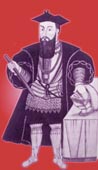 sea-faring, a new
sea route to India, west of Africa was discovered. Encouragement by Prince
Henry of Portugal who loved navigation and exploration also further boosted
the thrill to seek newer lands. By 1481 Bartholomew Diaz reach the cape of Good
Hope in Southern Africa. In 1497 Vasco da Gama another Portuguese navigator
sailed along the Atlantic coast of Africa rounded the cape of Good Hope and
reached Mozambique in the Indian Ocean.
sea-faring, a new
sea route to India, west of Africa was discovered. Encouragement by Prince
Henry of Portugal who loved navigation and exploration also further boosted
the thrill to seek newer lands. By 1481 Bartholomew Diaz reach the cape of Good
Hope in Southern Africa. In 1497 Vasco da Gama another Portuguese navigator
sailed along the Atlantic coast of Africa rounded the cape of Good Hope and
reached Mozambique in the Indian Ocean.
On April, 1498 he reached the western coast of India at Calicut in the south Indian state of Kerala.
He was received by the Zamorin ruler of Calicut who permitted establishment of trading centres at Calicut, Cochin and Cannanore. Fuelled by the instigation of the Arabs the Zamorins attacked the Portuguese but was defeated. The Portuguese thus became supreme in the west coast. Almeida was the first Portuguese Governor in India. He was determined to make Portugal powerful at sea. From 1509 to 1515 Albequerque became the second governor of the Indian territory held by Portugal. He aimed at occupying places for trade, developing a group of intermixed population who would rightfully claim possession of the Portuguese territory in India. Building of forts was another effort of his to consolidate the Portuguese position in India. In 1510 he conquered Goa from the sultan of Bijapur. He established a factory at Colombo in Ceylon and fort at Cochin. With his able administration he increased the Portuguese influence in India. In 1534 the Portuguese occupied Bassein and in 1538 Daman too. In the same year the Portuguese started constructing a factory neat Hugli. After a century the Portuguese power began to decline owing to factors like incompetent successors of Albequerque, defective administration, religions intolerance, resistance from the Mughals, lack of financial support from home, conditions arising of the union of Portugal with Spain under Philip II in 1580. Besides this the inefficient trading methods, discovery of Brazil and above all the emergence of strong European competitions especially the Dutch English also hastened the Portuguese decline.
The Dutch
After the Portuguese, the Dutch rose to power in the South East Asia. Their contact with India was through settlements at Nagapatnam and Cinsura in Bengal. The Dutch East India Company declined under the pressure from the English. The British navy was much superior to the Dutch and finally the English controlled the Dutch possessions in India.
| |||||||||||||
|
| |||||||||||||
| Updated on 03/08/2015 |


