 |
|||||||
Saturday, April 20, 2024 |
|||||||
| |||||||



SOURCES OF INDIAN HISTORY
The sources of Indian history can be classified under the following heads:
-
Inscriptions
-
Numismatics
-
Archaeology
-
Literature
-
Foreign Sources
-
Traditions
1. Inscriptions
Epigraphy is the study of inscriptions. Epigraphic evidences form the most reliable source of ancient history. They are engraved on stone tablets, metal plates, pillars, walls of caves, etc. The inscriptions represent various languages at different places and period of time. Some inscriptions give details about the political and religious activities of that time. Others are official, commemorative and historical.
The edicts of Ashoka, the pillars of Samudragupta and Rudradaman I are religious and administrative inscriptions. Sanskrit plays at Dhar and Ajmer and musical rules found in the Pudukottai, treaties on architecture inscribed on a tower at Chittor are examples of inscriptions.
Inscriptions on metal plates also cast light on the period during the Mauryans. The Mandasor copper plates, the Sohgaura plate from Gorakpur district, the Aihole inscription of Mahendra-Varman, the Uttiramerur inscriptions of Parantaka Chola I cast light on trade, taxes, currency. Some of these are dated in the Saka and Vikrama era reflects the condition of India. It gives knowledge about the boundaries of kingdoms and empire.
2. Numismatics
Numismatic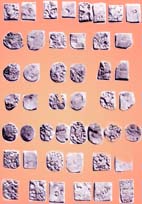 s
is the study of coins. Coins yield information on the condition of country.
The coins made of gold, silver and copper speak of the economic situation
of that place in the period. Coins gives us chronological information. It
also gives us knowledge about the extent of influence of that a particular
ruler or kingdom and its relation with the distant areas. Roman coins discovered
in India gives us an idea about the existence of contacts with the Roman
empire. Coins are the only source of idea knowledge of the Bactarian; Indo-Greeks
and Indo-Parthian dynasty. The coins of this period brings to light an improvement
in the coin artistry of India. Portraits and figures, Hellenistic
art and dates on the coins of the western straps of Saurashtra are remarkable
sources for reconstructing this period. The Puranic accounts of the Satavahanas
is ascertained from the Jogalthambi hoard of coins.
s
is the study of coins. Coins yield information on the condition of country.
The coins made of gold, silver and copper speak of the economic situation
of that place in the period. Coins gives us chronological information. It
also gives us knowledge about the extent of influence of that a particular
ruler or kingdom and its relation with the distant areas. Roman coins discovered
in India gives us an idea about the existence of contacts with the Roman
empire. Coins are the only source of idea knowledge of the Bactarian; Indo-Greeks
and Indo-Parthian dynasty. The coins of this period brings to light an improvement
in the coin artistry of India. Portraits and figures, Hellenistic
art and dates on the coins of the western straps of Saurashtra are remarkable
sources for reconstructing this period. The Puranic accounts of the Satavahanas
is ascertained from the Jogalthambi hoard of coins.
The circulation of coins in gold and silver during the Gupta empire imparts an idea of the healthy economic condition during the rule of the Guptas.
3. Archaeology
Archaeology is the scientific study of the remains of the past. They include buildings monuments and other material relics that the inhabitants of that period were associated with. The Department of Archaeology was set up by Lord Curzon under the Director Generalship of Dr Marshal.
Excavations conducted at various sites in the valley of the river Indus, Lothal in Gujarat, Kalibangan in Rajasthan, at Sind and Punjab gives us knowledge of the civilization during about 2700 BC.
Excavations at Taxila gives an idea about the Kushanas.
Similarity in monuments excavated in India and abroad establish a relations between various areas of the globe, besides this it express the Indian migration beyond India. The fine example of this is the temple of Angkor vat in Cambodia.
Excavations at south Indian sites such as Adichana llur, Chandravalli, Brahmagiri highlights the prehistoric periods.
The rock cut temples of Ajanta and Ellora with its sculptures and paintings express the artistic finery of that period
Besides all these pots, pottery, seals, skeletal remains all are inseparable parts of the reconstructing history.
4. Literature
This can be classified into
-
Indigenous literature
-
Foreign literature
Literature in the ancient period was not fuelled by the urge to preserve history but was a complication of experiences and rules of worship. Most of the literature of this period was religious.
(a) The Indigenous literature includes the Vedas, the Brahmanas, the Aryankas, the Upanishads, the Epics Ramayana and Mahabharatha, the Brahmashastras, the Puranas.
The Buddhist and Jain literature gives knowledge of the traditions prevalent in those periods. The literature of this period are in Sanskrit Pali Prakrit. It gives us a knowledge about music, dance, painting architecture and administration of various kings.
Kautilya`s Arthashastra is a remarkable work on the system of administration.
The Sangam literature in south is an elaborate record of life in South India.
Though these literature lacks historical sense yet they are the main sources to venture into the facts of Indian history.
(b) Foreign Literature
The loop holes in the indigenous literature is supported by the numerous account by foreigners who were either pilgrims, travellers, traders or ambassadors in the court of various kings.
The writings of Herodotus helped in scattering the knowledge of India to Europe before the invasion by Alexander. He highlights the features of the Indo-Persian relations.
Megasthanes the Greek ambassador in the court of Chandragupta gives us an idea about India in his book 'Indica'.
Accounts of Fa-Hien and Hieun-Tsang who toured India as a pilgrim during the rule of Harshavardhana and the Guptas gives us a detailed idea about the country.
Accounts by Muslims personalities also add a great insight into the history of India.
'Tarikh - e - Hind' ( 'an enquiry into India') by Alberuni a learned mathematician and astronomer is a remarkable document about the country. The composition of Firishta, the Ceylonese chronicle Deepavamsa of Mahavamsa of Ceylon portrays the life in the ancient period. Accounts of Pliny in the first century AD, accounts of Ptolemy in the second century AD and the Accounts of Taranath of Tibet is an insight into the religion and history of the India in that period.
5. Foreign sources
The existence of details in the literature of the Greeks, Chinese, Persians, Romans and Europeans gives an account of the condition of the country then. It also speaks the truth about the conditions under which they came in contact India. The presence of various artifacts and materials of Indian origin has added to the study of Indian history.
The histories of the Chinese from 120BC to 400AD and 700AD, the accounts of Abul-Fazl in his 'Ain - i - Akbari' are a few examples of the foreign sources to know about the Indian history.
In many cases where there was a need to fill in the vagueness caused by the lack of evidence in the study of Indian history these foreign sources have proved handy.
6. Traditions
Traditions have modulated and synthesized the Indian life. These were practiced from the dome of civilizations and practiced through generations. Songs, dramas, fairs and festivals besides rituals are an inalienable part of the society. These are living sources of history.
| |||||||||||||
|
| |||||||||||||
| Updated on 03/08/2015 |


