 |
|||||||
Thursday, December 18, 2025 |
|||||||
| |||||||



AKBAR (1556-1605)
| Other Kingdoms | Mughal |
Akbar inherite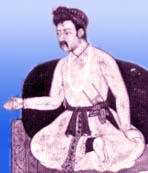 d the throne of the mughal empire at
the age of 14
after the death of Humayun. With an empire which was not yet consolidated he had
to face several obstacles before establishing a powerful empire. He was advised
by Bairam Khan. Akbar was confronted by the still existing Afghan threat, the
threat of Hemu who possessed a large army, the rising power of the Rajputs
and the independent territories. Besides this the condition of the citizens was
worse.
d the throne of the mughal empire at
the age of 14
after the death of Humayun. With an empire which was not yet consolidated he had
to face several obstacles before establishing a powerful empire. He was advised
by Bairam Khan. Akbar was confronted by the still existing Afghan threat, the
threat of Hemu who possessed a large army, the rising power of the Rajputs
and the independent territories. Besides this the condition of the citizens was
worse.
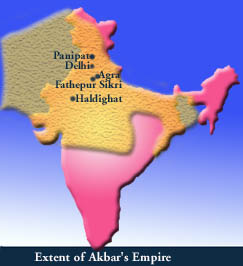
In 1556 Akbar met Hemu on the battle field of Panipat . With the defeat of Hemu, the Mughals had established their sway over Delhi and Agra.
In 1557 under the leadership of Bairam Khan, Sikander Sur submitted to the Mughals.
Bairam Khan became an important figure during the younger days of Akbar. He was able to influence Akbar, and became the ruler of the country from 1556-60.
In 1560 he met with his downfall. The power of the Mughals was taken over by Akbar himself. Bairam Khan retired to Mecca.
In 1561 Adam Khan posed a threat to Akbar when he
 defied the
authority of Akbar and captured Malwa. He met with his fate in 1562 as a result
of his attitude towards the captured people of Malwa, and his greed for power .
defied the
authority of Akbar and captured Malwa. He met with his fate in 1562 as a result
of his attitude towards the captured people of Malwa, and his greed for power .
In 1564 Abdullah Khan Uzbeg revolted against Akbar. He associated with Ali Quli Khan posed a danger to Akbar. In 1567 Akbar was able to subdue them.
Akbar followed a policy of reconciliation with the Rajputs and won their support by establishing matrimonial alliances.
In 1562 he married the eldest daughter of Raja Bihal mal of Jaipur. He maintained alliances with Bihar and Jaisalmer. In 1584 his son Salim was married to the daughter of Raja Bhagwan Das. In 1567 he marched against Chittor. In 1568 Chittor was captured by the Mughals. By 1569 Ranthambhor and Kalinjar was also captured.
He met the Rajput ruler Maharana Pratap in the battle of Haldighat in 1576. After a fierce battle Akbar defeated Maharana Pratap. Gujarat was subdued and completely annexed in 1684. This conquest brought the Mughals in touch with the Portuguese. Under the leadership of Todal Mal, Akbar sent an army to defeat Daud Khan the ruler of Bengal who annoyed him. In between 1576 and 1580 Bengal became a part of the Mughal empire. In 1592 Bengal was reconquered by Man Singh. In 1585 AD Akbar annexed Kabul and appointed Man Singh as its governor. In an onsalught with the Afghans Raja Birbal a close associate of Akbar was killed in 1586.
By 1589 Akbar conquered Kashmir with the help of Raja Bhagwan Das
By 1591 Akbar completed the conquest of Sind and in 1595 he sent an expedition to Qandhar and annexed it. Towards the Deccan Akbar attacked Ahmednagar. This was bravely defended by Chand bibi but she could not hold on longer and Ahmednagar fell in 1596 . In 1600 with the help of Prince Daniyal and Abdur Rahim Khaj-i-Khannan Ahmednagar was annexed to the Mughal empire. In 1601 the fort of Asigarh fell to the Mughals Akbar's failure to curb the Portuguese influence was owing to the superiority of the Portuguese fleet.
Akbar was not only a conqueror by an able administrator who raised the Mughal empire to glory. On the other hand Akbar's policy towards the Afghans was of forced submission and conquest. Unlike the early rulers who were fanatics and resorted to brutal suppression of the Hindus. Akbar followed a tolerant policy. He abolished the Jizya, a religious tax on the Hindus in 1564 and also the pilgrimage tax in 1563. In 1603 he issued a firman allowing conversion to Christianity. Akbar had his own views about religion. This was by establishing a national religion called Din-i-illahi which was to be pleasing both the Hindus and Muslims. Akbar's religious aspirations were expressed in the administration of the empire. The system of land revenue initiated by Sher Shah was continued making his matters of economy systematic. Akbar introduced the Mansabdari system, that systematized the civil and military administration. He started many social reforms against the Sati system, child marriages, slavery etc. He was also a patron of art and literature besides firmly pursuing the policy of aggression and conquest. He was indeed the greatest Mughal who influenced the people who till then had only the view of a conqueror in every muslim ruler.
Akbar was succeeded by his son Muhammad Salim also called Jahangir. His early days before succession were spent in lavish living with wine and women. In 1600 Prince Salim declared himself the emperor of Delhi in the absence of Akbar. He surrendered himself before Akbar. In 1605 Akbar proclaimed him as the ruler. On assuming power he introduced several reforms to bring an opinion of trust in his subjects. In 1606 Prince Khusrau rose in revolt against him but was blinded after he was successful in his attempt. Prince Salim was deeply influenced by the charms of his queen Nur Jahan whom he married 1611 and left the task of administration entirely on her at times. He was engaged in a war with Amar Singh of Mewar in 1614, and subdued him. In 1610 he captured the fort of Kangra. In 1620 Kistwar was under his rule.The period of 1610-1620 witnessed wars with Ahmednagar ruled by the Nizam Shahi dynasty under Malik Ambar.
Jahangir
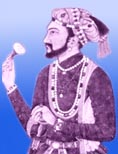 died in 1627 and was succeed by Shah Jahan was ruled
from 1
died in 1627 and was succeed by Shah Jahan was ruled
from 1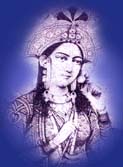 627 to 1658. He was one of the four sons of
Jahangir. He came into
prominence after the revolt in 1622.
627 to 1658. He was one of the four sons of
Jahangir. He came into
prominence after the revolt in 1622.
On coming to the throne he solved the problems which led to rebellion by the Bundela Rajputs. In 1628 Shah Jahan quelled the rebellion by Khan Jahan Lodi and annexed his territory by 1630. His love for his queen Mumtaz Mahal was immense. After her death in 1631, he built the Taj Mahal in memory of her.
In the years 1631-32 he was involved in wars with the Portuguese. He shared the Kingdom of Ahmednagar with the Sultan of Bijapur in 1636. After settling the problems he faced in the Deccan he retired to Agra in 1636. Aurangzeb was appointed Governor of the Deccan and he ruled from 1633-44.
Khandhar which had evaded Mughal rule since 1623 was seiged by Aurangeb in 1649. In 1652 a second attempt was made in the wake of the failure of the first attempt. In 1653 for the third time Kandhar was threatened but was not captured. In 1657 a war of succession started owing to the illness of Shah Jahan between Dara, Shah Suja, Aurangzeb, and Murad.
Aurangzeb being the ablest of the three, succeed Shah Jahan He ruled from 1658-1707. Aurangzeb was the last great Mughal ruler who took the Mughal empire to its greatest glory. Aurangzeb possessed an empire which extended from Ghazni to Bengal and from Kashmir to the Deccan. Through his stern measures much of which had a fanatical motive towards his religion, he could rule the empire all by himself. Every power of authority was granted with his consent.
In 1667 Aurangzeb put down the revolt of the Yusufzais. In 1672 the revolt of the Afridis against the Mughals brought losses to the emperor. In 1674 Auranzeb used a diplomatic tactics supported by force to resolve the issue. Aurangzeb's diplomatic efforts resulted in relations with Mecca, Persia, Abyssinia, and the Turks between the period of 1661 and 1667. He had established contacts with Constaninople in 1690. Aurangzeb adopted various measures to promote Islam in its wholesome moral standards. In many instances he even undertook demolition of Hindu temples in his effort to subdue influence o f the Hindu religion. He issued regulations and imposed religious taxes to prevent the progress of his rival religion. The imposition of Jizya on the Hindus in 1679 which was an anti Hindu policy resulted in the rise of the Rajput in a revolt in 1769. This struggle continued till 1681 when Aurangzeb made peace with the Rajputs.The other sect affected by the Anti-hindu policy of Aurangzeb were the Satnamis. Their revolt was crushed by Aurangzeb. Next was the revolt of the Jats of Mathura which was an opposition to the policy and oppression under Aurangzeb. Though they were suppressed in the early period they carried on the struggle till the death of Aurangzeb. The revolt of the Bundela Rajputs and the Sikhs were other significant effects of Aurangzeb's anti Hindu policy. The sikhs who temples were destroyed were hurt. The death of Guru Teg Bahadur their 9th guru was more hurting . They swore the destruction of the Mughals. Under the 10th Guru Govind Singh, and ,after his death in 1708 the struggle was carried on.
From the period 1682-1707 Aurangzeb turned towards the Deccan , conqeured Bijapur in 1686 and Golconda in 1687. Aurangzeb faced stiff resistance from the Marathas under Shivaji and remained unsuccessful in subduing the Marathas. It was in about 1600 that the Mughals established contacts witht the English ever since the visit of Sir Thomas Roe. In 1616 the English were permitted to build a factory at Masulipattam . And in 1639 they built the famous Fort St. George. It was from the time of Aurangzeb that the English began defiance of the authority of the Mughal's. The action of James II to send an expedition to Bengal infuriated Aurangzeb who ordered capture of the English forts at Hugli, Surat and Masaulipatanam. Aurangzeb died in 1707. He was succeeded by Bahadur Shah I who was the eldest of the three surviving sons of Aurangzeb. The vast Mughal empire which was now the biggest of the empires existing then, was divided among the three sons. Bahadurr Shah I who was known as Prince Muazzam had to face the problems from the Marathas, Rajputs and the Sikhs.
Bahadur Shah I who died in 1712 left behind four sons who were engaged in a war of succession. Ultimately Jahandar Shah the eldest of the four came out successful and became the ruler of the Mughal empire. He was a squanderer who emptied the offers of the Mughal empire. He was over powered by Farukh Siyar the second son of Azim-us-Shan who was Jahandar Shah's brother. In 1713 Jahandar Shah was put to death. Farukh Siyar ruled from 1713-1719. Having forgotten the favours of the Sayyid brothers who helped Farukh Siyar to succeed to the Mughal throne, he was involved in petty quarrels with the Sayyids. This resulted in conspiracies against him and ,his death in 1719. He was followed by Rafi-ud-Darajat in 1719 who was put on the throne by the Sayyid brothers. After a short rule of about four months he died of ailment and was succeeded by Rafi-ud-Daula alias Shah Jahan II who also died owing to physical ailment in a period of one month in 1719. After him Muhammad Shah came to the throne as prefered by the Sayyid brothers. He ruled from 1719 to 1748. During this period he disposed the authority of the Sayyid brothers in 1722.
Along with this ruling power in Delhi. There existed Bengal an independent province under the governorship of Murshid Quli Khan in 1717. He was succeeded by Shuja-ud-din Muhammad Khan the son-in-law of Murshid Quli Khan. After his death in 1739 he was succeeded by Sarfaraz Khan. Owing to his inexperienced administration Alivardi Khan the deputy governor of Bihar captured the power from Sarfaraz Khan. Alivardi Khan was succeeded by Siraj-ud-Daula. his grandson in 1756. As a result of intrigues and conspiracies the Battle of Plassey resulted. This marked the foundation of the British rule in India under the British East India Company in 1764.
The Mughal rule in Delhi while under Muhammad Shah witnessed the invasion of Nadir Shah in 1739. This invasion sealed the fate of Muhammad Shah. This was followed by the invasion of Ahmad Shah Abdali, the general of Nadir Shah.
After the death of Muhamad Shah in 1748 his son Ahmad Shah ruled from Delhi from 1748-1754. During his rule Delhi became a territory full of disputes and rivalry. It ultimately resulted in the imprisonment of Ahmad Shah and the succession of Alamgir II the second son of Jahandar Shah. Being inexperienced and weak he was a puppet in the hands of his Wazir, who finally got Alamgir II assassinated in November 1759.
Shah Alam II who was earlier called Ali Gauhar became the Mughal Emperor. At a time when the East India Company had subdued the Mughal rule in Bengal ,and, the onslaught of the Marathas there was the need for a competent military ruler who could resist the advances of the diplomatic playoffs of the English . He was a religious man fuelled by idleness. superstition and luxury. He was bridled by his subordinates. In 1803 when the English captured Delhi Shah Alam II was proclaimed as a pensioner. He died in 1806 and was succeeded by Akbar II who was only a title head and was considered another pensioner . He died in 1837. After him Bahadur Shah II retained the imperial title of Emperor. He took part in the revolt of 1857 against the English. After the failure of this revolt he was imprisoned and deported to Rangoon where he died in 1862. This marked the end of the Mughal dynasty.
The hasty disintegration of the Mughal empire was owing to many factors besides the incompetence of the rulers after Aurangzeb. One of the major cause was the role of the Sayyid brothers, Rajputs, Jats, Sikhs and Marathas. Besides this the independent provinces of Bengal, Avadh, Rohilkhand, Farrukhabad, Hyderabad, Carnatic and Mysore also longed to restore their days of glory.
| Previous | Next |
| |||||||||||||
|
| |||||||||||||
| Updated on 03/08/2015 |


