 |
|||||||
Sunday, May 5, 2024 |
|||||||
| |||||||



PERIOD OF RELIGIOUS UPHEAVAL
| Pre-Mauryan | Period of Persian Conquest | Invasion of Alexander |
The sixth century BC was a period of religious turmoil. The Indian movement was kindled in the Magadha and its neighbouring areas. The prevalence of the Brahmanical system based on complicated sacrifices and ceremonies created unrest among the common folks. The formalities of the sacrificial rites which were simple during the Vedic age proved expensive andunfeasible among the Kshatriyas, Vaisyas and Sudras. The Brahmanas who now adorned the status of being the highest in the society provoked religious propagators to preach a new philosophy of life and death. Opinions about God and soul was diverse. Looking into the facts of that period it can be summed up that the the Saisunagas, the Licchavis and other ruling clans or families being not Indo- Aryans evoked and encourage the growth of independent views on philosophy and religion. Thus many sects arose advocating diverse opinions about God and ways of attaining Moksha. The most common of the several sect was Jainism and Buddhism. Both Jainism and Buddhism originated in the Magadha or the territories adjoiningit during the reigns of Bimbisara and Ajatasutra.
Jainism
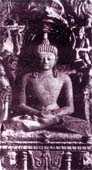 Jainism, as
believed by its followers is said to have originated in the antiquity.
Mahavira was said to have been the 24th Trithankara . Rishabha is
considered to be the founder of Jainism. He is said to have been the father of Bharata.
The main doctrines of Jainism lay stress on a
persons personality which is believed to be dual . It up holds the
material and spiritual natures of human life but rejects the Vedantists
doctrine of Universal soul . The principle of Ahimsa is the practical aspect of
the religion. They defy caste practices. The Jains are classified into two
sects, the Swetambaras and the Digambaras. During the reign of Chandragupta Maurya a dreadful famine lasted for 12 years. This led to the migration
of a large number of disciples led by Bhadrabahu to Karnataka. In course
of time they shifted to parts of Mathura, Ujjain and Gujarat.
Jainism, as
believed by its followers is said to have originated in the antiquity.
Mahavira was said to have been the 24th Trithankara . Rishabha is
considered to be the founder of Jainism. He is said to have been the father of Bharata.
The main doctrines of Jainism lay stress on a
persons personality which is believed to be dual . It up holds the
material and spiritual natures of human life but rejects the Vedantists
doctrine of Universal soul . The principle of Ahimsa is the practical aspect of
the religion. They defy caste practices. The Jains are classified into two
sects, the Swetambaras and the Digambaras. During the reign of Chandragupta Maurya a dreadful famine lasted for 12 years. This led to the migration
of a large number of disciples led by Bhadrabahu to Karnataka. In course
of time they shifted to parts of Mathura, Ujjain and Gujarat.
Buddhism
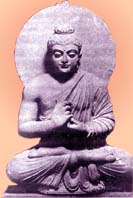 The role of Buddhism is more significant in the religious
history of Indiay . The influence of this religion was not only on the
Indo- Greeks and Scythians who settled in India, but also propagated to
foreign countries like Sri Lanka Myanmar, Thailand, Cambodia, Central
Asia, China, Nepal, Tibet, Indonesia, Korea, Japan and Mongolia. This propagation helped in the exchange of ideas of art, architecture
and literature, thus enhancing the cultural heritage of India.
The role of Buddhism is more significant in the religious
history of Indiay . The influence of this religion was not only on the
Indo- Greeks and Scythians who settled in India, but also propagated to
foreign countries like Sri Lanka Myanmar, Thailand, Cambodia, Central
Asia, China, Nepal, Tibet, Indonesia, Korea, Japan and Mongolia. This propagation helped in the exchange of ideas of art, architecture
and literature, thus enhancing the cultural heritage of India.
Buddha, addressed as Tathagetha, Siddhartha, Gautama or Sakyamuni was the son of Raja Sudhodana of the Sakya clan and Mayadevi at Kapilavastu near Nepal. At the age of 29 he abandoned the comforts of the palace and became an ascetic. After seven years of meditation he became enlightened. At saranath in Benares he delivered his first sermon and set in motion the Dharmma chakra or the wheel of the law. The four noble truths were the teachings of Buddha. It said that life is unhappy, desire or craving causes unhappiness, annihilation of desire is the means ending unhappiness. The fourth truth is the path between sensual pleasure and body torture. The ultimate reality of life is 'nirvana'
The Buddha formed the Sangha. The revival of Brahmanical Hinduisms under the Gupta rulers affected Buddhism. The loss of royal patronage also weakened Buddhism in India.The spread of Buddhism led to many changes in the country.
Political Changes
Buddhism contributed in relieving the society of many of its social evils. It helped the country in developing a better social and political understanding.The spread of Ahimsa weakened the violent spirit of the people thus exposing the country to foreign invaders Buddhism led to the promotion of universal peace. India came into contact with other countries.
Social Changes
The rigidity and exclusiveness of the class distinction in Hinduism destroyed in the sense of unity and co-operation. Buddhism tried to end religious disunity and brought about social unity in the Hindu society.Caste system declined in the Hindu society, changing the outlook of the Brahmanas and priestly class.
Religious and Cultural Changes
Buddhism reformed Hinduism developing a sense of unity among all religions. It invoked the Bhakti cult in Hinduism. The idea of organising Sanghas for propagating Buddhist philosophy led to construction of temples for spreading the Hindu spirit. Art and architecture developed, besides this literature also improved. The Buddhist Sanghas and Viharas laid foundations of centres of learning of universities. These were well known the world over and were visited by students from around the globe.
The Bhakti Cult
The reaction against the atheistic tendency of Jainism and Buddhism and against the formalism of religion of rituals on the other resulted in the evolution among Brahmanical Hindus. Devotion to the Deity, Vasudeva was propagated. The Bhagavad Gita offered the earliest formal exposition the Bhakti cult. The deity was represented in the name Krishna. The practice of this cult rose in the Brahmamaharshi region of Mathura and Delhi. Along with Vasudeva, and Krishna, Vishnu and Sivawas also identified.
| |||||||||||||
|
| |||||||||||||
| Updated on 03/08/2015 |


