You are in : GARDENING » FLOWERING PLANTS » Bleeding Heart
Bleeding Heart
| Scientific Name : Dicentra Spectabilis |
| Family : Fumariaceae |
| Colour : Red, Pink, White |
| Common names : Bleeding Heart, Dutchman's Trousers |
| Flowering Period : May-August |
| |
Native to Japan, Bleeding Hearts are excellent perennial for the shade garden
and they are very attractive with their light transparent green colour, deeply divided and fern like
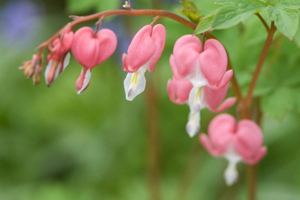
foliage and blooms are borne on arching flower stems above the foliage. Their 1 inch, heart-shaped flowers have rose pink,
red or white outer petals with strongly reflexed tips, and the inner petals are white and
exerted. The Bleeding Heart is fine for the border or margins of shrubbery.
There is a variety with white outer petals and an exerted red flower like inner
petal.
Planting
Bleeding Heart requires average, medium wet,
well-drained, organically rich soil in part shade to full shade.
Bleeding Hearts are propagated
from seeds, division of the roots or from young shoots which start from the
soil. Roots can be taken carefully by digging a section of the plant from a
mature plant, cutting through one side. These shoots or the roots should be divided just before they start growth.
It should be planted in an area where trees or roots of other plants will not compete for moisture or nutrients.
Best growth is obtained when plants are spaced 2 feet apart and if planted in rows, space rows 3 feet apart.
The pH can range from 6.0-7.5 and feed lightly, 5-10-5 commercial fertilizer. The
plant takes 2
years to mature and grows to an average of 2 to 3 feet long.
It
can be grown as pot plants or on the ground and they do best if planted in well-rotted manure or
compost, with top dressing applied yearly.
Care
For the Bleeding Heart, there
is no serious insect or disease problems. Organic matter in the soil will supply all the protection the roots need. Foliage dies down in the fall.
Some susceptibility to aphid infestations. Occasionally stem rot appears but this can be prevented by planting in clean soil.
Because Bleeding Hearts last for years, they will probably become overcrowded and need dividing in 3-4 years. Dig up in early spring but be sure to handle the roots very carefully because they are extremely brittle. Each piece of root division should have an eye or bud however, the root need not be more than 3 feet long. New planting locations should be well marked
and cleaned removing dormant stems
remaining if any.
Questions of
Questions & Answers |
|
| 1. |
Posted on :
31.7.2010 By : Mary Jeanson , Moose Lake MN, Moose Lake MN
|
View Answer (0)
|
Post Answer
|
|
| |
My bleeding heart has turned yellow already -should I cut it back? |
|
|
|
|
| 2. |
Posted on :
4.7.2010 By : Barb , Lakeview, NY, Lakeview, NY
|
View Answer (0)
|
Post Answer
|
|
| |
why are my bleeding heart leaves turning yellow? They are in mostly shade and it is not too wet now. |
|
|
|
|
| 3. |
Posted on :
19.9.2009 By : Linda , Benson, Arizona, USA
|
View Answer (0)
|
Post Answer
|
|
| |
I am trying to find out if a bleeding heart plant will survive in Benson |
|
|
|
|
| » more... |