You are in : GARDENING » FLOWERING PLANTS » ORCHIDS » Dendrobium Orchid
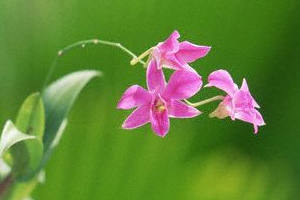
Dendrobium Orchid
| Scientific Name : Dendrobium taurinum |
| Family : Orchidaceae |
| Colour : Pinks, lavenders, reds,
yellows, orange |
| Common names : Dendrobium |
| |
Dendrobium hybrids are the largest group of orchid sub-tribe which contain more than 1,500 species and possibly thousands of
hybrids. They are found from the orient and tropical Asia
down to Australia. Dendrobium plants vary in size, some being smaller than a
matchbox, others large, robust specimens measuring over 1 meter. They are
epiphytic by nature and require good light and ventilation. Some
dendrobiums are deciduous while others are evergreen. Some have pseudobulbs and
others have jointed stems resembling canes. Because of the complexity of
this genus, some varieties may prove to be shy to flower.
Dendrobium can be propagated by cutting the old canes
between the sections and laying them on fresh, damp compost. Plantlets will
quickly develop at the nodes. Dendrobium prefer open compost of either tree-fern
fibre and perlite or bark-based peat. Whichever medium is used, it must be open
enough to maintain some air around the roots. They cannot tolerate wet, soggy
composts, which will inevitably damage and rot their wiry roots. Occasional
misting on the foliage will help any moisture loss occurring during very warm
days in tropical and sub-tropical climates. They can stand
temperatures from 45° to 95° F (7°-35° C), the ideal temperatures are 60°-85°
(16°-30° C).
Dendrobiums are one of the few types of
orchids that will bloom from the old pseudobulbs/canes, and they also bloom from
the new growth. The flower spikes can be over two feet tall with over twenty
blooms on them. The flowers last for 6 to 8 weeks and they make excellent cut
flowers. The blooms are all the colors of the rainbow - pinks, lavenders, reds,
yellows, oranges and many mixed color combinations. Lavender or white flowers are borne in profusion on a well-grown plant and are
long lasting. They are a prolific group in which offset plantlets are frequently
produced on the cane. When each offset has produced several aerial roots, it can
be cut from the parent plant and will frequently flower after one year of
growth.
Questions of
Questions & Answers |
|
| 1. |
Posted on :
2.9.2013 By : Shaleen Chikara , Gurgaon, NCR
|
View Answer (0)
|
Post Answer
|
|
| |
I am growing an Orchid in a small pot filled with charcoal (that's how it came). It was flowering when it came, and now I see 3 new shoots emerging from the sides. How should I care for it and how much should I water it? Also, what is a good potting medium?
I am living in Delhi, and currently it is monsoon season, but soon dry winters will set in. |
|
|
|
|
| 2. |
Posted on :
24.1.2011 By : shruthi , bangalore
|
View Answer (2)
|
Post Answer
|
|
| |
few of my phaelanopsis orchids started to loose the topmost leaf(the blooms were present) and eventually all the leaves fell off.The roots are fine,not dry totally but will the plant grow back? what could be the problem and what do i do? |
|
|
| A1: |
As long as the bulbs are still there and not rotten, it will still grow but takes time to wait for new leaves. |
| |
Posted By :grace de la pena , Cagayan de Oro City, Mindanao | On 9.5.2013 |
|
| A2: |
water got into the center of the plant and rotted must water from the bottom and keep tops dry and no it wont grow back |
| |
Posted By :kevin , las vegas | On 22.2.2011 |
|
|
|
|
| 3. |
Posted on :
5.9.2010 By : Maxine , Spring Hill. Fl, Spring Hill. Fl
|
View Answer (1)
|
Post Answer
|
|
| |
I separated my ground orchid, Spathoglottis plicata this spring as it was over crowed and it has not shown any sige of blooming, What so I need to do to encourage blooming? |
|
|
| A1: |
Hi. I had the same problem. However, I solved it with a bi-weekly watering of a small orchid fertilizer (literally 1/8 of a teaspoon). The water itself was taken from my patio pond. I placed the plant in a high humidity area near other plants. Let the plants drain out completely between waterings. The soil mix comprised real, finely chopped coconut bark, crushed egg shells, charcoal, phosphorus, lumus soil - basically nothing compact. Watch out for mealy bugs as they love these plants. |
| |
Posted By :Paulos , Trinidad | On 15.7.2016 |
|
|
|
|
| » more... |