You are in : GARDENING » FLOWERING PLANTS » ORCHIDS » Epidendrum Orchid
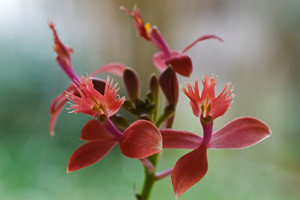
Epidendrum Orchid
| Scientific Name : Epidendrum stamfordianum |
| Family : Orchidaceae |
| Colour : Varied |
| Common names : Poor man's orchid |
| |
Epidendrum hybrids, sometimes called the poor man's
orchid, is one of the most
prolific groups and one of the easiest orchids to grow. These Mexican natives require very little attention. There are
at least four hundred species of epidendrum orchids. The tall, thin, reed-like growths constantly put forth new
plantlets. They are free flowering and the colours range from white to yellow, pink, orange and purple, and all shades
in between. It has an upright, clumping growth habit with roots emerging from the
base of the stems, at or below soil level. They are relatively free
of insects and flowers reliably throughout the year.
The leaves of epidendrum orchids which grow up the cane are leathery and the
small, beautiful one inch mini cattleya shaped flowers appear in a globular
heads of 30 to 40 flowers at a time. The long-lasting blooms are borne at the top of
a long spike. Many species have a fragrance. After flowering, the spike may be left on the plant
and it will generally flower again in a few months. The spike is also prone to
producing a keikis (baby plant) after flowering. Once
these keikis develop their own 2- to 4-inch-long roots, they can be detached and
planted individually.
Epidendrium are easily propagated,
yielding many plants from one stem and they are tolerant of a wide range of growing
conditions, including outdoors. They are propagated
by plantlets that form after flowering. These sun loving orchids needs bright light and can be grown in
any fine-textured orchid mix. They are best grown in a compost consisting of
bark, tree fern fiber and sphagnum moss. They can tolerate wide range of temperatures and
are able to stand temperatures in the 100º range without suffering. During the
growing season they require plenty of water and fresh air. Don't let the plants completely dry between watering.
Epidendrium orchids require copious amounts
of fertilizer. Fertilize
every two weeks with a diluted orchid food. When fertilized
regularly they respond immediately with denser flower spikes, greener, stronger
leaves and more robust roots.
To keep the epidendrium plant tidy, remove old
flower spikes and stems down to the base by snapping them clean with your
fingers or cutting with sterile clippers. Plants grown in low light may
need to be staked, while those growing in full sun are usually self-supporting.
Questions of
Questions & Answers |
|
| 1. |
Posted on :
2.9.2013 By : Shaleen Chikara , Gurgaon, NCR
|
View Answer (0)
|
Post Answer
|
|
| |
I am growing an Orchid in a small pot filled with charcoal (that's how it came). It was flowering when it came, and now I see 3 new shoots emerging from the sides. How should I care for it and how much should I water it? Also, what is a good potting medium?
I am living in Delhi, and currently it is monsoon season, but soon dry winters will set in. |
|
|
|
|
| 2. |
Posted on :
24.1.2011 By : shruthi , bangalore
|
View Answer (2)
|
Post Answer
|
|
| |
few of my phaelanopsis orchids started to loose the topmost leaf(the blooms were present) and eventually all the leaves fell off.The roots are fine,not dry totally but will the plant grow back? what could be the problem and what do i do? |
|
|
| A1: |
As long as the bulbs are still there and not rotten, it will still grow but takes time to wait for new leaves. |
| |
Posted By :grace de la pena , Cagayan de Oro City, Mindanao | On 9.5.2013 |
|
| A2: |
water got into the center of the plant and rotted must water from the bottom and keep tops dry and no it wont grow back |
| |
Posted By :kevin , las vegas | On 22.2.2011 |
|
|
|
|
| 3. |
Posted on :
5.9.2010 By : Maxine , Spring Hill. Fl, Spring Hill. Fl
|
View Answer (1)
|
Post Answer
|
|
| |
I separated my ground orchid, Spathoglottis plicata this spring as it was over crowed and it has not shown any sige of blooming, What so I need to do to encourage blooming? |
|
|
| A1: |
Hi. I had the same problem. However, I solved it with a bi-weekly watering of a small orchid fertilizer (literally 1/8 of a teaspoon). The water itself was taken from my patio pond. I placed the plant in a high humidity area near other plants. Let the plants drain out completely between waterings. The soil mix comprised real, finely chopped coconut bark, crushed egg shells, charcoal, phosphorus, lumus soil - basically nothing compact. Watch out for mealy bugs as they love these plants. |
| |
Posted By :Paulos , Trinidad | On 15.7.2016 |
|
|
|
|
| » more... |