|
Patayani
Patayani is a ritualistic dance, which literally means
an array of common people. Patayani involves many powerful themes of
eso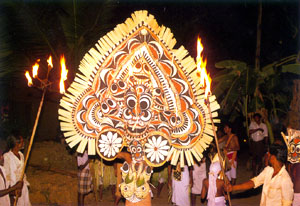 teric
appeal. The whole village activity corporate in this popular art. The
figures in Patayani consists of Pisachu, Kali, Karakkura, Pillatini,
Bhairavi, Kalan etc. The masks are painted with a grotesque surrealistic
touch. The round eyes and the triangular ears and abnormal size of the
head gear give a touch of super human dimension. teric
appeal. The whole village activity corporate in this popular art. The
figures in Patayani consists of Pisachu, Kali, Karakkura, Pillatini,
Bhairavi, Kalan etc. The masks are painted with a grotesque surrealistic
touch. The round eyes and the triangular ears and abnormal size of the
head gear give a touch of super human dimension.
Pillatini literally means one who devours. In the song
accompanying the dance a child is described as dwelling the blue mountains
top from where she is invoked by the chanting of meaningless syllables
and with burning torches (making them blaze by throwing of a powder).
The spirit is supposed to descend from the heights and occupy the painted
mask of sheath worn by the dancer. This Kolam is called 'Pillatini' because
its main action is pouncing on a symbolic child with a cannibalistic hunger.
This Kolam is danced as a ritual to ward off evil eye on a family or its
off springs. Kalan Kolam is another variety in the Patayani with
black colour predominating the facial make up of the dancer. Kalan is
the god of death. The Kolam appears as the symbol of time and shows how
the human soul (in the epic theme of Markandeya) is chased by Yamadharma.
The narrative of the story tells about a Brahmin who had no children.
He performed penance to Lord Shiva who asked the Brahmin whether he wanted
a child with little intelligence who would live for a hundred years or
one who was highly intelligent but would have a short life. The Brahmin
asked for a great and glorious child. This is how Markandeya was born.
He was destined to live for sixteen years only. When his sixteenth year
came Markandeya started rigorous penance. When Yama visited him, he embraced
the Sivalinga so that Yama could not take him away without involving the
Sivalinga also. While Yama tried to take the life of the boy Shiva opened
his third eye and Yama was turned to ashes. This drama is enacted in Kalan
Kolam. The character of Shiva is not represented as such. The last moments
of the pangs of death of the god of death form a dramatic sequence. The
actor rushed into the crowd and creates in the congregation a sense of
contact with the invisible world, people move away in awe. Sometimes the
Kolam snatches away a boy from the crowd signifying the hunt of Markandeya.
In a subtle way, the same actor enacts the chaser and the chased suggesting
the unending drama of life and death. There also emerges a third concept
of 'Kala Kala' the supreme custodian of time or the destroyer of the destroyer.
The great cosmic dancer, Shiva is symbolized in the ritual and the Kolam
is also known as 'Kalari' or the enemy of Kala.
Kala is defeated by Kala Kala who ultimately subjects
himself to extreme suffering, struggles hard and collapses only to be
awakened to resume the drama of chase. Lord Shiva again comes to bring
back Yama to real life.
Patayani is associated with the Devi (goddess) temples of Central Travancore
area. At least in a dozen village temples the art finds its existence,
with the active corporation of the villagers who share the ritual experience
and the responsibilities. The Velan (the sorcerer) plays on his percussion
instrument 'Para' when the areca tree is uprooted and ceremoniously placed
at the temple premises as the flagstaff of the festival for 28 days which
has to conclude on the 'Bharani' day in the month of Meenam. The 'Velichappadu'
who is from the Nayar caste gets possessed and dances to the rhythm of
the Para and officiates the ritual of uprooting and placing the flagstaff
with the help of the villagers. The Mannan (village washerman) who is
also in charge of plucking coconuts supplies the areca sheaths and other
materials with which the masks are made. The Kaniyan paints the masks.
On the next day of the flag hosting ceremony, the villagers assemble in
the temple around 10 in the night with lighted torches and go thrice around
the shrine articulating meaningless syllables meant for invoking the subordinate
spirits who pay homage to the main deity. This is technically called 'Chuttupatayani'
or Patayani with torches. This process continue for 18 days. On the 19th
day the villagers reach the temple in procession singing boat songs in
group in a rhythm peculiar to the rowing of a country boat. In front of
the temple before a lighted lamp the neighbouring villagers conduct a
group dance called 'Kappoli' as a gesture of corporation to the celebrations.
In dancing they show a number of acrobatic martial feat accompanied by
singing. The first item proper in the series is 'Tavati' in which six
to seven experts dance the basic rhythms of Patayani to the accompaniment
of the drum called 'Tappu' a round wooden instrument covered with thick
hide.
|