|
Thullal
Thullal which literally means dance emerged in the eighteenth century.
This art form is the cumulative product of all traditional theatrical
arts of Kerala, both folk and classical. Kunchan Nambiar who was the
creator of Thullal, was vigorously earthy. He wanted to make the earth
a cleaner place and its inhabitants more decent people. According
to him there was no need for social stratum in the society. He wanted
the whole society as his audience. He realized that the highly Sanskritized
literary diction would fail to get his message across to a large section
of the people. So he used the simplest diction, including slang. His
verse had a vital rhythm and clung to the memory of the audience even
without any conscious effort. The internal rhymes keep up a lively
beat and the actor deliver hammer- blows with his rhymes with a smashing
impact. Nambiar rejected Kathakali and turned to the tradition of
people, the dance forms of the lowest strata even of the Pariahs.
|
|
The art of Thullal was evolved as a system out of the
various singing and dancing art forms of the people incorporating apt
features of the classical styles. This harmonious blend of the folk and
classical forms of art, represented the accumulated aesthetic experience
of all sections of the people high and low. The themes were drawn from
the never failing myths and Epics of India.
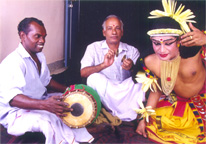
The Thullal has a full-fledged libretto, a tale narrated
in verse. It is like the Sanskrit Bhana. The dance form has only one actor
and he uses gesture language, but vestigially and transparently so that
his mimetic narration gains in speed and benefits by rapid communication.
The full painting of the face is retained for the expressive advantage.
The costume is picturesque. The actor is supported by a singer who repeat
his lines, a drummer and a cymbalist. The narration is accompanied by
dancing.
The roles of raconteur and actor are perpetually interchanged
in the same man with aesthetic effect and imaginative direction. The narrative
thus emerges with a continuously shifting focus penetrating the interior
world of men's fantasies and day-dreams, seeing the things with same objectivity,
correcting vanity with raillery and deeper fixations with a cathartic,
caricaturist distortion.
Nambiar spared nobody and hit every hard. But he also
laughed loudly when he hit and his victims could not resist the whole
some, infectious quality of that laughter even while reeling under the
chastening blows. The rapacity of the pretty rulers, who looted the people,
but were gullible enough to be looted in turn by the astrologer, the vendor
of the magical tails-mans and the courtesans, the officials who feathered
their own nests by betraying both their masters and the people, the rich
Nambootiris who spent their lives in slumber, scandal mongering and flirtations,
and the Nairs who clung with absurd pride to the memories of their martial
traditions, when the feudal order that supported it was fast decaying,
all got boisterous handling. Insisting on an irreducible minimum of social
elegance, he even lampooned people with messy hygienic and eating habits.
Nambiar is not intolerant of natural human imperfection.
But what he cannot tolerate and must suppress with snubs is the egotism
of men who forget their limitations. Nambiar has left an indelible impression
upon the people of Kerala. If the present age of political rivalries and
controversies in Kerala are also quick to see through the pretentious
promises of parties and politicians. That is one of the reason why there
is such a rapid turn over of political leadership in the state. |