| Kalam - Kalampattu
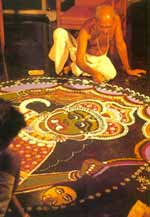 The Kalam in the Kali cult, denotes a floor painting of the goddess. Before
the form of the goddess is painted, a Chakra in the tantrik structure
is drawn using two colours, white and yellow made respectively of rice
and turmeric flour. On the north eastern corner (minakon) is the place
in which the image of Kali is proposed to be drawn. At the centre of this
drawing, a bronze oil lamp is lit in the belief that with the lighting
of the lamp on the Chakra, the goddess has made her divine presence at
the spot. Before the lamp is placed on the floor a plantain leaf with
offerings to the goddess like paddy, rice, coconut etc is placed.
The Kalam in the Kali cult, denotes a floor painting of the goddess. Before
the form of the goddess is painted, a Chakra in the tantrik structure
is drawn using two colours, white and yellow made respectively of rice
and turmeric flour. On the north eastern corner (minakon) is the place
in which the image of Kali is proposed to be drawn. At the centre of this
drawing, a bronze oil lamp is lit in the belief that with the lighting
of the lamp on the Chakra, the goddess has made her divine presence at
the spot. Before the lamp is placed on the floor a plantain leaf with
offerings to the goddess like paddy, rice, coconut etc is placed.
Painting the image of the goddess, using herbal and grain
powders of different kind is a consummate art. The dhulisilpam (the powder
made image) attains supreme perfection by meticulous care in furnishing
all its subtle details. To paint an image of Kali with sixty-four arms,
more than fifteen persons is required. The Kalam is painted in multi colour.
The Kalampattu begins with the beginning of the Kalam itself. The Brahmin
priest is assigned the privilege of doing the first special puja of the
image before the onset of the Kalampattu.
Kalampattu is a kind of song sung by persons belonging
to different castes which are lower down in the caste hierarchy. Kaniyan
draws the Kalam of Gandharva, and Pulluva that of serpents. Vannan uses
a stringed instrument called Nantuni. The Kurup who sings Kalampattu uses
a percussion instrument with cymbals and gong as accompaniments.
The paintings of the Kalam commences with a ritual called
Uchappattu (noon songs). The Kalam would be completed by evening. The
singers sit in a thatched shed in front of the courtyard of the temple
or the house in which the ritual is conducted. The shed is decorated elaborately
with plantain trunks, with leaves and bunch of fruits, tender coconut
leaves, gold coloured tender coconut bunches, mango leaves and flowers.
Inside the shed beneath the thatched roofing is a red canopy. The floor
is plastered with cow dung. The painting of the goddess is made on this
plastered floor. The size and dimension of the image of Kali are decided
according to the deity. Normally, the image has sixteen hands with a weapon
in each hand. The size of the image can be as big as to have sixty four
arms and breasts each big as five paras (measures) of rice heaped and
bedecked with paddy stalks malted into delicate forms. Ornaments of a
rich variety are drawn on the image with coloured powder. The song goes
on without a break round the clock. It starts with an invocation to Ganapathy,
the god that clears his devotees path of all hurdles, passes on to the
story of the confrontation between Kali and her demon-rival, Darika and
ends up with the slaying of the demon by the goddess. The entire song
is known by the name tottam, which means 'to awaken the deity'.
To mark the end of the ritual of Kalampattu, the figure
of Kali is wiped out, starting from the feet upwards, but keeping the
breast untouched. The powder used for painting the breasts is then worshipfully
collected for distribution as prasadam to the devotees. The
Kalampattu is associated with some ritualistic dance performances. The
dancer is the descendant of a line of ritual dancers, the counterparts
of the oracle and the shaman. The ritual dance is known as itum kurum
chavittu. The goddess is believed to enter into the body of the ritual
dancer and into the Kalam and the presence is manifested differently in
the two media. In the dance, the goddess express herself through the ritual
dance, while in the Kalam, she makes her presence felt by its flowing
patterns and colours. As the ritual dancer gets possessed by goddess,
his limbs move and he utters uncontrollably. The movements and utterances
rise slowly in a crescendo and reach their highest pitch and then abruptly
stop. The possession leaves the body and the dancer falls exhausted and
unconscious. The ritual dancer visits the houses of the devotees and receives
offerings to the goddess in the form of rice, coconuts which are the symbols
of fertility. Kali may bless or curse with her disease, the small pox.
Such blessing or curse is considered her playfullness or revelry, 'amma
vilayattam'. If Kali is wreaking her wrath, the disease might take a fatal
turn and is taken to be an omen of impending doom on the land. |