|
|

Friday, September 11, 2026
|
|


|
||||||
|
|
||||||
Yakshagana Introduction | Stage | Characters | Music | Performance | Costume & Make Up | Ornaments | Headgears |
||||||
|
The splendour of Yakshagana lies with the unusual costumes and make-up of the artistes. The smooth flow of heavy and gorgeous costumes testify to the stimulating power of this audiovisual medium. The facial make up varies from simple to intricate designs depending upon the roles they play. Motif on the face varies for hero, demon and female characters. Demonical make-up is heavy with artificial eyelids and white dots are liberally applied to portray the ferocious and violent nature of the demons. The traditional costume consists of a dhoti, a pyjama, a jacket and a loose gown. Depending upon the characters, they increase the girth of the body with sheets of colorful cloth and sarees tied around. In Yakshagana, it is customary for males to perform even the role of females.
Ornaments consists of 'Bhujakeerthi' worn for the elbow and looks like colourful shining wings. Its surface is plain in 'Mudalapaya' and it is rough, thorn-like in Paduvalapaya. Besides the heavy armlets and anklets, intricately designed 'Edehara' (chest ornament made of wood and pasted with paper and glass pieces) and 'Veeragase' (a piece of designed ornament tied around and flowing beneath the waist) are the other ornaments worn by the artistes.
Female costuming is simple and matches with the contemporary style but does not match with the psychedelic and gorgeous costumes of male roles. |
||||||
| |
||||||
|
||||||||||
|
||||||||||
Related Links |
| ▪ Classifieds |
| ▪ Education |
| ▪ Yellowpages |
| ▪ Photo Gallery |
| Last Updated on : 26 July 2018 |


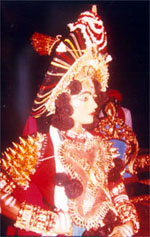 Headgears
have a wide array of crowns. The selection of the headgear commensurate
with the role represented by the artistes. The less important characters
wear simple turbans of cloth. 'Mundasu' is a heavily set headgear, which
gives a rich look to the character. It is broader in the middle which
tapers as it proceeds upwards and appears like a lotus leaf. Since the
Mundasu is heavy, it requires talent and prowess to wear it and dance.
Headgears
have a wide array of crowns. The selection of the headgear commensurate
with the role represented by the artistes. The less important characters
wear simple turbans of cloth. 'Mundasu' is a heavily set headgear, which
gives a rich look to the character. It is broader in the middle which
tapers as it proceeds upwards and appears like a lotus leaf. Since the
Mundasu is heavy, it requires talent and prowess to wear it and dance.