|
|

Saturday, April 27, 2024
|
|


|
||||||
|
|
||||||
The Puppet Theatre |
||||||
|
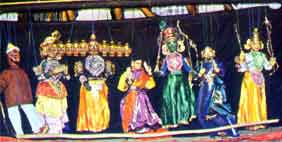
In Karnataka, the puppet theatre is said to have existed since ancient times. Puppetry in the state, is believed to have existed at the time of 'Kanakadasa' and 'Purandaradasa' and its roots are traced to the coastal tract of Karnataka. The health and family welfare department has been using puppetry shows for spreading messages like family planning, anti-dowry etc among the rural and semi urban places. The two prominent forms of puppetry of the state are (a) String puppets or Marionettes and (b) Leather or Shadow puppets.
A string puppet means a puppet manipulated from above and controlled by long strings invisible to the audience. Made of wood, the puppets of North Karnataka are short and slim in appearance possessing a pair of legs and hands whereas the puppets of South Karnataka are 3 feet high but without legs. All puppets are controlled by strings and the strings are tied to the hands and the head of the puppet. Some of the puppet troupes have discarded strings and have replaced them with rods for easier manipulation of puppets. The stage is simple, usually consisting of a thick black backdrop, two or three wooden poles and a curtain to cover the puppet players from being seen by the audience. Puppet artistes of a Nelamangala based troupe have developed a box type stage which is easily removable and mobile. The conventional puppet stage is covered on all the three sides to make the puppeteers and musicians not visible. With the result, the audience can watch the show from only one side. Prominent musical instruments used during the performance are 'Mrudanga' (also known as Maddale in Kannada), 'Mukhaveena' (a unique wind instrument made of wood, measuring one feet long and consisting twelve holes), cymbals and a Harmonium. Presentation: Approximately ten persons are required to stage a puppet show. The troupe consist of puppet manipulators, instrument players, musicians and a Bhagavata. Bhagavata is the chief musician followed by few performers who assist him in the background. Depending on the story, the artistes use about 15 to 20 puppets in a show.
The puppets perform against a black backdrop and are controlled and manipulated by black strings. The puppets are suspended from above and played by puppeteers who rest their hands on a 12 feet long wooden pole called 'Manthu'. The puppeteers of Karnataka perform the dual role of a narrator and an operator simultaneously. They not only manipulate the puppets behind the curtains but also conduct dialogues. The puppet operator wear anklets and dance along with puppets but such actions are not visible to the audience. The puppets are on an average 3 feet high, with fully articulated arms and hands. In some of the marionette puppets of Karnataka, the heads, the eyes and eyebrows move up and down and even move to the left and right. The master puppeteer controls the head, trunk and arm. Coordination with other puppeteers is a skill for any puppeteer to master. The discipline of movement, is extraordinary and the puppet move, dance and enact their roles that provide a perfectly balanced spectacle. The duration of the puppet show varies from 6 to 8 hours.
|
||||||
|
|
||||||
|
||||||||||
|
||||||||||
Related Links |
| ▪ Classifieds |
| ▪ Education |
| ▪ Yellowpages |
| ▪ Photo Gallery |
| Last Updated on : 26 July 2018 |


 At
present many marionette troops exist in the Karnataka state. The whole family
works as a team besides outside members as the art may be practiced by a member of any caste. A Brahmin family
in Nelamangala near Bangalore, owns a puppet troupe, which possesses a set of
almost a century-old puppets. It appears that these string puppets are quite
ancient and the puppets of Hallare, in Nanjangud taluk, Mysore district are said
to be of 300 years old.
At
present many marionette troops exist in the Karnataka state. The whole family
works as a team besides outside members as the art may be practiced by a member of any caste. A Brahmin family
in Nelamangala near Bangalore, owns a puppet troupe, which possesses a set of
almost a century-old puppets. It appears that these string puppets are quite
ancient and the puppets of Hallare, in Nanjangud taluk, Mysore district are said
to be of 300 years old.