Yakshagana
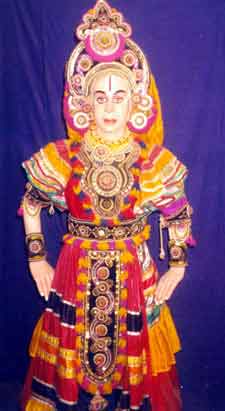 Yakshagana is believed to have a history of one thousand years. Yakshagana
is believed to have represented a specific type of music of the 'yakhas'. Yakshagana is believed to have a history of one thousand years. Yakshagana
is believed to have represented a specific type of music of the 'yakhas'.
Yaksha is the name of certain demi-gods attending on 'Kubera'- the god
of wealth in the Hindu
mythology. 'Gaana' means song. By combining the meaning, the term Yakshagana
might mean the 'song of Yakshas'.
Of the 29 districts in Karnataka, Yakshagana has established
its firm roots in the districts of Dakshina Kannada, Uttara Kannada, Dharwad,
Mysore and Hassan. Based on its technique of presentation, Yakshagana
has been broadly classified into 'Mudalapaya' (the custom of the east)
and 'Paduvalapaya' (the custom of the west). Popularly known as 'Bayalata'
or 'Aata', Mudalapaya is widely practiced in places like Tumkur, Bangalore,
Kolar, Mandya, Mysore, Hassan, Chitradurga, Bellary, Dharwad, Bijapur,
Gulbarga, Raichur, Bidar and Belgaum. While Yakshagana of North Karnataka
has assumed varied forms like 'Sannata', 'Doddata', 'Krishna Parijatha'
and 'Dasarata'. The form of Paduvalapaya' popular extensively in Uttara
and Dakshina Kannad districts has been further divided into 'Thenku Tittu'
(south) and 'Badagu Tittu' (north). Paduvalapaya is practiced in places
like Karki, Keladi, Ikkeri, Sagar, Kolluru, Maranakatt, Sankuru, Coondapur,
Kotesvara, Kota, Udupi, Dharmasthala, Mangalore, Brahmavara, Suratkal
and Saligrama.
The Epics of Ramayana and Mahabharata offer extensive material
for Yakshagana Prasangas (topic). The literature is presented both in
verse and prose and the former is interpreted in simple prose and dialogues.
The show begins with an announcement of Yakshagana by beating the 'Chande',
in important places of the village. |



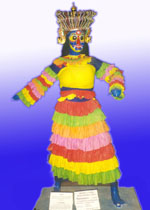 The
life force of Yakshagana is the Bhagavata, the chief narrator of
the story, in the verse form. Bhagavata also conducts light hearted conversation
with the 'Vidushaka'- the jester. The dialogues between these two
characters is very amusing and the Bhagavata ably supports the Vidushaka
in carrying out extempore dialogues.
The
life force of Yakshagana is the Bhagavata, the chief narrator of
the story, in the verse form. Bhagavata also conducts light hearted conversation
with the 'Vidushaka'- the jester. The dialogues between these two
characters is very amusing and the Bhagavata ably supports the Vidushaka
in carrying out extempore dialogues.