Rituals connected with Marriage
There are many rituals associated with the coming of
a new bride into the family. The bride first performs the puja to the
deities of her new family under the guidance of the older 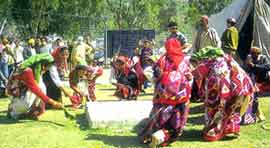 women
and is then made to distribute sweets (Gune) in front of the Dehre which
is a traditional wall painting done as a religious ritual after marriage. women
and is then made to distribute sweets (Gune) in front of the Dehre which
is a traditional wall painting done as a religious ritual after marriage.
The bride distributes the Gune with both hands. The groom is the first
to get these and gives his bride, money or jewellery in return. Ritual
songs are sung at this time by women sitting around the bride.
Munh Dikhai is a custom which reveals the face of the bride. The mother-in-law
comes first who presents the bride with jewellery and sees her face and
then follows the uncles wives, sister-in-law etc. Each one of them presents
the bride with money or pieces of jewellery.
Pair Bandai (touching the feet) is another custom which
helps introduce the bride to husband's family. In this, the bride first
offers the close relatives a gift of money and then covering her hands
with the edge of her sari, touches their feet. She is then blessed by
the elders to be well-loved of her husband and produce sons.
Darosh Dab Dhab, Dam-Chalshish, Dual or Har, Batta-Satta,
Jhajhara, Gadar, Mool Biah, Jhindphook and Yuth Vivah are some other interesting
forms of marriage prevalent in the area. Darosh Dab Dhab is a tribal system
prevalent in Kinnaur. In this the girl is forcibly dragged away from a
fair ground or a festival meeting. She pretends to scream, scratch, bite
and show annoyance but the boy holding her does not relent his hold. At
night the village tries to bring the girl round and if she agrees then
the next day a match-maker goes to her family with a gift of five rupees
and a bottle of wine (ijit) and tries to get their permission. Similar
gifts are presented to the village deities.
In Dam-Chalshish, the lovers elope together and the boy's father sends
the Mazomi to the girl's house and tries to placate them and their relatives
with gifts. If the family agrees, then a ritual marriage follows. In Jhindphook,
the lovers go to a lonely spot and set some shrubs on fire and then go
round the fire seven times. This makes them husband and wife. In the Chalshish
system as the girl departs from her home sad tunes are played and the
son-in-law presents the mother of the daughter with a sum of five hundred
rupees as Masore or the price of her milk.
Hari or Har means that a woman who is dissatisfied with
her husband, goes and begins to live with another. Her new husband has
to settle it with the previous one by offering him a price acceptable
to him. Such marriages are known as Jhanjhara or Jhanhrada. The new husband
also invites all his relatives and at night offers a special puja known
as Nuala to lord Shiva. When the priest or the Chela gives him the lords
blessings he in turn, puts his Balu (a piece of jewellery) on the Woman
and this makes her his lawful wife. The Gaddis follow this custom more
than the others.
The Gaddis and some labourer families follows the Batta-Satta
system of marriage in which the bride's brother has to marry the groom's
sister or vice versa. If one of the girls refuses to go to her husband,
the other one also will stay back. In case of complications, the village
assembly of Pachi (Panchayat) is called. They listen to arguments from
both sides and give their verdict in writing, copies of which are preserved
by both sides.
The Gaddis perform the marriage ceremony twice. First
comes the Jooth Pana when the groom's party goes to the girl's house (who
is usually a minor of 8-10 years) and breaks a lump of jaggery in the
girl's name and the girls family smears them with red colour. On their
way back, the groom's party distributes lumps of jaggery to all the passer
by thus announcing the confirming of the betrothal. Then the real marriage
ceremony follows, in which the woman from the girls family help her through
the rituals. There is no system of dowry. After five or ten years comes
the second half known as Sadnoj. By now the girl is mature. On
a fixed day the groom in ritual finery, goes to his wife's house with
a few relatives and after staying there for a couple of days, departs
with his bride for his own village. At this time gifts are presented and
dances and celebrations begin in the groom's house to welcome the party.
In Pangi, at the time of the marriage the grooms younger
brother presents the bride's mother with a silver rupee. This gives him
the right of a second husband over the bride, but the bride is not to
be shared by more than two brothers. The people in Pangi are monogamous
and a widow may remarry, but such marriages are not held in high esteem. |



