|
|

Thursday, April 25, 2024
|
|


|
|||
| Women
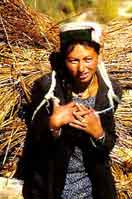
A After house hold chores of looking after the children and cooking, women are usually away from their homes most of the day collecting grass, leaves or firewood or tending animals in the forests. On moonlit nights at harvest time they often work in the fields after meals past midnight. Besides carrying the produce to her home, she has to spread it for drying on the roof or the yard to protect it from early decomposition. In horticulture, besides the pruning and plucking she is also mainly responsible for grading and packing of apples. The rearing of animals, milking of cows and buffaloes, preparing butter milk and butter and later ghee are all performed by women. Collection of the dung of cattle, dumping it and later carrying it to the field to be used as manure is the woman's job. Winter and rainy season are a period of inactivity in
the fields. But even then, women spin, weave or knit and m The married women in the area are fond of dressing up and bedecking themselves with ornaments of all kinds. The married women braid their hair and wear numerous pieces of jewellery denoting their married status. They must wear a ring (koka) in their noses and their clothes are colourful and often trimmed with Gota (silver or gold edging). They cover their faces in front of the elders and may not speak directly to older relatives like the father-in-law, the uncle-in-law or the husband's older brothers. They must not sit on a seat higher than the one occupied by the elders of the family. Serving the in-laws, massaging and rubbing them with oil are all parts of her daily routine. If a women forgoes any of her duties, she is heavily criticized.
The woman in Himachal are bound strictly by traditions. They must not utter the first name of an older relative but imply it symbolically or by pointing at an article with a similar name. On feast days and festivals all of them barring widows dress up in all their finery with colourful skirts and scarves and waistcoats and rows of jewellery all over their bodies.
|
|||
|
||||||||||
|
||||||||||
Related Links |
| ▪ Classifieds |
| ▪ Education |
| ▪ Yellowpages |
| ▪ Photo Gallery |
| Last Updated on : 20 July 2018 |


 hill women's life is extremely busy from early morning to late evening
and sometimes even till late at night.
hill women's life is extremely busy from early morning to late evening
and sometimes even till late at night. 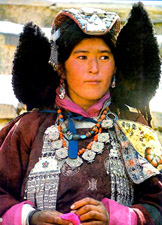 akes
mats and baskets. Some even help their mates in chopping wood. This inequitable
division of labour among men and women is surprising. Probably when agriculture
was first started in the hills, man engaged himself in the more intensive
tasks like that of cleaning the fields and constructing terrace walls.
His wife must have assisted him sowing and harvesting the crop. Later
this division of labour became more or less fixed, even when the work
of cleaning and terracing did not engage him to that extent. Hill women
are not inhibited in her work or behaviour. She maintains her cheerfulness
as also her freedom. Though tradition ridden, she has many liberal ideas
of family relationships.
akes
mats and baskets. Some even help their mates in chopping wood. This inequitable
division of labour among men and women is surprising. Probably when agriculture
was first started in the hills, man engaged himself in the more intensive
tasks like that of cleaning the fields and constructing terrace walls.
His wife must have assisted him sowing and harvesting the crop. Later
this division of labour became more or less fixed, even when the work
of cleaning and terracing did not engage him to that extent. Hill women
are not inhibited in her work or behaviour. She maintains her cheerfulness
as also her freedom. Though tradition ridden, she has many liberal ideas
of family relationships. 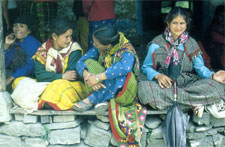 The
widows life is totally colourless. She must live like a nun and she cannot
wear colourful clothes or jewellery or participate in the singing and
dancing on feast days and festivals.
The
widows life is totally colourless. She must live like a nun and she cannot
wear colourful clothes or jewellery or participate in the singing and
dancing on feast days and festivals.