|
|

Wednesday, February 11, 2026
|
|


| Scientific Name : Dianthus Caryophyllus |
| Family : Caryophyllaceae |
| Colour : Various |
| Common names : Carnation, Divine flower, Clove pink, Gilly Flower |
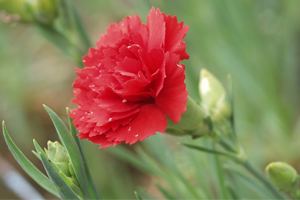 |
Native of the Eurasia, Carnations; the most popular garden plant is one among some 300 species of annual, biennial and perennial herbs in the genus Dianthus. There are hundreds of more hybrid varieties. Dianthus in Greek means 'Flower of Zeus' or Divine flower.
Carnations will grow from 2" to 3 feet high, most garden varieties grow 10 to 20 inches tall. The plants have grayish-green foliage and fragrant, semi-double rosy, purple or white flowers. There are many hybrid varieties in a variety of colours and sizes with no fragrance. They bloom mainly during cool times of the year, especially early winter. They are great plants to grow in gardens and can be used as cut-flowers. If properly treated, carnations will last up to a month.
PlantingCarnations require fertile, slightly alkaline, neutral, well-drained soil and 4-5 hours of full sun each day. They should be planted 12-18 inches apart. Propagation can be done by seeds, cuttings, layering or division.
Seeds can be sowed, 1/8 inch deep in a well drained mix in spring or early summer. Make sure the compost is moist but not wet. Mist spray occasionally and keep it moist. The seeds will germinate in 2 to 3 weeks. Transplant in pots or on the ground when large enough to handle and the plants will bloom in 6 - 9 months or a year.
Cuttings can be taken off any carnation, but the best shoot come from cuttings off a year-old plant after it has bloomed. In fact, the flower stem is often the only place where a carnation will form a stalk long enough to take a cutting from. It is best to take carnation cuttings in early Fall. They will root at the swollen node hidden beneath each leaf. Cut at an angle just below a node, and trim off the top, leaving 1 node for roots at the bottom and one at the top for the growth to come out of. Poke into well-drained soil in pots or in a seedling tray.
Layering is the easiest way to propagate carnations and the plant will do this themselves once mature. Observing a mature clump of carnations, seek out sturdy stems pointing away from the centre of the clump. If you look at the bottoms of these stems they will often be rooted, and if they are not yet, you can promote rooting by bending them down to touch the soil. Keep them pinned down with a rock, a stick, or whatever else. Cut off any flowers that are growing on that particular stem. Within a few weeks you will see your new plant rooting. Once the roots seem 4 to 5 inches long, cut this new plant away from the mother plant and repot in well-drained soil.
They can also be propagated by division. Dig up the whole non productive clump of an old plant. Gently and carefully separate the plant segments with your hands or gardening fork. Replant each new division in a well drained mix and keep it moist.
CareCarnations need some hours of full sun each day and should be kept moist. Avoid over-watering as it may tend to turn the foliage yellow. For continued blooming feed lightly every 6 to 8 weeks with an all-purpose (10-10-10) liquid fertilizer. Spent flowers should be removed promptly to promote continued blooming.
Questions & Answers |
|||||||||||||||||||||||
| |||||||||||||||||||||||
| |||||||||||||||||||||||
| |||||||||||||||||||||||
| » more... | |||||||||||||||||||||||