You are in : GARDENING » FLOWERING PLANTS » Aster
Aster (China Aster)
| Scientific Name : Callistephus Chinensis |
| Family : Asteraceae |
| Colour : Various |
| Common names : Aster, China Aster |
| Flowering Period : August-September |
| |
The family Asteraceae have an estimated 1,150 genera and
a huge number of species seen almost all over the world originating from North
America, Europe, China etc. The large China Asters are the most common form grown
by florists and gardeners. Native to Asia, this lovely flowering annual is worth
the little extra effort it takes for growing. It has a wide array of varieties and the height ranges from 6 inches to 3 feet.
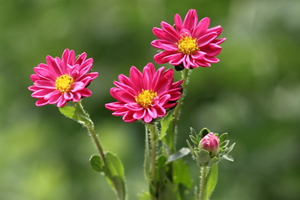
Most species of Aster are perennial and generally bloom in August. They have daisy-like or star-like flower heads
(4-6" in diameter) with a yellow center on leafy, often tall, stems. Their colors vary from white to
creamy yellow, pink, blue, red and purple. They do well in beds, borders or pots
and are a favorite as cut flowers because of their longevity.
Propagation
Asters need fertile, sandy,
well-drained soil and full sun. The propagation is through seeds. Before
sowing, sterilize the seeds with organic mercuric compounds to prevent stem rot
and damping-off. For sowing of seeds, it is best to use a shallow flat. Add
one-forth well rotted manure and enough sand to the soil to prevent the soil
from becoming hard. Fill the flat half or two-thirds full, water thoroughly, and finish filling with soil just moist enough to handle nicely. Sow the seed in rows 2 inches apart, cover with fine sand and press firmly.
The wet soil in the bottom will furnish enough moisture so that the boxes will not have to be sprinkled until after the seedlings are up.
The seeds will germinate in a little over a week.
As soon as several true leaves have grown, the seedlings should-be transplanted.
Use rich soil in the bottom of the flats and ordinary soil above as further protection against disease. Set the seedlings
3 to 9 inches apart depending on the variety. The plants will grow to a height
of 6-10 inches to 3 feet and a width of 6-18 inches.
Care
Since they are prone to wilt disease, virus diseases, foot rot, root rot, and
aphids, avoid planting in the same location year after year.
Pinch off faded flowers and yellowing foliage regularly to encourage new blooms. Shading plants prevents injury from the tarnished plant bug and yellows.
If plants are badly diseased, burn them and stop growing China-asters for a few years.
Water well in dry weather.
Questions of
Questions & Answers |
|
| 1. |
Posted on :
2.4.2010 By : Peter bell , sarosota,Florida
|
View Answer (1)
|
Post Answer
|
|
| |
Is a aster plant a monocot or dicot. |
|
|
| A1: |
Aster is a dicot belonging to family Asteraceae |
| |
Posted By :Vidhya Sankar. M , Madhya Pradesh | On 15.7.2011 |
|
|
|
|
| 2. |
Posted on :
7.11.2009 By : Rajesh Iyer , Baroda
|
View Answer (0)
|
Post Answer
|
|
| |
I had purchased Aster plant around 3 months back. After the first set of flowers wilted, the plant stopped growing. Now the leaves are turning yellow.
I want to know the life span of Aster plant. Will it wilt down altogether or survive the off season. What is the flowering month in India ? Does it bloom all year around ?
|
|
|
|
|
| » more... |