Kathak - Repertoire
Kathak can be divided into two main parts, namely nritta and
abhinaya on the one hand, and tandava and lasya on the other. The nritta portions
are presented in a sequence beginning with the traditional entry, known as
the amada. It is commonly believed that the amada was preceded by an invocation
to god Ganesa. This was known as the Ganesa Vandana or the Ganesa parana.
Through the amada, the dancer makes his entry into the stage and the invocations
to the Hindu god Ganesa was changed into the salami or the court salutation.
The amada is usually composed in the medium tempo of a metrical cycle of 16
beats (trital). The amada end with a short pirouette movement and then follows
Thata.
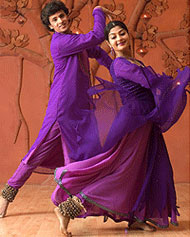 The Thata is the Kathak dancer's way of presenting the different
movements of the angas and the upangas. Thata is an initial stance in which
the dancer stands with the body firm and upright the right arm bent at elbow
and the hand resting on the waist and the left raised a little over. The dancer
stands with his feet crossed with the right slightly bent and only the toes
touching the ground. There might be some variations in the Thata. The dancer
introduces the Kathak with the rhythmic graceful movements of his eyes, eyebrows,
neck, chest and shoulders, while the musicians play at a medium tempo in a
relaxed mood. It is a sort or warming-up for the full and scintillating dance
which is to follow. The hands and forearms are held parallel to the chest
and the finger tips of one hand touching those of the other. The hands are
then moved outwards and forwards with the feet moving backwards and forwards
and in a circle. The dancer makes various feet movements virtually standing
at the same spot.
The Thata is the Kathak dancer's way of presenting the different
movements of the angas and the upangas. Thata is an initial stance in which
the dancer stands with the body firm and upright the right arm bent at elbow
and the hand resting on the waist and the left raised a little over. The dancer
stands with his feet crossed with the right slightly bent and only the toes
touching the ground. There might be some variations in the Thata. The dancer
introduces the Kathak with the rhythmic graceful movements of his eyes, eyebrows,
neck, chest and shoulders, while the musicians play at a medium tempo in a
relaxed mood. It is a sort or warming-up for the full and scintillating dance
which is to follow. The hands and forearms are held parallel to the chest
and the finger tips of one hand touching those of the other. The hands are
then moved outwards and forwards with the feet moving backwards and forwards
and in a circle. The dancer makes various feet movements virtually standing
at the same spot.
These entry numbers are soon followed by the presentation of pure dance patterns
known as the tora, tukra and parana. These are successive rhythmic patterns,
named so either according to the varying degree of the complexity of the rhythmic
pattern or on account of the mnemonics used. Whether they are of the tabla
or of the pakhavaj (drum). The tukra is perhaps the simplest variety
where the mnemonics are of the tabla and it emphasises one particular type
of pattern which is usually terse and uncomplicated by quarter beats or two-third
beats. Sometimes, people have defined the toras analogues to the toras of
the sitar where clusters of sound patterns are presented in a given raga structure.
The distinguishing feature of the tora is its formalized pattern, taking
only a few types of mnemonics into consideration.
The tora is followed by the tukra, which is often presented as the chakkardar
tukra. These tukras are built in the same manner as the tirmanams of the varnam
in Bharatnatyam. The dancer begins with a rhythmic pattern seemingly slow and
in Vilambit laya. This is followed by presenting some mnemonics in a different
tempo and then presenting them finally in a double or a triple laya. The entire
sequence is repeated usually three times or in multiples of three. The structure
is thus built on an acute mathematical sense and the dexterity of the artists
lies in building up this structure either from the first beat of rhythmic
pattern or from any of the subsequent beats, the unalterable principle being
that the dancer must end on the last beat of the metrical cycle or the
first beat of the new cycle, but mostly the former.
The parana is the next variety and it has been identified normally as dance
pattern executed to the mnemonics of the pakhavaj. In parana the tempo is very
fast, the patterns highly intricate and rhythmic and the control of the feet so
great that at times, when desired, the hundreds of ankle-bells produce the sound
of one seven or twelve only. The friendly but challenging competition between
the danseuse and the percussionist at this stage is extremely thrilling and
fantastically brilliant .
There are sub-divisions and re-classification of the tukras, toras and the
paranas. One such re-classification is the composition which
comprises sound of various percussion instruments such as the nagara, pakhavaj,
jhang, manjira, duff and tabla. It has a combination of the tandava and the
lasya mnemonics. There are tukras which are known as the sangeet ka tukras.
These are compositions usually with mnemonics of one syllable or at best
two syllables each, but with some musical quality about them.
The nritta portions of Kathak are presented to a repetitive melodic line
known as the nagma. The recurrent line serves the same function as the tonic in
a raga. Both the drummer and the dancer weave endless. Very few numbers are
known to Kathak which aim at or achieve a svara to svara synchronization of
dance movement and musical sound. The synchronization is all in the sphere of
the metrical cycle. The tarana may be cited as a single exception. Here the
dancer does weave patterns to the accompaniment of svaras of the tarana.



