|
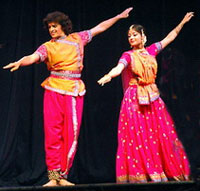 Torso movements are known to this dance style.
Only the shoulder line changes its angle which appears to be manipulation
of the upper torso. This treatment gives the dance style its peculiar
fluidity and some its characteristic torso postures. The shoulder
line and its deflection (with one shoulder depressed and the
other raised) is used at its best in the execution of movements known
as the Kasak masak. The movements of the arms are definite but they
do not make any single geometrical pattern. In the basic stance, the
dancer hold a variation of the hamsasya hasta above the head, the
second arm is extended side-ways or in front and is slightly rounded. Torso movements are known to this dance style.
Only the shoulder line changes its angle which appears to be manipulation
of the upper torso. This treatment gives the dance style its peculiar
fluidity and some its characteristic torso postures. The shoulder
line and its deflection (with one shoulder depressed and the
other raised) is used at its best in the execution of movements known
as the Kasak masak. The movements of the arms are definite but they
do not make any single geometrical pattern. In the basic stance, the
dancer hold a variation of the hamsasya hasta above the head, the
second arm is extended side-ways or in front and is slightly rounded.
The hasta is hamsasya at the waist level. In this
basic stance with a svastika foot (crossing at the back), the mukuta
of Krishna is represented by the right hand and the holdings of Radha
on his left side by the other. The same stance, when it was performed
in a different milieu, acquired a more secular character and came
to be known as the entrance stance which, at its worst, becomes somewhat
coquettish. There are many hastas known to this dance style. The mushti,
the sikhara, the hamsasya, the chandrakala and the alapadma are common.
The characteristic feature of the dance style is its jumps and pirouettes.
There is only a release from gravity, usually in place and there is not attempt
on the part of the dancer to cover space forward or backward through the process
of the jump. In the bhramaris, the Kathak dancer maintains the axis of the body
by using one foot as a centre and the other foot to make a circle. The static
foot represents the centre and the dynamic foot is the arm of a compass drawing
swiftly the circumference of a circle.
Face movements are limited but great emphasis
is placed on the movements of the eyebrows. The use of the eyebrows for the
lasyanga is a characteristic feature of this dance style. The horizontal, side-to-side
movement of the neck is used most frequently in Kathak. |



