|
In Indian dance, the abhinaya is invariably known as
the dancer's ability to interpret words set to music. Such interpretation
of a word through movement distinguishes the classical tradition from folk
forms. The degree of interpretative stylization trough hastas and facial expressions
(mukhaj abhinaya ) gives each dance style its distinctive character.
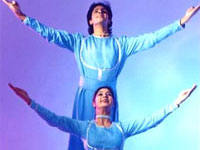 In Kathak, the abhinaya portions have evolved out of many dance
traditions known to central India. To the accompaniment of the song
the dancer presents meaning through gesture. A collection of Sahitya (literature)
of the dance-style from scattered sources in Central India would perhaps
bring to light a sizeable literature of the dance -The Sahitya gave way to the
abstract playing on the sarangi of the recurrent melodic line without the words. In Kathak, the abhinaya portions have evolved out of many dance
traditions known to central India. To the accompaniment of the song
the dancer presents meaning through gesture. A collection of Sahitya (literature)
of the dance-style from scattered sources in Central India would perhaps
bring to light a sizeable literature of the dance -The Sahitya gave way to the
abstract playing on the sarangi of the recurrent melodic line without the words.
Kathak conceives of abhinaya under two broad headings. The first is known as the
gatabhava or just bhava and the second asabhinaya proper. The gatabhava is
executed without the help of words .The dancer makes another entry into the
acting arena by what is known as the gatapalta and gatanikas. After this entry she presents very brief pieces based on the life of Krishna and the gopis.Some times, these gatabhavas are also known as artha gata, but this is a term
which is inaccurately applied because the artha gata would have some meaning
only if it was an interpretation of the world.
The principle of the transitory states (sancharibhava ) is seen at its best
in the abhinaya proper in Closely related to the gatabhava is the presentation
of the nayikabheda by the Kathak dancer. The Kathak dancer presents different
types of the nayikas not through abhinaya to a song, but only the tune of
the lehara. All the eight nayikas of the Indian tradition are known to the
Kathak dancer and she may present them as a separate number or as different
gatas. All these are presentations of Bhava, and the variations of a dominant
mood could be endless.
Kathak. The abhinaya is performed to different types
of poetic and musical compositions. The abhinaya was performed by the rasadhari
dancers to the singing of the dhruvapad and the prabandh. These compositions
went out of vogue but were replaced by two other compositions namely the hori
and the dhamar. The hori is a set composition of north Indian music
which is usually sung to the deepachandi tala. The lyric revolves round the
theme of the Holi festival. The dhamar takes its name from the tala of 14
beats called dhamar and is usually sung or performed in a mood
of obeisance. The Kathak dancer also presents the dhamar in this manner;
the learning of various rhythmical composition in the dhamar song and
tala is essential for her. The great masters of the kathak dancer, Maharaj
Bindadin and his brother kalka, were composes of thumris, bhajans and
padas. These bhajans and padas were written specially for the
dance and it is clear from their wording that the writers were providing
words for movements.
The richest part of the abhinaya number is the thumri.
The musical composition has been the Kathak dancer's solid foundation for
abhinaya. The Kathak dancer interprets the word, sometimes the entire line,
sometimes only the word and sometimes the nuances of the word as interpreted
through the vocal rendering of the thumri. In a given framework, the singer
can present several variations and the dancer can also execute as many variations
in the content. This makes great demands on the imaginative faculty of the
dancer who has to represent, through movement, many analogies and images which
communicates the basic idea contained in the word. A simple word like path
can be interpreted in the appropriate context as the milky way or as the auspicious
parting of a woman's hair or the path of the collyrium of her eyes etc. The
rhythmic footwork is not important and even if the dancer is not sitting
down and interpreting the song, there is hardly any movement of the
feet. It is only through the movement of the hands, the eyes, the eyebrows
etc. that the dancer presents the entire gamut of feelings and emotions
possible for a particular sthayibhava. The vitality of the Kathak dance
has remained undiminished because the thumri on the one hand and the
tala on the other provided the dancer with solid pillars around which
variations could be built in both the nritta and the abhinaya portions.
The dadra is another type of musical composition which is used for abhinaya
in Kathak. It derives its name from the tala of the same name, which is of
two units of three beats each. This has been another favourite musical
composition on which a great deal of interpretative dancing in Kathak has
been developed.
The Kathak dancer has been a solo dancer. Here she is presented
not as an actor but as a narrator. During the last two
decades there have been many attempts at utilizing Kathak for
presenting dance dramas. Sri Birju Caharaj has enlarged the traditional Kathak by
choreography group dances. The form of the dance has also
undergone many significant changes during the last ten years.
|



