|
|

Wednesday, May 8, 2024
|
|


|
The word 'Sikh' goes back to Sanskrit 'Shishya', meaning disciple or leader. In Pali, Shishya became Sissa. The Pali word Sekh (also Sekha) means a pupil or one under training in a religious doctrine.
Sikhism had its birth in Punjab. The founder of the Sikh faith, Guru Nanak belonged to Punjab, a region where Hindus and Muslims had come in closer contact than in any other part of India.
 The Sikhs are recognized by their
beards and turbans. They value these as the signs of their
religious faith. These symbols are an essential part of the Sikh way of life. They are
tall and well-built; the men all grow beards and wear turbans over their long
hair which is never cut. Every Sikh considers it an obligations to wear a Kara
(steel bangle). There are other religious injunctions, like abstaining from
tobacco, which are obeyed rigorously.
The Sikhs are recognized by their
beards and turbans. They value these as the signs of their
religious faith. These symbols are an essential part of the Sikh way of life. They are
tall and well-built; the men all grow beards and wear turbans over their long
hair which is never cut. Every Sikh considers it an obligations to wear a Kara
(steel bangle). There are other religious injunctions, like abstaining from
tobacco, which are obeyed rigorously.
The 'Guru Granth', the Holy scriptures, is the spiritual authority and is venerated as the living presence of the Gurus. It gives form and meaning to the Sikhs religious style and social customs. Their faith has a broad humanitarian base. Singly and in groups, in their homes and in congregations in their places of wor ship , the Sikhs conclude their morning and evening prayers, or prayer said at any other time as part of personal piety or of a ceremony , with the words : 'Nanak nam Charhdi Kala, tere bhane Sarbatt Ka Bhala'-May Thy Name, Thy Glory, forever triumphant, Nanak and in Thy will, may peace and prosperity come to one and all.
DEVOTED LIFE OF GURU NANAK
The first date in Sikhism is 1469, the year in which Guru Nanak was born.
Guru Nanak's fathe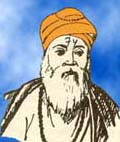 r, Kalyan Chand, who belonged to Bedi clan of the Kshatriyas and his mother Tripti, lived in a village of
Talwandi Rai Bhoe, (now in Pakistan) and now named as "Nankana Sahib".
According to the 'Janamsakhis' (traditional accounts of Guru Nanak's life) "Light flashed across the
mud-built room in which the birth took place". The family priest, who came
to cast the child's horoscope, told his father that his son would sit under
Canopy. He further spoke: "Both Hindus and Turks will pay him reverence. He
will worship and acknowledge but one formless Lord and teach others to do so.
Every creature he will consider as god's own creation." Those early years
of his life are described in 'Janamsakhis' in a variety of legends and miracles.
Guru Nanak was the
favourite of both Hindus and Muslims in the village, which was agreed by the
early biographers.
r, Kalyan Chand, who belonged to Bedi clan of the Kshatriyas and his mother Tripti, lived in a village of
Talwandi Rai Bhoe, (now in Pakistan) and now named as "Nankana Sahib".
According to the 'Janamsakhis' (traditional accounts of Guru Nanak's life) "Light flashed across the
mud-built room in which the birth took place". The family priest, who came
to cast the child's horoscope, told his father that his son would sit under
Canopy. He further spoke: "Both Hindus and Turks will pay him reverence. He
will worship and acknowledge but one formless Lord and teach others to do so.
Every creature he will consider as god's own creation." Those early years
of his life are described in 'Janamsakhis' in a variety of legends and miracles.
Guru Nanak was the
favourite of both Hindus and Muslims in the village, which was agreed by the
early biographers.
Seeing that Nanak did not take to any useful calling in life, his father sent him to Sultanpur where his daughter , Nanaki lived with her husband. At Sultanpur, Nanak was put to work in the local Lodi chief's modihhana or stores, but he distributed things free to fakirs. So his father, at the age of 14 got him married to Sulakshna and they had two sons. But at the age of twenty seven, he left Sultanpur to embark on his long preaching odysseys called Udasis in the Sikh tradition.
The first words he uttered, after three days of silent communion were: "There is no Hindu, there is no Musalman".
Guru Nanak thus rejected distinctions between man and woman by reason of creed or caste. He showed people the way to look beyond these barriers. His equal attention to Hindu and Muslim identities and use of some of their religious vocabulary have led some to depict him as the reconciler of the two faith and to see Sikhism as "a deliberate mingling of Hindu and Muslim practices".
Accompanied by a Muslim follower, called Mardana, Guru Nanak went to different parts in India and spread the message of love, faith and equality.


