|
|

Thursday, May 2, 2024
|
|


|
|||||||||||||||
|
|||||||||||||||
Customs
of Brahmins
Brahmins used to follow the most complex process of rituals in connection with the major events in the person's life like veli (marriage), pregnancy, birth of a child, death. Garbhadhanam
It is a ritual for women to get a blessing from god to conceive. This is the first sacrament which followed immediately on every matrimonial union. Pumsavanam It is a ritual for begetting a male child. It is conducted in the third month of pregnancy. If it is the first pregnancy, it can be in the forth month also. The pregnant women consumes one head of barley and two beads of black grain along with a little curd accompanied by religious chanting. Among Nayars and Ezhavas the ceremony is known as 'Pulikuti' a customary rite of drinking the juice of sour fruits by women during the first pregnancy. Seemantam
This sacrament is performed in the fourth month of pregnancy (only in the case of first pregnancy). Seemantam is conducted for the protection of the mother at the critical period of gestation. If the child is still born, this has to be prepared during the next pregnancy. Fragrant oil was poured on the mother's head and a line or parting (sumanta) was drawn 3 times through her hair from the forehead upwards with 3 stalks of 'Kusa' grass bound together. Three sacred words called 'Vyathiris' (Bheer, Bhavar, Svar) and the hallowed syllable OM uttered during each operation. Jatakarmam
It is meant for the development of the intellect of the child. When the male child is born, the ritual connected with birth is performed immediately. A small portion of a mixture of honey and ghee is given to the new born infant. This rite symbolises good fortune. Namakaranam ( naming the child )
It is like the baptism in Christianity and is done on the12th day after the birth of the child. It is done by the father who calls the name of the child in its right ear. The mother also joins in certain rituals. Among the Nayars, Ezhavas it is done on the 28th day.
Vatilpurappad (Nishkramanam)
Taking the child from the house into the open. The child is usually taken out only in the 4th month. If it is done then, the next opportunity is on the Chorunu day.
Chorunu (Annaprasam )
It is the day on which the first morsel of food is given to the child. It takes place in the sixth month. This is an important ritual among all sections of Hindus .
Vidyarambham
Chooda karanam In the third year or fifth year of the child, the hair is cut leaving behind, a tuft of hair known as 'Kutuma'. Karnavedham (Piercing the ears)
This is done with a particular thorn. Butter is applied to the wound. It is applicable to both male and female children. Upanayanam
When the child attains eight years, the wearing of the thread, is ceremoniously done. This is only in the case of the boys. It is taking the child to the preceptor for initiation. Along the sacred thread, the hide of the antelope called Krishnajinam is also worn by the boy. Praishartham (Learning of Vedas and Upanishads )
The preceptor who leads the boy to himself by conducting 'Upanayanam' teaches him the rules of the scriptures. It is believed that he has become a Brahmin or Dwija; which means twice born and that by undergoing the rituals he becomes a worthy recipient of knowledge. Death
When a Brahmin is dying, he is made to lie on darbha grass spread on the ground in the south-north direction. The body lies with the head towards the south. Mantras are chanted in his ear. When it is confirmed the person is dead, the body is covered with white cloth and a line is drawn around with sacred ash and an oil lamp is lighted. Water is sprinkled over the body. In some cases the body is ceremoniously bathed. The forehead is marked with sacred ash and sandal paste and the ear is adorned with the sacred 'basil flower'. The body is then covered with a new cloth and tied up. It is taken to the cremation ground and placed with head towards the south. The bearers of the body wash their legs and wear the ritual ring ('pavitram' made of a particular grass). A fresh plantain leaf is placed on the south-east of the crematorium, water is poured on the leaf and with a brush made of leaves and grass, this water is sprinkled at the funeral pyre by chanting mantras. This sprinkling of water starts from the agnikon (pyre) in an anti-clock wise direction. The mantra has to be chanted thrice while walking round thrice. The remaining water in the leaf may also be poured on the pyre. The person who does these rituals washes his hands, sits at the feet of the pyre facing south and digs the earth with a knife and removes the sand with his hands. He then cuts a piece from the firewood that is arranged on the pyre, washes his hands and cuts a little fire wood from outside and adds it to the pyre. All the relatives then wear the sacred grass ring. The chief man lights the pyre at its north end.
There are several chants at intervals until the body is completely burned. On the fourth day there is a ritual called Sanchayanam. Thursday, Friday and the birth day of the dead or chief man who does the rites are avoided for sanchayanam. Many other communities consider the fifth day as auspicious unless the star of the day is not inauspicious. There are a lot of rituals for collecting the ashes and bones from the funeral place. The ritual on the eleventh day is known as Pindam. In the morning all relatives take the ceremonial bath as a mark of removal of pollution caused due to the death. The old practice of observance of such pollution was ten days for Brahmins, eleven for Kshatriyas, twelve for Vaishyas and Fifteen for Sudras. Now all Hindus have accepted ten days as the usual practice. The mourners fast on the night previous to the pulakuli and on the next morning bathe with a few drops of oil on their body and perform the ceremony of Shadangam. Rice balls are offered to the names of the deceased which are afterwards thrown into the water. They then bathe once more and an Enangan sprinkles some water with cow dung on them. Caste men are entertained to a feast on the night of the 15th day and the bones of the departed are placed in a metal pot and covered with a piece of silk. It is carried by the chief mourner who goes to the nearest place of water. Whether tank or river, he dips himself with it in the water. The procession is accompanied by music and drums. The 16th day feast, is celebrated sumptuously. There is another important ritual on completion of one year after the death of a person known as pantrandam Masam (the twelfth month). |
|||||||||||||||


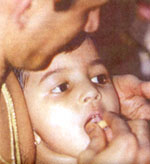 This
is done either when the child attains three or five years. On the tongue
of the child the letters "Hari Sri Ganapataye Namah Avignamastu "and
all the alphabets are written with a piece of gold. The child is
made to write the same letters from "Hari Sri" onwards with
its ring finger on raw rice in a bell metal vessel and the child is made
to utter each word when it is written. Either the father of the child
or an eminent teacher officiates at this ritual. There are also centres
which are noted for the ceremony like 'Thuncham parambu' in Malppuram
district. On Vijayadasami day during Dussera celebrations, a lot
of children get initiated in the learning in temples dedicated to
Saraswati, the goddess of wisdom and learning.
This
is done either when the child attains three or five years. On the tongue
of the child the letters "Hari Sri Ganapataye Namah Avignamastu "and
all the alphabets are written with a piece of gold. The child is
made to write the same letters from "Hari Sri" onwards with
its ring finger on raw rice in a bell metal vessel and the child is made
to utter each word when it is written. Either the father of the child
or an eminent teacher officiates at this ritual. There are also centres
which are noted for the ceremony like 'Thuncham parambu' in Malppuram
district. On Vijayadasami day during Dussera celebrations, a lot
of children get initiated in the learning in temples dedicated to
Saraswati, the goddess of wisdom and learning. 