|
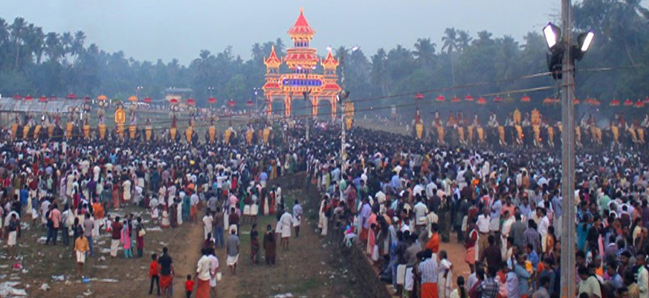
Ochira Kali This is an annual festival celebrated at Ochchira, a village near Kayamkulam in
Thiruvananthapuram district. This festival is celebrated in memory of a battle between the
Rajas of Quilon (Kollam) and Kayamkulam. The fight is the final part of the
festival of the Ochira Parabrahma temple here. Thousands of devotees, including
residents and tourists, witness the festival.
The Dynasty of the king of Kayamkulam was spread over eight
provinces. The battlefield is known as 'Ettukandam' or the eight fields. Ochira
Kali is conducted on the first and second days of the Malayalam
months Mithunam or Avany (June-July) annually during the monsoon season. For
seven days beginning with the first, it is popularly believed that there will
be incessant rain.
The participants fight each other in a mock battle standing
in knee-deep water, brandishing mock swords and shields while splashing water
and mud. On the first day, the fight is conducted from 8 am to 11
a.m. and on the second from 12 pm to 3 pm. Only men, usually from the Nair
community could take part in it. The appearance of a kite hovering
in the air summons the players to arms. Each player is dressed colourfully in the
native attire and armed with a sword and shield. The combatants
do not fight in pairs but in sets. The parties advance towards each other,
perform a number of movements forwards and backwards, with a
single individual standing in front on each side. The movements are first slow, but
as the fight progresses they become
quicker and quicker. These resemble the movements of assault and retreat in
regular warfare. The kite appears again and this time it is the signal for the
tournament to stop. The same programme is repeated on the second day.
The Ochira Parabrahma temple, is dedicated to universal
consciousness. The uniqueness of the temple is that there are no idols.
Vykathu Ashtami
The festival is celebrated in the month of Vrischigam
(Nov-Dec) in the well known Siva
shrine at Vykam in Travancore. Though the Malayalis take part in it, the majority
of pilgrims come from Madura, Tanjore, Trichinopoly, Tirunelvelly. The chief part
of the festival consists in the pilgrims worshipping Siva early in the morning
before day break.
This worship goes on till morning. The Brahmans among the pilgrims is given a
grand feast and in the night the God is carried in procession round the temple
on richly caparisoned elephant with all the temple paraphernalia. It is
considered highly meritorious to worship the god before the sun's rays fall on
the copper plate roofing of the temple, so devotees rush to the temple at early
dawn. Merchants congregate from distant places
and all sorts of wares are for sale.
Kottiyoor Utsavam
This festival partakes in part of the nature of Vela and
Pooram. The temple is situated at the foot of the Wynad hills rising 3,000 to
5,000 feet from the sides of the little glade. The festival is attended by all
classes but they do not mix together. The Nairs go first and after a few days,
the Nairs having done, the Tiyans and so on. The pilgrims like those bound to
the cock-festival at Cranganore, indulge in the vilest and filthiest abuse. They
use personal violence to persons and property all along the road. The festival
is held is not in the temple but in the forest about a quarter of a mile away
from it. There is a stream between the spot where the festival is held and the
temple. About a hundred yards beyond the stream there is a little glade in the
forest which is a sacred spot. It is heed extremely holy and the very idea of
visiting it except at the festival is deemed dreadful. In the centre of the
glade is a circle of piled stones, 12 feet in diameter and in the middle of the
pile of stones is rude lingam. Temporary sheds are put up for the occasion.
Pilgrims carry with them offerings when they go up for the festival.
|