|
|

Monday, April 29, 2024
|
|


|
||||||
|
Secular Singers are broadly classified into five categories : (1) Karapala (2) Dombidasa (3) Helava (4) Kinnari Jogis (5) Tamburis
Karapala or Jangamakathe, a popular song mela of southern Karnataka, is a mixture of folk literature with music and dance. The 'Karapala mela' consisting of three members, has the main narrator in 'jangama'- the preceptor wearing a saffron robe with a red cloth around his waist and an embellished head gear. 'Gummate', the chief folk musical instrument in the mela is a small minaret shaped drum made of mud with one side left uncovered. Besides the Gummate, they also use the cymbals for rhythmical presentation of the songs. The 'Karapala mela' appears like a one-man-show. The chief narrator dominates the show with his impressive creation. Karapala is still performed in places like Arsikere, Tiptur, Hassan as also in places across the Sahyadri range. 'Dombidasa' is an exclusive tribe belonging to the Vaishnava religious sect. Their music constitutes a wide range of religious, secular, historical and mythological stories. e.g. Magadi Kempegowda is a popular heroic song sung by them. They are also known as wandering performers. The artistes wear a robe and head gear besides a chain of beads and carry a satchel. The artistes play the 'Yekatari' (a single stringed 3 to 4 feet long instrument) in one hand and the 'Chitagi' (two small wooden pieces joined together on one side) on the other.
Helava is a tribe found in the southern parts of the state. A big bell is the symbolic instrument of Helavas. The metal bell is passed on to the artistes from one generation to another. Half a meter of cloth is always tied to the handle of the bell. In one hand the artiste firmly holds the cloth and with the other he plays the bell rhythmically and judiciously. The 'Helava song mela' consist of just two or three members. Throughout the long narration of the stories, the artistes play the bell in regular succession. Their songs predominantly illustrate the history of any family in the community running to several generations. As Helavas have a lasting memory of family histories, they are commonly known as family capsules. There are many instances of property disputes being solved by the information provided by the Helavas.
Kinnari Jogis are primarily nomads, who move from place to place with their families, costumes and musical instruments. The name Kinnari Jogi is derived from the popular folk instrument known as the Kinnari. Kinnari resembles the classical instrument, veena and is a 3 to 4 feet long bamboo staff with three strings and three gourds fixed at the bottom. The artistes, dressed in colourful cloth present an attractive spectacle. Decked with embellished head gear and rudrakshi chains they play the Kinnari splendidly.
Two singers form any Kinnari mela. Kinnari Jogis are famous story-tellers. The stories are musically portrayed with perfect balance. Tamburi singers belongs to the Vaishnava cult. This folk art has derived its name from the musical instrument Tamburi which is four stringed and artistically carved. The performers wear a white robe and a yellow or saffron head gear. Carrying a satchel, they play cymbals with one hand and the Tamburi with the other. They impart moral values and norms to the villagers through their music. |
||||||
|
||||||||||
|
||||||||||
Related Links |
| ▪ Classifieds |
| ▪ Education |
| ▪ Yellowpages |
| ▪ Photo Gallery |
| Last Updated on : 26 July 2018 |


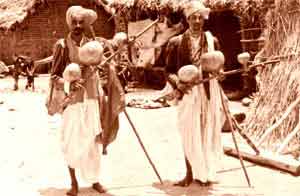 Kinnari
Jogis' have a pride of place among the folk singers of Karnataka. The
artistes belong to the Jogi tribe and worship Lord Shiva.
Kinnari
Jogis' have a pride of place among the folk singers of Karnataka. The
artistes belong to the Jogi tribe and worship Lord Shiva.