Health »
Disease & Conditions »
Baby Growth in stages » Baby - 6-12 months
6 to 12 months of your baby
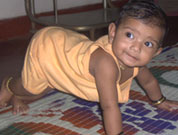 Now
your baby is taking a more and more active part in life and has become an established
member of the family. During the second half of the first year, the baby develops
a great deal physically and mentally. He
will sit up unsupported, may crawl, stand, and even walk by his first birthday.
Babies at this age are developing a real personality and will reward you with
laughter, funny faces, affectionate hugs, gurgling, waving, playing with his toys
and yelling for attention. He begins to model speech patterns after the speech
of those around him. This is a period of steady progress, though the stages of
progress may vary with each child.
Now
your baby is taking a more and more active part in life and has become an established
member of the family. During the second half of the first year, the baby develops
a great deal physically and mentally. He
will sit up unsupported, may crawl, stand, and even walk by his first birthday.
Babies at this age are developing a real personality and will reward you with
laughter, funny faces, affectionate hugs, gurgling, waving, playing with his toys
and yelling for attention. He begins to model speech patterns after the speech
of those around him. This is a period of steady progress, though the stages of
progress may vary with each child.
One-year-olds are delightful.
Each child is special in his or her own way, and you will be amazed at the new
discoveries as your older baby develops. Your baby's first steps and first
words are exciting events.
Feeding
This
is the age when he starts putting anything he wants to explore, into the mouth.
This is the best time to introduce him to soft finger foods to hold and nibble
on. By the time your baby is 8 to 10 months old, he may be ready and interested
in eating with the rest of the family. At this age she can hold a spoon and is
ready to learn to drink from a cup. Some babies will already be on three meals
a day at six or seven months. Others will be on milk feedings only. Solids need
not be quite as liquid because she can cope with a slightly thicker consistency
now, although foods should still be pureed. By the time she is having solids
three time a day she will probably be taking only two milk feedings. Start your
baby on very soft table foods such as mashed, potatoes, bananas or apples; yogurt,
rice cereals, boiled and pureed carrots, cauliflower or other vegetables, and
soft textured meats. Cows milk, citrus fruits, egg whites etc is best avoided
during this time as they may cause allergy. As your baby grows more teeth, the
consistency of the foods as well as the foods we offer can become more varied.
Crawling
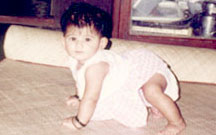 Moving
around on all fours is a great achievement. A 6 to 7 month old baby starts lifting
her chest and bottom, not together but alternatively from the floor supporting
her weight on her arms and legs. By 7-8 months she begins to move, sometimes backwards
not forward, or wriggles forward on the stomach. She may not use each leg in the
same way, a lopsided shuffle with one knee and the other foot is quite normal.
Then she'll figure out how to move forward and backward by pushing off with her
knees. Encourage her to practice crawling by placing a colourful thing or toy
in front of her just out of reach or sitting a few feet away and calling to her.
You must note that many babies never crawl, but may go right ahead with learning
to stand and walk. Some may just roll over or push themselves forward in the sitting
position to move from one place to another. Between 9 to 12 months, the crawling
becomes well coordinated and fast.
Moving
around on all fours is a great achievement. A 6 to 7 month old baby starts lifting
her chest and bottom, not together but alternatively from the floor supporting
her weight on her arms and legs. By 7-8 months she begins to move, sometimes backwards
not forward, or wriggles forward on the stomach. She may not use each leg in the
same way, a lopsided shuffle with one knee and the other foot is quite normal.
Then she'll figure out how to move forward and backward by pushing off with her
knees. Encourage her to practice crawling by placing a colourful thing or toy
in front of her just out of reach or sitting a few feet away and calling to her.
You must note that many babies never crawl, but may go right ahead with learning
to stand and walk. Some may just roll over or push themselves forward in the sitting
position to move from one place to another. Between 9 to 12 months, the crawling
becomes well coordinated and fast.
Sitting
up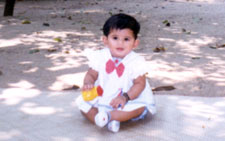
Between 6 to 9 months of age your baby will learn
to sit up without support. At first when she learns to balance sitting up she
will lean forward and spread her legs out wide and straight for support. Then
she gets enough confidence to reach her hands to grasp things while sitting. They
could turn their whole body while sitting, with out fear of toppling over by 9
months.
| Viewer's Comment |
| Ramesh, cbe 15/5/2015 |
| › |
Thanks for ur advice.... I learn hw to make my baby in yr of middle stage.... Thank u |
|
|
|
Questions of
Questions & Answers |
|
| 1. |
Posted on :
6.7.2015 By : H B Nagle , Nagpur
|
View Answer (0)
|
Post Answer
|
|
| |
My son akshay has been suffering from hydocele for last one year. His one testis is increasing. one more thing is that he is suffering from hemangioma by birth and after two years of his birth hydrocele and tonsils are the new diseases arises |
|
|
|
|
| 2. |
Posted on :
20.5.2014 By : Arav Gagan , Ranchi
|
View Answer (1)
|
Post Answer
|
|
| |
I want to 01 Years old baby Vaccine chart ex. Pneumonia, Hepatitis A, Chicken Pocks, Flu.
1.Pneumonia Patient Baby
2. DOB-02/04/2013 |
|
|
| A1: |
These are the reccommendations for immunization by Indian peadiatric associations
1. Hepatitis A - 1 dose (12 Months) ,
2 Dose (24 Months)
Pnumococcus Vaccination - 1 Dose (1 1/2 Months)
2 Dose (2 1/2 months)
3 Dose - (3 1/2 months)
Chickenpox Vaccination 1 Dose - 15 months
2 Dose - 4- 6 years
Influence Vaccination - Every Year
Check the link for more details
https://www.webindia123.com/health/child/baby/Immunization_Chart.html
Please consult your peadiatrician for further Advise |
| |
Posted By :Admin , Kochi | On 26.5.2014 |
|
|
|
|
| 3. |
Posted on :
27.1.2014 By : Vaishnavi , Chennai
|
View Answer (1)
|
Post Answer
|
|
| |
Hi thanks for the above information and I am having two more question first one is we can use citric acid regularly for new born baby second my son body over heat what I want to do become normal |
|
|
|
|
|
|
| » more... |
Note : All statements given are only for information purpose. We are not responsible or liable for any problems related to the utilization of information on this site. We suggest that you consult a qualified doctor before trying any alternative health care remedies.



