| Viewer's Comment |
| Mythili, Coimbatore 10/2/2018 |
| › |
Now 4 months old in triplets babies start solid food very confused |
|
|
|
| Sowbakya, Chennai 22/12/2015 |
| › |
Now my son is 4 month old.it's very useful tips for my baby. Thank you so much. |
|
|
|
| Mobeena, Kundrathur 12/11/2015 |
| › |
This tips is very usefull of my baby thanks a lot. |
|
|
|
| Arul Ramasundaram, Neermulai, Nagapattinam 30/3/2015 |
| › |
Thanks for your valuable tips.. |
|
|
|
| sonia, 20/2/2015 |
| › |
Thanks alot for all the information. we are hpy***** |
|
|
|
| Sabna, Ayanicode 12/12/2014 |
| › |
Thanks for your valuable information.Now i have no confusion fed my 4 months baby |
|
|
|
| Janumuthu, mdu 8/12/2014 |
| › |
Thanku verymuch for useful tips , it helps to take care our child muchmore pls write more tips. |
|
|
|
| Keerthi Venkatesh, hosur 1/7/2014 |
| › |
Thanks giving a good and prefect advice for us : we r happy ! |
|
|
|
| Rajiv, Ballia 12/1/2014 |
| › |
INFORMATION ARE VERY USEFUL CAN U SHARE TIPS FOR SEVEN MONTH BABY . |
|
|
|
| Riya , Chandigarh 22/9/2013 |
| › |
Thanx alot for information..Act i want more information about 3-4 months old babies..... |
|
|
|
| Sangeetha, Singapore 6/9/2013 |
| › |
Thank u for ur advise............send me more information.....
|
|
|
|
| shefali, bangalore 2/3/2013 |
| › |
Information shared are good please add more information on topic,how to take care premature baby. My baby is 5 month old. |
|
|
|
| Preethu, Kerala 10/2/2013 |
| › |
i used to mix water or milk with raw banana powder and stir continuously under low flame till it become thick. This is a healthy meal to your baby. To make this powder, cut raw kerala bananas into thin slices and dry it under sunlight. And then make a powder of it. I started giving this when my baby was 3 month old |
|
|
|
| PavithraAnanth, Chennai 26/1/2013 |
| › |
It's very usefull tips for me to care my 4 and half month old baby..., thank you very much.... |
|
|
|
| Shivani , Mumbai 28/12/2012 |
| › |
I read all and it is very good and nice tips for a mother to take care of her baby. thank you so much for such nice tips. |
|
|
|
| Fathima Rimo, Sri Lanka 27/11/2012 |
| › |
Thanks you very much for your useful advice. I hope definetely these tips will give for my baby's good health. |
|
|
|
| Farhana Begum, Bangalore 3/11/2012 |
| › |
Thanks for the useful information, now its much easier for me to take good care of my child. |
|
|
|
| JOTHI A/P SUBRAMANIAM, Malaysia 22/10/2012 |
| › |
Thank u, for ur tips, becoz its first baby for me i follow this tips for my baby
thank you so much...............
|
|
|
|
| Subodh, Mumbai 10/10/2012 |
| › |
Thanks for this valuable information. My baby now 5 month I dont know what food give for my baby. So i read these usefull tips. these are realy very useful for Parents. Thank you very much. |
|
|
|
| Vaishali Amit Talawadekar, Mumbai 13/9/2012 |
| › |
I am lucky to have read this useful tips, now I am confident to start feeding my baby with the proper food. |
|
|
|
| Simmi, India in Delhi 3/8/2012 |
| › |
Thanks for information. My baby now 5 to 6 month I dont know what food give for my baby. So i read this tips. Its very useful tips for Parents. Thankyou so much. |
|
|
|
| Kennedy macharia, Naivasha kenya 23/7/2012 |
| › |
Thanks for your advise. Now she can be fed without any worries.Thanks to you. |
|
|
|
| Debopriya, Katlicherra, Assam, 28/6/2012 |
| › |
So nice information. Very much useful for our baby. |
|
|
|
| Ruchika, Punjab 26/6/2012 |
| › |
These are very useful tips. My baby is 5 months old. Now i m confidentely give her solid food after reading this. |
|
|
|
| Afroz Tanvir, Rawalpindi 4/6/2012 |
| › |
I am really very happy after reading this now I m confident about my baby food thanks a lot... |
|
|
|
| Udaya, Kanchipuram 9/5/2012 |
| › |
I am lucky to have read this useful tips, now I am confident to start feeding my baby with the proper food. |
|
|
|
| Smita Gupta, Kharagpur 4/5/2012 |
| › |
First of all thanks.I was totally confused about my baby food, but its very worth full information for me. |
|
|
|
| Rejean, Philippines 28/4/2012 |
| › |
I am lucky to have read this useful tips, now I am confident to start feeding my baby with the proper food. |
|
|
|
| K.Saravanan, Puducherry 26/4/2012 |
| › |
Very useful and timely advice. Thanking You a lot. |
|
|
|
| Thamara, Milano 15/4/2012 |
| › |
Good advice for me. Thanks a lots |
|
|
|
| Bhuvana Sundar, Namakkal 27/3/2012 |
| › |
Thanks 4 ur instructions bcoz it is very useful 2 us. And lot of thanks 4 urge suggestions. |
|
|
|
| Pooja, Aligarh 26/3/2012 |
| › |
Good advice for my baby. Thanks for useful tips
I want some more tips for six months to 1 year baby |
|
|
|
| Hymavathi, Hyderabad 24/2/2012 |
|
|
|
| Saravanann C, Trichy 23/2/2012 |
| › |
I really like your tips. These are very useful. Lot of Thanks for Ur Suggestion.... |
|
|
|
| Anjali, Pune 30/1/2012 |
| › |
I like Ur suggestion, these r very helpful. Thank u for solving my all quires... |
|
|
|
| Shabeena Khan, New Delhi 27/1/2012 |
| › |
Very helpfull for all mothers to give her little ones. |
|
|
|
|
|
| Sudharshanarajesh, Pondy 15/12/2011 |
| › |
Very useful and help full... |
|
|
|
| Deeba Khan, Lucknow 2/12/2011 |
| › |
I really like ur sugessions, these r always helpful for me in my all quiries.. Thank u for this site..
|
|
|
|



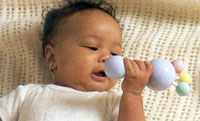 During
these months you will see your baby develop into a real personality. Although
there are toys aimed at this age group, he needs and loves, people most of all.
When he is awake, talk to your baby about everything you do and praise any sound
he makes, smile and respond to his facial expressions. There is no need
for expensive toys. Toys like rattles, bright picture books or any ordinary,
safe objects which stimulate the senses, with colors, texture, sounds and smells
serve the purpose just as well. Position old postcards and photographs or
a child's non glass mirror near him, so he can look at and smile at himself.
A rattle in his hand can keep him engaged for a long time.
During
these months you will see your baby develop into a real personality. Although
there are toys aimed at this age group, he needs and loves, people most of all.
When he is awake, talk to your baby about everything you do and praise any sound
he makes, smile and respond to his facial expressions. There is no need
for expensive toys. Toys like rattles, bright picture books or any ordinary,
safe objects which stimulate the senses, with colors, texture, sounds and smells
serve the purpose just as well. Position old postcards and photographs or
a child's non glass mirror near him, so he can look at and smile at himself.
A rattle in his hand can keep him engaged for a long time. 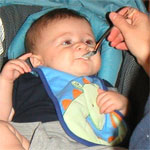 cereal,
mixed with milk, purees of fruits or
vegetables are good beginners. Do not introduce your baby to too many new flavours
at a time. Introduce one food at a time and wait at least 24 hours before adding
a new one. This way you can identify any particular likes or dislikes, as well
as giving your baby a variety of tastes to try.
cereal,
mixed with milk, purees of fruits or
vegetables are good beginners. Do not introduce your baby to too many new flavours
at a time. Introduce one food at a time and wait at least 24 hours before adding
a new one. This way you can identify any particular likes or dislikes, as well
as giving your baby a variety of tastes to try. 


