|
|

Saturday, April 27, 2024
|
|


Breast-feeding
may not be possible or preferable for all women. For those times when you will
be away for 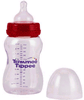 a few hours or if you're planning to return to work, you may be forced to
feed him your breast milk from a bottle. One of the Bottle feeding's advantage
is either parent or anyone else can feed the baby at any time and you can
know exactly how much milk your baby has had.
a few hours or if you're planning to return to work, you may be forced to
feed him your breast milk from a bottle. One of the Bottle feeding's advantage
is either parent or anyone else can feed the baby at any time and you can
know exactly how much milk your baby has had.
 There
are many types and shapes of bottles and nipples available. Silicone nipples
last more while latex nipples last only about just more than a month. There are
anti-colic nipples with a valve in the rim which allows air under the nipple into
the bottle and bottles with throw away plastic liners which prevent the nipple
from collapsing and the baby from gulping air as he sucks. Formulas are available
in powdered form and concentrated liquid form which should be mixed with water
as well as ready to feed formula. Many commercial formulas are modified cow's
milk, some babies do have allergic reactions like stomach pain, diarrhea, skin
rashes. So ask your pediatrician if you suspect an
There
are many types and shapes of bottles and nipples available. Silicone nipples
last more while latex nipples last only about just more than a month. There are
anti-colic nipples with a valve in the rim which allows air under the nipple into
the bottle and bottles with throw away plastic liners which prevent the nipple
from collapsing and the baby from gulping air as he sucks. Formulas are available
in powdered form and concentrated liquid form which should be mixed with water
as well as ready to feed formula. Many commercial formulas are modified cow's
milk, some babies do have allergic reactions like stomach pain, diarrhea, skin
rashes. So ask your pediatrician if you suspect an  allergy
and he will tell you the recommended formulas.
allergy
and he will tell you the recommended formulas.
Here we are giving few tips to make an enjoyable bottle feeding for your new born baby. Remember to wash you hand before preparing your baby's bottles.
• Always use clean boiled and cooled water to make your baby's formula and warm it once only. Once warmed, feed it to the baby immediately, if not, throw it away. Never save it for the next feeding.
• It is recommend to sterilize all bottles and equipment for your baby especially for the first three or four months of life. First of all you wash the equipment bottle, ring, nipple cap or nipples and boil it fully submerged in water for five minutes. Store it in the refrigerator or a cupboard.
• If you’re using a powder formula, it’s easiest to prepare the entire day’s bottles in the morning and put them in the refrigerator so they’ll be ready when baby is hungry. Warm it slightly by dipping the bottle in hot water for sometime, before feeding the baby. Don't store the prepared formula in the fridge for more than 24 hours.
• Throw away half finished formulas, never save it for the next feeding.
• When you travel, take cans of ready-to-use formula, or sterile water and single-serving powder formula packets.
How much milk will baby wantYour baby's needs vary from day to day. During the first weeks of life, 6 feedings (bottles) of 125ml of formula may be enough. As he gains weight he may need more. As a rough guide, your baby needs about 150ml per kg of body weight every 24 hours. So if a 5.5kg baby is on six feeding a day, he make take about 140ml of formula at each feeding.
How
to Bottle Feed
 If
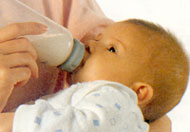
you have decided to choose bottle feeding for your baby, one important thing you
should keep in mind is that your love, cuddling and attention are just important
as to your baby as the formula itself.
If
you have decided to choose bottle feeding for your baby, one important thing you
should keep in mind is that your love, cuddling and attention are just important
as to your baby as the formula itself.
• After preparing your infant's formula, test the temperature by shaking a few drops onto the back of your hand. Many babies prefer their formula slightly warm.
• Check the flow of the milk. It should be 2 or 3 drops a second. Too small a hole will make sucking hard, too large will allow milk to gush out.
• Always lie the baby in a semi- upright position on the bed or in your arms like in breast feeding.
• During feeding hold the bottle firmly at an incline so the nipple fills completely with formula. So that she can pull against it as she sucks, and tilt it so that the nipple is full of formula, not air. If he dozes off during her feeding, he may have gas, which is making her feel full. Sit her up and burp him for a couple of minutes, then offer her some more formula.
• If your baby refuses to let go of the nipple after feeding , do not pull the nipple out from her mouth, slide your little finger in between the gums and the nipple to release.
• Feeding time should be pleasant for both you and your baby. Always hold her close and cuddle against you, and talk softly during the feeding. Skin to skin contact will also help you feel closer to your baby.
• Never leave your baby alone with her bottle, she may choke. Feeding may take as long as a half hour if she is feeling playful.
Questions & Answers |
|||||||||||||||||||||||
| |||||||||||||||||||||||
| |||||||||||||||||||||||
| |||||||||||||||||||||||
| » more... | |||||||||||||||||||||||
Note : All statements given are only for information purpose. We are not responsible or liable for any problems related to the utilization of information on this site. We suggest that you consult a qualified doctor before trying any alternative health care remedies.
|
||||||||||||||||||||||||||||||||


