|
Hinduism
The Hinduism in Manipur seems to have been adopted after the
period of animism. The geographical isolation of Manipur seems to be the
major factor to resist the immediate religious transformation from animism
to any sect of Hinduism, Shaivism and Vaishnavism. There are different
stages which marked the introduced of Hinduism into Manipur.
The kings of the period from 1467 to 1697 did not adopt Vaishnavism formally.
Charai Rongba became king in 1697 AD. and in 1704 AD. He embraced Hinduism.
This was the first step towards royal adoption of religion along with
their king. The king adopted a Hindu preacher as Guru. His descendants
are called Guru Aribom. A full locality of these descendant Brahmins now
exist at Brahampur. The second stage starts with the reign of Garib
Niwaj (1709-1748 AD.). The reign of Garib Niwaj reflects a series of transformations
between the different sects of Hinduism. The king took the sacred thread
for three occasion. He initiated into Vaishnavism in 1717 AD. by appointing
Gopal Das as his Guru. The king popularized Bhagvat in Manipur by taking
the original manuscripts from Assam. During 1728 AD. Santi Das, a Hindu
preacher from Sylhet, arrived in Manipur and started his mission to preach
Ramanandi cult of Vaishnavism. Santi Das initiated the king into his religion.
This event marked the beginning of Ramamandi cult in Manipur. After the
death of Garib Niwaj when King Jai Singh or Bhagya chandra became the
king, he and his subjects accepted the Chaitanya school of Vaishnavism
and the king offered royal sanction to the sect.
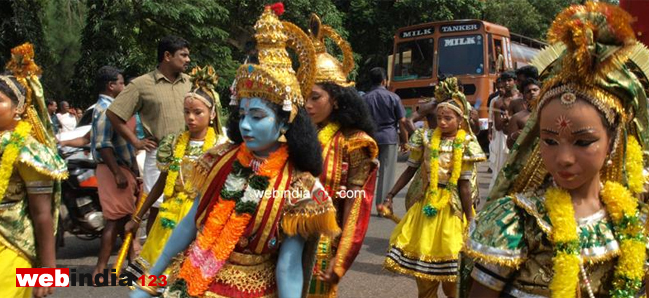
The Manipuris are strict Hindus of the Vaishnav sect. They eat fish but will
not touch flesh and profess to be very particular in their social and religious
observances. The Hinduism of Manipur has a peculiar character showing the
indigenous character. The ritualistic performances are carried out by youngsters
especially women. A Vaishnavite Hindu man and a woman wear 'Tilak' mark on their
forehead which is pasted on the ridge of the nose just behind the nose tip,
upward, right to the centre of the forehead. Hindus show warmth of humanity in their hearts. There are no social or
religious restrictions to accept any one visiting their homes. Most of them have
deep knowledge of the Guru, Mahabharata, Ramayana and the Puranas. They will
show their temple, deities and other things without hesitation and queries. If
there is some festivals in the temple, they will invite others to witness the
festival. The Manipuri Hindus as a society have a plus point that there is no
caste rigidity. They have a curious customs by which a man of low-caste marrying
a high-caste woman can be adopted into her tribe. |