|
|

Thursday, May 2, 2024
|
|


|
||||||||||||
|
||||||||||||
|
In Hansengav the boys and girls form a circle. The steps are taken with music and alternately changed. The movement is slow in the beginning and so is the music but gradually the tempo increases as the dance nears the climax. The dance ends when the male dancers come closer in the circle and hold their Daos by exposing them in the air. In Toonaga Lomna also, girls and boys form a circle. They dance but the circle as a whole moves slowly at the centre two couples face each other. The girls exchange while turning round and round. The steps are taken with the tune and changed alternately. Boys and girls forms two parallel rows in the dance Heng Naga Toona. The hands are clasped by the two opposing each other. These are swung up and down with music, the rows move with taking steps side to side alternately. Towards the end two or four girls dance in the centre to finish the dance. In Tinkoom Gueina Tonagga Lamay dance girls and boys form a circle which is stationary and two girls dance in the centre. They show fantastic movements of their hands with the music. The dance Chan Lam is performed only by the men forming a circle and they move, the step is taken forward then backward to its position and then again forward. While they move everyone shouts ho! ho! ho!. The dancers divide and then form a party dance is irregular pacing with quick music and at last the dance is finished with howls. The Kukis also perform these four types of dances. The Kukis were inferior tot he Nagas in dances, though superior in singing.
The Lushais of Churachandpur perform a beautiful dance called Bamboo dance. It is performed by girls. The costume of the dancer is colourful. The long skirt up to the feet, is a colourful combination of horizontal and vertical stripes. The block carry geometric designs of varied colours. The head-dress is unique. A ribbon of bamboo strip encircles the head with plumes adjusted around. At the back of the head the ribbon carries a horizontal rod like a bob kin with strings hanging down. The dancers perform the dance by lightly jumping over the bamboo sticks. The bamboo sticks are placed horizontally in parallel spacing over the vertically placed bamboo sticks to form criss-cross. Two women, each sitting on one side, slide the horizontal bamboo sticks over the vertically placed bamboo sticks on the ground, matching the rhythm of the music. The striking of the sticks with each other at regular intervals also produces a tempo. The dancers adjust rhythmic helps of their feet according to the music. |
||||||||||||


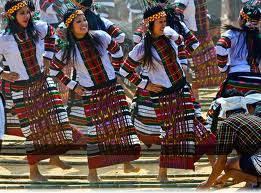 The
tribal dances are part and parcel of the Manipuri dances. It provides
an evolutionary trend of dance styles. The tribal dances are closely related
to nature. Besides war dances, they have also developed some sacred dances
from their experience of spirits and superstitions. Such dances are performed
to please the spirits. The tribal dances of Manipuri Nagas are very popular.
The men wear a coloured loin cloth round the hip, a scarf with multi coloured
bands is crossed at chest hanging down the front and back, the leggings
are white or coloured and Dao or spear is carriedin in the hand.
Generally unmarried girls take part in the dance. They wear skirt by wrapping
around their body, the tinsel ornaments in circles round the hair-knot
on the head. There are several kinds of dances.
The
tribal dances are part and parcel of the Manipuri dances. It provides
an evolutionary trend of dance styles. The tribal dances are closely related
to nature. Besides war dances, they have also developed some sacred dances
from their experience of spirits and superstitions. Such dances are performed
to please the spirits. The tribal dances of Manipuri Nagas are very popular.
The men wear a coloured loin cloth round the hip, a scarf with multi coloured
bands is crossed at chest hanging down the front and back, the leggings
are white or coloured and Dao or spear is carriedin in the hand.
Generally unmarried girls take part in the dance. They wear skirt by wrapping
around their body, the tinsel ornaments in circles round the hair-knot
on the head. There are several kinds of dances.