|
|

Friday, May 3, 2024
|
|


|
|||
|
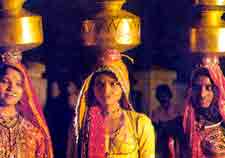
The peninsula of Kathiawar is named after the Kathis who came to Saurashtra at the close of the fourteenth century. 'Rabaris' are a community of cattle-breeders who have migrated from Sindh and Marwar and claim a Rajput ancestry. The Rabaris stand out prominently by their features and dress. They lead a nomadic life.
The community of 'Patidars' owning land is the strongest force in the economic and political life of the state. Patidars, also called Patels, are the best agriculturists of Gujarat. They are grouped into four categories namely Levas, Kadawas, Anjana and Uda. The Levas are most shrewd and are concentrated in central Gujarat. The Kadawas are most numerous in Mehsana district.
The Kutchis, who were the natives of the peninsula of Kutch, have their own dialects. The Kutchis are both Hindus and Muslims and a large number of them have migrated from Sindh. The Jadeja Rajputs, the Lohanas and even the Muslims many of whom are 'Maldharis', the cattle-breeders, have all come from Sindh consequent upon their defeat at the hands of some kings or as a result of some religious persecution. The fourth regional group which may have been a native of Gujarat is the community of aboriginals, locally known as 'Bhils', inhabit the hilly tracts of Gujarat that border the plains from Abu in the north to Dangs in the south. The Bhils may be regarded as a hybrid group in Gujarat, on the one hand absorbing Rajput blood and on the other representing a tribal sub-stratum. The Bhils regard themselves as belonging to the Kshatriya caste who had to take shelter in the hills of the Vindhyas and the Satpuras, along the lower Narmada, to save themselves from the wrath of the Brahmin hero, Parashuram. The Bhils of Gujarat thus do not possess any racial basis distinct from the other inhabitants of the region. >>Next |
|||


 The Aryans were the first people to come from the north who either conquered
or drove away the Bhils, the traditional rulers of Gujarat. Apart from
these two distinct classes, a third class of people known as 'Kolis' are
equally important and occupy an intermediate social position between the
Aryans and the Bhils. Aryans are now commonly recognised as Hindus. The
immigration during the medieval period brought Islam and Zoroastrianism
to Gujarat and initiated the growth of a multi-religious society.
The Aryans were the first people to come from the north who either conquered
or drove away the Bhils, the traditional rulers of Gujarat. Apart from
these two distinct classes, a third class of people known as 'Kolis' are
equally important and occupy an intermediate social position between the
Aryans and the Bhils. Aryans are now commonly recognised as Hindus. The
immigration during the medieval period brought Islam and Zoroastrianism
to Gujarat and initiated the growth of a multi-religious society.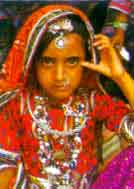 The
Gujaratis, the people of Gujarat, are found all over the state. These
people trace their lineage from the people originally known as Gurjars.
They are believed to have come to India with the Huns and while passing
through Punjab, settled in Gujarat. Gujaratis were highly influenced by
the cultural waves from the mainland and accepted the monarchies that
ruled over them. Various Hindu traditions like Shavism and Vaishnavism
which sprang upon the mainland were imbibed by Gujarat which in turn developed
its own galaxy of saints and devotees and its own art and culture. The
successive waves of immigration were absorbed in the society that was
fast evolving and today the word Gujarati does not seem to suggest any
definite association with a particular stock, a tribe of immigrants or
a specific group of people.
The
Gujaratis, the people of Gujarat, are found all over the state. These
people trace their lineage from the people originally known as Gurjars.
They are believed to have come to India with the Huns and while passing
through Punjab, settled in Gujarat. Gujaratis were highly influenced by
the cultural waves from the mainland and accepted the monarchies that
ruled over them. Various Hindu traditions like Shavism and Vaishnavism
which sprang upon the mainland were imbibed by Gujarat which in turn developed
its own galaxy of saints and devotees and its own art and culture. The
successive waves of immigration were absorbed in the society that was
fast evolving and today the word Gujarati does not seem to suggest any
definite association with a particular stock, a tribe of immigrants or
a specific group of people.