|
Handicrafts
Gujarat has a very rich heritage of art crafts.
The excavations at the Harappan sites in Gujarat at Lothal, Rangpur, Rozdi
etc. have brought to light some of the very ancient handicraft articles.
Patola
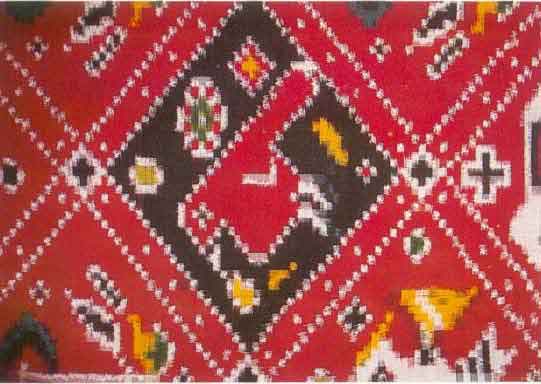 The Patola of Patan is a unique fabric of Gujarat.
Patan is a historic town situated on the banks of river Saraswati,130 km from
Ahmedabad. Originally known as Anhil-Vad-Patan, the place was founded in 1796 AD.
and flourished during the Solanki dynasty. It was the capital of Gujarat from the 8th century till Ahmed Shah moved the capital to Ahmedabad.
Textiles like Patola silk and Mushroo weaving originated in Patan from the time of royalty. The Patola of Patan is a unique fabric of Gujarat.
Patan is a historic town situated on the banks of river Saraswati,130 km from
Ahmedabad. Originally known as Anhil-Vad-Patan, the place was founded in 1796 AD.
and flourished during the Solanki dynasty. It was the capital of Gujarat from the 8th century till Ahmed Shah moved the capital to Ahmedabad.
Textiles like Patola silk and Mushroo weaving originated in Patan from the time of royalty.
This special variety
of women's fabric or Sarees is strikingly attractive with its colourful geometrical
patterns and motifs of birds, flowers, animals, human figures etc. This lovely silken fabric, which resembles a printed sari is
not an apparel printed by blocks.
Its tie and weave method resulting
in identical patterns on both sides of the fabric involving complicated
calculations, is entirely based on the geometry of the design. As both
sides have the same design the saree can be worn either way. The process
is done in the double ikkat style and consists of dyeing the warp and the weft threads
horizontally in conformity with the
proposed design on the fabric. Hand-woven, silk yarn called Patola silk is used
for weaving. The process is both costly and time consuming and the
market is limited with the result that the families doing this work
are fast dwindling.
Patola is also available from Rajkot which is done in
the single ikkat syle and is vertically resist dyed.
|