Home Site Map Make Your Home Page Suggestions Enquiry Advertise With Us
 
Indian States and Union Territories

Tamilnadu

      Land
      History
      People
      Festivals
      Economy
      Arts
      Tourism
      Cuisine
      Tell A Friend
      Feedback

Metro Cities

      Calcutta
      Chennai
      Delhi
      Mumbai
      More Cities

FESTIVALS & FAIRS

Fairs | Festivals


FESTIVALS - Hindus | Christians | Muslims

HINDU FESTIVALS - Introduction | Pongal | Chitrai Festival | Vaikasi Visakam | Vaishnava Festivals | Avani Moolam | Navaratri | Deepavali | Karthigai Deepam | Thirupalli Ezhuchi | Thiruvadhirai | Vaikunta Ekadesi | Maham | Maha Sivaratri | Panguni Uttiram | Kambam Festival | Monthiyan Festival | Nadapavai Festival | Koda Festival | Kumbabisheka


THIRUPALLI EZHUCHI

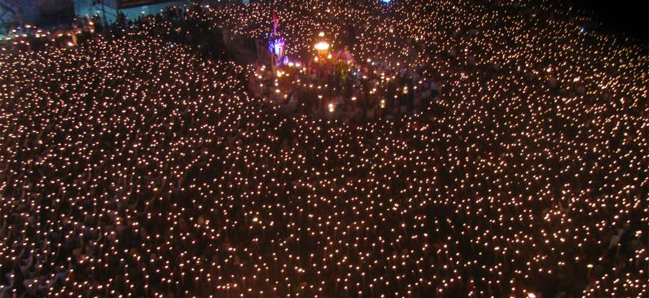
The entire month of Margazhi (December-January ) is a period of early morning  bath, prayer, and  temple  worship completed before dawn, in spite of the chilly weather. The songs sung are Thiryupavai and Thiruvampavai..

THIRUVADHIRAI 

 Thiruvadhirai or Arudhra Darshan festival on the full moon day of Margazhi is sacred to Lord Nataraja, the dancing Shiva. Streams of devotees flow to Chidambaram  to attend  this festival at the temples for the Tamil Shaivaits. Lord Shiva is believed  to have given darshan to saint Manickavacakar on this day on the completion  of his recital of Thiruvampavai. In Perur  of Melai  Chidambaram, Lord Shiva  is believed to have given darshan to Kamadhenu  (the divine cow of plenty) on this day. In the small hours of morning  oil, milk, honey, coconut-water, and curd are poured over image of Shiva and the ceremony continues till day-break when the lord give darshan to the cow.

VAIKUNTA EKADESI 

In the month of Margazhi, a twenty-day festival beginning  with the bright  fortnight takes place at Srirangam, the temple for the Tamil Vaishnavites. Thousands of people attend the Mohini Avatara festival  or Nachiarkolam (10th day) and Ekadesi  festival (11th day). Songs of the Alwars are recited in this festival. On the 18th day, the encounter of the Lord with Thirumangai Alwar takes place and Thiruvaimozhi festival, which the Alwar inaugurated is concluded on the 20th day. On the 11th day  and every day, thereafter lord Ranganatha comes through the Paramapatha vasal  or the Gate of heaven  to receive offerings of several edibles  and bless the saints, and returns to the sanctum sanctorum is a ceremonial procession .

MAHAM

Maham comes in the month of Maasi and the images of gods and goddesses are taken out to the sea for a dip. In areas away from the coast, the rivers or the tanks are the centres for this float festival.

The Maham  is an annual event. But once in twelve years, its importance exceeds bounds of imagination. When  the planet Guru or Jupiter enters Simha sign, the Kumba  Mela  festival of south India is held at the famous Mahamaham  tank at Kumbakonam. Vast crowds gather in Kumbakonam and ordinary folk have a dip in the tank, along with the saints  and philosophers. All the rivers of India  are said to meet at Mahamaham Tank on this day and so, a purificatory bath in this tank on this particular day is considered equal to the combined  effect of dips in all the holy rivers of India.

MAHA SIVARATRI

New-moon night in Massy is the great night of Shiva or Maha Shivaratri is very sacred to the devotees of Lord Shiva. Tradition on this day, Lord Shiva consumed the deity poison which emanated when the ocean of milk was churned by the Devas and Asuras, and this saved the universe.

The worship that was offered to Shiva on that night is being repeated annually. Another version  is that at the time of deluge, the whole world was immersed in complete darkness, and the divine mother Parvati  restored light to the world, by offering worship to the Shiva  on this night. It is said that the rituals observed by the ordinary folk are the same as those observed by Parvati 

Maha Sivaratri  is observed in every temple dedicated to  Lord Shiva and in every Shaivite  Hindu household. The devotees keep vigil the whole night. Throughout the night, the people  worship Shiva by chanting "Om Nama Sivaya " or singing hymns in his  praise. The next morning  they take their bath and after worshipping Shiva, break their fast. Shiva temples are specially illuminated on  that occasion and the deity is worshipped in four different ways, during the four periods of night, each three hours. The image is anointed with milk, curd, butter or honey during the four periods.


[Back]

[Continued]


Quick Links - Webindia123.com
Services
Hobbies
 
Entertainment
Classifieds
Career / Education
UK, USA, Canada
Utilities
E-Booking
India Reference


IndianStates


Pradesh

Copyright 2000- Suni Systems (P) Ltd.
All rights reserved