|
|

Friday, April 26, 2024
|
|


|
|||||
|
The land mass of the state can be divided into two natural divisions, (1) The Eastern coastal plain (2) The hilly region along the North and the West Along the whole length of the western part, the sea varying at a distance from, 80 to 160 km runs the range of the western Ghats, a steep and rugged mass averaging 1220 metres above the sea level and rising to 2440 metres at the highest point. The Palghat Gap about 25 km in width is the only marked break in the great mountain wall. To the south of this gap, the range is known as Anamalai (Elephant Hills) On the east are the Palani Hills on which the famous hill station Kodaikanal is situated. The slopes of the western Ghats are covered with heavy ever green forests. The Nilgiris and the Anamalai are the hill groups with the maximum height. In the famous Ootacamund area of the Nilgiris district, is the highest peak Doddabetta, 2640 metres above the sea level. Ootacamund is known as the 'Queen of hill stations' in India. Almost every district has a hill-station or a sea-side resort.
The rivers of the state flow eastward from the western ghats and are entirely rain-fed. The perennial river fed by both the monsoons is the Cauvery which flows across Tamil Nadu cutting the state in to two halves. The perennial rivers are :- Palar, Cheyyar, Ponnaiyar Kaveri, Meyar, Bhavan, Amaravati, Vaigai, Chittar and Tamaraparni. The non-perennial rivers are the Vellur, Noyal, Suruli, Gundar, Vaipar, Valparai and Varshali. The 760 km long Cauveri is the largest river of the state. |
|||||
|
||||||||||
|
||||||||||
| Last Updated on : 2 June 2018 | ||||||||||


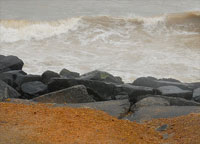 Tamil Nadu is situated on the south eastern side of the Indian peninsula.
It is bounded on the east by Bay of Bengal, in the south by the
Indian ocean, in the west by the states of Kerala and Karnataka
and in the North by the Karnataka and Andhra Pradesh.
Tamil Nadu is situated on the south eastern side of the Indian peninsula.
It is bounded on the east by Bay of Bengal, in the south by the
Indian ocean, in the west by the states of Kerala and Karnataka
and in the North by the Karnataka and Andhra Pradesh.