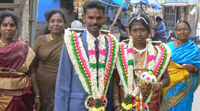
Marriage
Marriages
are generally contracted within the caste and there is no unfettered freedom for
the boy and the girl. Post independence trends of social change have led
to a few inter-caste and inter religious marriages.
Cross-cousin marriage is widely prevalent in Tamil
Nadu. Marriage
of an adult to his sister's daughter is common in some castes,
while it is a taboo among others. No marriage can take place
among the people belonging to the same gotra or having the same ancestors. Communities like the
Maravas,
the Yadhavas and the Nadars
have exogamous group called Kilai which runs on the female line. It is passed
on from mother to daughter. In these castes no one can marry a girl of the
same Kilai. The preferred marriageable relationship are aunt's
daughter or the maternal uncle's daughter. There are traditions in
each caste, who should initiate the talks for a marriage, the bride's
family or the grooms.
'Thai'
(January),
the post-harvest month is an important marriage season. "Thai piranthal vazhi pirakkum" (with the coming of the thai
month a way will be open) is a repeated saying by eligible bachelors longing to
get married. Adi and Margazhi
months are
observed as prohibited months for marriages.
The
marriages are held only at the brides house, in the case of the Mukkulathars, the
Nadars, the Chakkilians, while in some other castes, the celebrations take
place at the groom's residence.
The
bridegroom's party proceeds to the brides house in a ceremonial
procession, carrying turmeric, coconuts, plantains, betel leaves,
flowers, dry fruits, saree for the bride and other articles with the thali and a
thread dyed yellow with turmeric. The marriage canopy is
erected. The canopy is a temporary thatched super structure using
coconut leaves knit together.
Under
the canopy, a marriage platform is erected. On the platform until the
marriage is solemnised, the bride sits to right of the groom. The thali is kept in a
plate, circulated among the assembled guests and their blessings sought. The
groom's sister assist the groom in tying the thali around the
bride's neck. Three knots are
supposed to be made. At this juncture conch shells are blown and
nadaswaram is played in a high-pitch. After the
ceremony, i.e., the tying of the thali by the groom, she sits at the groom's left.
Both of them face east. Coconuts
are broken and prayers are offered to the gods.
The
peculiar custom amongst the Thevars and Ahmudiyars is the
'Kulavaiyidal'. It consists of women folk assembled at the marriage, raising
some kind of a shrill voice which is known as kulavai.
Flowers
and coloured rice are thrown on the heads of the bridal pair. The couple exchange their
garlands and the groom then takes the right hand of the bride and
goes around the sacred fire or bridal platform thrice. After wards, the
bridal pair prostrate before the parents of both groom and bride and
all elders assembled. Everyone bless the pair to have good progeny
and long life.
Several
castes engages Brahmin priest to officiate at wedding. Nadars and Kongu
vellalas engage their own elderly men to officiate as priests.
TRIBAL
MARRIAGES
The
Pazhiyars
Marriage
among Pazhiyars is a simple affair. Both parties should declare their
consent before the elders and give them a sumptuous feast. With this, the
marriage is effected. The only understanding is that the men should collect
roots and yams and trap some wild animals, and women should cook and feed the
elders.
The
Thodas
The
Thodas celebrate marriages on any day including the new-moon day. Intimation is
sent from one 'mund' to another by an agreed call as message, without
deputing a messenger. All the munds are so informed and the entire
community gathers to celebrate every marriage.
On
the day prior to the marriage day, a prayer party is held in an open space. The
marriage ceremony, itself takes place under a cluster of trees, amidst the glare
of light lit within an artificial hole created in the middle of the
tree. At night the place is cleaned. Two sticks to represent the bride and groom
are planted, decorated with black clothes and worshipped as deities. Food cooked
by the bride in a new pot is placed on leaves before the sticks. A lad
related to the bride brings a pot of water and pours some of it over the sticks
and over the buffalo which is the symbol of Thoda wealth. Then the groom pours
the rest of the water over the bride. Then follows a feast .
The
next day, the Thodas meet again in their traditional costumes. The women seek
blessings from elderly men. The entire gathering has a drink and moves to the
place of marriage, generally a high-level area on the top of the hills
under a cluster trees. A lamp of ghee is hung in the tree. The groom and the
bride take part in all the preparations for the marriage even on the marriage
day also. They do their share of manual work without any shyness.
The
bridal pair worship the elders with the permission of the groom's father.
The bridal necklace is handed to the groom to be tied the bride to
the accompaniment of songs sung in chorus by all those present.
After a simple meal, everybody departs and the ceremony is over.
The Kunnavars
Among
the Kunnavars, the engagement ceremony is as important as the marriage.
Prayers are offered for the conclusion of the marriage planned. Flowers
and sandal paste are offered to the Gods and anticipatory thanks giving songs
are sung.
VILAKKIDU KALYANAM
This ceremony is found among the Karkather of Thirunelveli
who are endogamous division of Vellalas. It is a miniature marriage conducted on
the first day of the Tamil month Thai. All the girls of this caste generally in
their ninth year (before attaining puberty) or seventeenth have to wear a
necklace or badge called the 'navamaalai' on this occasion. The ornament
is tied around the girls neck by the maternal grand father or grand mother or
maternal uncle or his wife. A Brahmin priest is called in to officiate this
ceremony. The girls get bronze lamps, which she lights on that occasion. The
badge will be removed at the time of her 'real' marriage but a small piece,
reminiscent of the navamaalai will be attached to her wedding symbol or Thaali.
INTERESTING
CUSTOMS
There are certain interesting customs at marriages. The dhal is a must at the
marriage lunch. The proverb says marriage and dhal go together.
A
type of ducking is prevalent in many castes as part of
marriage festivals. Yellow coloured water is prepared and thrown by
every one over his or her brother-in-law, sister -in-law, and cross
cousins.
Some
castes have a 'Nalungu' ceremony, the bride sing a suitable song and invites
the groom to the ceremony. Green turmeric and reddish paint
are applied by her to the groom's feet. The groom reciprocates by applying them
to the bride. Then she applies sandal paste to his body. He adorns
her with flowers, she shows him a mirror. Both of them play a game
with a ball of flowers. They eat some sweets. For each part of the
ceremony, a suitable song is sung.
Among
conservative Vaishnavite non-Brahmins, offerings are made to the deity in the
forest as a part of the marriage time-table. The bride is taken away by
her uncle to whom she belongs by custom. Later he releases her to the
groom.
In
the marriage of Christian fishermen of the Tuticorin coast,
the groom pays some consideration money or jewellery to the bride's
'customary husband' and get his approval and consent, before walking with his
bride into the nuptial room.
|