|
|

Monday, May 6, 2024
|
|


|
|||
|
|||
|
This dance is performed on Baisakhi when harvesting is over and fairs are held all over the Punjab. It can also be performed without any let or hindrance at any other social occasion of importance. No particular form of dress is indicated for Bhangra. For maintaining unifromity, the dancers wear shirts with loose sleeves, stiff-starched long-cloth tahmats (loose loin cloth reaching up to the ankles) and bright black, red, green or yellow waist-coasts. A bright strip over the turban is often regarded as a must. Tiny bells are sometimes tied over the ankles. Bhangra is danced to the accompaniment of dhol and
rhythmic clapping. The drummer stands at the centre and the dancers stand
in a circle around him. At the beat of the drum, they proceed first with
a slow movement of the feet then a rhythmic wriggling of the body and
after the shaking of the shoulders they start strutting in rhythm. The
tempo increases as the beat of the drum becomes more and more exciting.
The physical movements in twist and turn take the drumming and dance to
a fine climax. The drummer and the dancers all reaching a stage of swinging
ecstasy where sound and movements merge into each other. The flow of the
rhythm is interspersed with chants of "Hoy, Hoy" and "Balle,
Balle" by the dancers. There are short pauses in between. At each
pause when the drumming ceases one of the dancers comes forward, puts
one hand on his ear lifts the other and sings a Boli. As soon as he comes
to the end of it, dancing is resumed. The dancers must keep the rhythm
and increase or decrease the tempo in accordance with the beat of the
drum. Sometimes young men divide themselves competitively into pairs,
each pair performing in its turn while the rest remain in a
With the passage of time Bhangra, is losing its gruffness and its movements are tending to become more and more sophisticated. The Bhangra which is danced on Republic Day and in the films is quite different from the one danced in villages by the unsophisticated people. |
|||


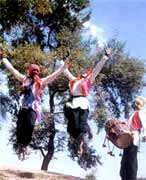 Bhangra is the favourite dance of the Punjabi villager. It is a dance
of stamina in sheer force and tempo. This ancient dance is associated
with the ripening of the harvest. The origin of this is associated with
fertility rites.
Bhangra is the favourite dance of the Punjabi villager. It is a dance
of stamina in sheer force and tempo. This ancient dance is associated
with the ripening of the harvest. The origin of this is associated with
fertility rites.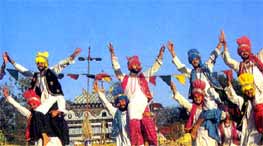 circle.
The gestures are full of vigour that they are difficult to sustain over
long periods. So when a pair exhausts itself, it goes back to the ring
and another pair comes forward to take its places. This may go on for
hours.
circle.
The gestures are full of vigour that they are difficult to sustain over
long periods. So when a pair exhausts itself, it goes back to the ring
and another pair comes forward to take its places. This may go on for
hours. 