|
|

Friday, April 26, 2024
|
|


| Music Home » Musical Instruments |
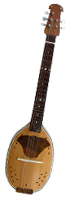 Tambura
(tanpura in north) is one of the classical instruments of the stringed group.
It is a common instrument in the south and it is found in different varieties.
In appearance tambura looks like the southern veena but it does not have the
second gourd and elaborate head-piece.
Tambura
(tanpura in north) is one of the classical instruments of the stringed group.
It is a common instrument in the south and it is found in different varieties.
In appearance tambura looks like the southern veena but it does not have the
second gourd and elaborate head-piece.
The resonance box or bowl of tambura or tamboori is made of wood and is spherical in shape having an upper covering made out of a plain flat plank. The length of the instrument varies from 31/2 feet to 5 feet. The hollow body of the tambura has a small neck. The bridge which is placed on the bowl in the center is made of wood or ivory.
There are four metal strings attached directly to the narrow ledge fixed to the body of the tambura. Three of the strings are made of steel and the fourth and lowest one is of brass. The strings pass through holes in the ledge which is near the peg. The tuning pegs of the first and second strings are fixed at the side of the neck and the other two strings are at right angles to the head. There are beads threaded upon the strings, between the bridge and the attachment to which they are secured. These beads act like a wedge between the belly which is slightly convex and the string, when it is pushed down in the direction of the attachment.
There is a slight difference in the northern and southern varieties of tambura. In the south, tamburas usually have wooden bodies whereas in the north gourds are used.
The tambura is held upright while playing. Sometimes the bowl is placed on the right thigh. The strings of the tambura are gently and continuously plucked with the fingers, one after the other. Little pieces of silk or wool is placed in certain positions between the strings and the main bridge to improve the tonal effect.
The finest tamburas are made in Miraj, Lucknoe and Rampur in the north. Tanjavoor, Thiruvananthapuram, Vizianagaram and Mysore are famous centers of manufacturing tamburas in the south. Tanjavoor tamburas are beautifully carved and ornamented with ivory.
|