|
|

Wednesday, April 29, 2026
|
|


| Music Home » Musical Instruments |
Flute is one among the three celebrated musical instruments of India (the
other two are veena and mridanga). It has various names such as bansuri, venu,
vamshi, kuzhal, murali and so on.
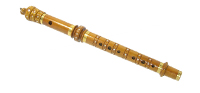 The flute was used in the Vedic period. In ancient India,
flute was commonly used in the religious music of the Buddhists. It is used
The flute was used in the Vedic period. In ancient India,
flute was commonly used in the religious music of the Buddhists. It is used
Flute is a cylindrical tube made of bamboo with uniform bore and closed at one end. Flutes are of different kinds and their lengths and number of holes vary. The length can vary from eight inches to two and a half feet. There is a mouth hole in every flute. In addition to it there are 6 to 8 holes arranged in a straight line. The range of the flute is about 21/2 octaves. Long flutes have a rich, deep and mellow tone whereas in small flutes the tone is high pitched.
The flute is held in a horizontal position with a slight downward inclination. The two thumbs are used to hold the flute in position. The three fingers of the left hand, excluding the little finger and the four fingers of the right hand are used to manipulate the finger holes.
The player blows into the mouth hole, thus setting in vibration, the column of air inside the tube. The lowest octave of the scale is produced by altering the effective length of the tube by covering the holes with the finger. The player can produce any interval by opening or closing the available holes with his fingers.
Bamboo flutes used in the north are longer than those used in the south. South India and Bengal are popular for horizontal flute. Vertical flutes are popular in the north and the west. These are held vertically and played through a mouthpiece. There are a number of artists who have excelled in this instrument. One of the most notable flautist is Pandit Hariprasad Chaurasya.
Artists |
|
| • | Pandit Hariprasad Chaurasia |
| • | Mysore
Chandan Kumar |
| • | B.V
Balasai |
| • | Kudamaloor
Janardhanan |
| • | Pandit
Nityanand Haldipur |
| • | Ronu
Majumdar |
| • | Shashank Subramaniam |
|


