SARANGI
Sarangi is one of the most important bowed instrument of
India. Sarangi is suitable both for solo playing and group performances.
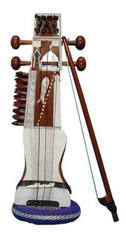 Sarangi is about 2 feet long and made by hollowing out a
single block of wood and covered with a parchment. A bridge is tied on the
belly in the middle. The sides of the sarangi are pinched to facilitate bowing.
Four tuning pegs are fixed to the hollow head, one on each side. The
instrument usually has 3 main strings of guts. But in some type a fourth string
made out of brass is used for drone.
Sarangi is about 2 feet long and made by hollowing out a
single block of wood and covered with a parchment. A bridge is tied on the
belly in the middle. The sides of the sarangi are pinched to facilitate bowing.
Four tuning pegs are fixed to the hollow head, one on each side. The
instrument usually has 3 main strings of guts. But in some type a fourth string
made out of brass is used for drone.
When played, sarangi is positioned in such a way that the
uppermost part (head) is placed on the lap and the other end rests against
the left shoulder. It is played with a horse hair bow which is held in the
right hand. The finger of the left hand is used for stopping the strings.
The
most notable aspect is that strings are stopped with the
sides of finger nails and not by the balls of fingers.
Modern
sarangis generally have 35 to 40 sympathetic strings running under the main
strings. These are fastened to small pegs on the right side of the finger board
and also on the top of the head. The other members of sarangi family are the
Dotara, the Dhad sarangi of Punjab and the Chikara of Uttar Pradesh.