|
|

Sunday, March 8, 2026
|
|


|
|||||||||
|
|||||||||
| Onam
Legend | Rituals | Onasadya | Onakalikal |
|||||||||
|
Onakalikal (Onam Games)
When the meals are over, members of the family used to participate in the games. There are both in-door and out door games and recreations. The older and more sedate members of the family have a game of chess, dice or cards. The younger and the more robust join in the noisy merry-making outside. The outdoor recreations consist of football matches, personal combats, archery, boxing, others like Pulikali, Kummattikali, Thumbi Thullal, Kaikotti kali and the Vallam kali etc. The foot-ball or 'Talappanthukali' is par-excellence the game for Onam. Pantukali is the most important out-door game. The ball is made by wrapping up layers of dried-up plantain leaves with some pebbles inside for giving the required weight and the whole thing is tied up with plantain fiber or coconut fiber to the size of a tennis ball. The players divide themselves into two groups. A stick called natta is planted at one end of the court which is an open space with a line drawn at the other end to demarcate the limit beyond which the ball should not be thrown. One party from the side of the planted stick serves the ball and the adversaries from the other side try to catch it. If they succeed, the man who served the ball is delivered out. If the catch is missed, then he gets another chance. By throwing the ball at the stick and hitting it he wins. The play proceeds in the following order of service. Talappantu (turning towards the stick and serving the ball above the head) otta (holding the ball and then hitting it with the right hand itself) eratta (holding the ball in the left hand, throwing it and hitting with the right palm) murukki (gripping the right hand with the left, through the back of the body, and hitting the ball with the right hand) Kalumkizhu (throwing the ball with the right hand under the right leg by lifting the leg and hitting it with right hand) indan (hitting the ball with foot) and again the first item talappantu. The winning party celebrates the victory by making a circle round the planted stick and dancing in loud chorus.
Combats
Combats are of two kinds, those that are undertaken singly and those held in batches. The first is known as Kayyankali and the second as Attakalam.
Kayyankali is a violent game. It posses all the risks
of an ancient duel, but no weapons or horses are allowed. The combatants
should only use their fists in the attack. The players form two opposing
p Attakalam is a boyish game. A large circle is drawn on the plain sand floor and people are selected for each of the two groups. One section is then placed inside the circle and the other stands around outside. The second group try to strike at and bring the former outside. when one outsider gets inside and try to touch the body of any one amongst the inside group the latter are allowed to beat and worry him. The moment he touches the person inside, he obtains complete immunity from violence at the hands of the rest of the inside batch. The person who is caught is at liberty to strike him and struggle to prevent his being driven out. If he gets turned out then he is no more to remain inside and when the whole of the inside section are driven out, the first batch has finished its turn. It is then followed by the other batch. If anybody is left inside who cannot be driven out his party is declared successful. Sometimes presents are given to the winners as tokens of appreciation of their training and strength.
Archery
In archery or 'ambeyyal', young men form themselves into two parties and shoot at each other with arrows. These arrows are blunted but exceedingly strong and are discharged with such force that a considerable number are generally wounded on both sides. There is a semicircular stop-butt about two feet in the highest parts, the centre and sloping to the ground at each side. The players stand 25 to 30 yards before the concave side of it. Each player is armed with a little bow made of bamboo about 18 inches in length, arrows are pieces of the mid rib of the coconut palm, leaf, roughly broken off, leaving a little bit of the leaf at one end to take the place of the feather. In the centre of the stop-butt, a target is placed on the ground. It is a piece of part of the plantain tree about 3 inches in diameter. It is pointed at the top in which is stuck a small stick convenient for lifting the cheppu or the mark which is the immediate objective of the players. They shoot indiscriminately at the mark and who hits it carries all the arrows lying on the ground. Each side strives to secure all the arrows and to deprive the other side of theirs. The game is accompanied by much shouting gesticulation and laughter.
Kummatti kali is a dance where teams of both kids and young men cover their bodies up in leaves or grass ( 'kumatti' grass or 'parppadaka' grass) patches and wear painted masks representing Bali (monkey king), Rama, Hanuman, demons etc, as characters from the epic Ramayana and as goddess Durga (Kali), an old woman 'thamma' etc. Then they dance clapping their hands together going from house to house. The dance will be accompanied by devotional songs and with a bow like instrument, 'onavillu'. The dance is related to Shaiva myth. The main character 'Thamma', an old woman who walks in front with the help of a stick is believed to be the mother of every being and everything. Pulikali also known as 'kaduvakali' is a recreation in which performers go from house to house, painted like tigers in bright yellow, red and black, dance to the loud beats of percussion instruments like the 'udukku' and 'thakil'. Read more details ..
Kutukutu is an another popular and simple game in which two groups participate. A lot of spectators watch the game with enthusiasm. A line drawn at the centre divides the court into two, with outer lines drawn at the edges making the whole court a rectangle. One man from one group advances from the middle line towards the opponent's area uttering "kutu". Kutu Kutu Kutu...... in one continuous breath and rushes to the line of the opponents trying to touch them and run back to the central line without being caught. If he is physically caught and his breath goes out he is defeated. Mirth and hilarity mark the life of the female members
of the Tarawad during the Onam season. Young maidens decked in their gayest
and finest attire and wearing beautiful and costly jewels spend the days
in dancing and singing. On the last day the images set up are removed at an auspicious moment. Preliminary to this Puja is offered and the removal is announced by the rhythmic shouting with which they were installed. The Vallamkali boat race is one of the outstanding attractions of Onam and the best spectacles are to be seen at Aranmula and Kottayam where the palm-fringed lagoons lend great charm to the event. Huge and graceful boats, each rowed rhythmically by about a hundred oarsmen race to the beat of cymbals and drums that are carried in the boats and the songs sung are typical in character. Above each boat, gleam scarlet silk umbrellas, their number denotes the affluence of the family owning the boat. Gold coins and tassels hang from the umbrellas.
|
|||||||||
|
|
 |
||||||||
|
||||||||||||||||||||||||
|
||||||||||||||||||||||||
| Last Updated on : 30 May 2025 | ||||||||||||||||||||||||


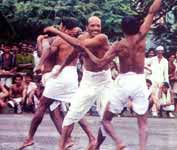 arties.
The number in each party is equal and well matched. On both sides stand
spectators. When everything is ready, one man goes from the ranks of one
party and advances to the middle of the field. He does it with certain
measured steps pertaining to the technology of the game. At once his match
from the opposite party goes out to meet him with the same measured steps.
when the opponents meet they give blows to each other. Blows and counter
blows, fists and counter fists constitute the game. The left elbow supplies
the shield and the right arm the weapon of attack. If the match is good
no single blow will fall on the opponent. But sometimes this happens when
amateurs play the game. Some blow hits on some vital part and kills the
opponent. The victory is indicated by the falling of the opponent to the
ground. Again another couple continue the game and in the end victorious
party wins the prize and applause of the spectators.
arties.
The number in each party is equal and well matched. On both sides stand
spectators. When everything is ready, one man goes from the ranks of one
party and advances to the middle of the field. He does it with certain
measured steps pertaining to the technology of the game. At once his match
from the opposite party goes out to meet him with the same measured steps.
when the opponents meet they give blows to each other. Blows and counter
blows, fists and counter fists constitute the game. The left elbow supplies
the shield and the right arm the weapon of attack. If the match is good
no single blow will fall on the opponent. But sometimes this happens when
amateurs play the game. Some blow hits on some vital part and kills the
opponent. The victory is indicated by the falling of the opponent to the
ground. Again another couple continue the game and in the end victorious
party wins the prize and applause of the spectators. 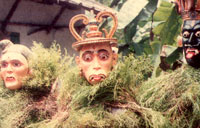
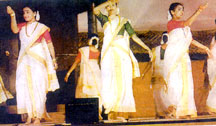 The dancing is peculiar. They stand in a circle and dance. The evolutions
are pretty and in keeping with the harmony of the vocal music. One of
them leads off by singing the first couplet of a song which is caught
up by the others in equally melodious and profuse strains. The leader
then sings the second couplet followed by others as before and so on until
the whole song is exhausted. When one strain is over another is set up
and the singing and dancing is continuous till the shades of evening fall.
The whole surrounding atmosphere of many a leading household is filled
by the melody of the charming choir of lady singers adding to the jollity
and attractiveness of the occasion all around.
The dancing is peculiar. They stand in a circle and dance. The evolutions
are pretty and in keeping with the harmony of the vocal music. One of
them leads off by singing the first couplet of a song which is caught
up by the others in equally melodious and profuse strains. The leader
then sings the second couplet followed by others as before and so on until
the whole song is exhausted. When one strain is over another is set up
and the singing and dancing is continuous till the shades of evening fall.
The whole surrounding atmosphere of many a leading household is filled
by the melody of the charming choir of lady singers adding to the jollity
and attractiveness of the occasion all around.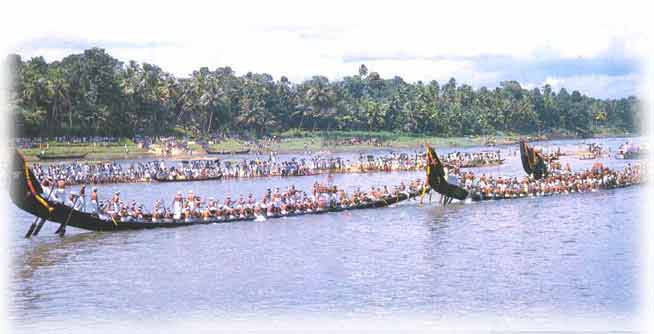 The Vallam Kali (boat game) at Chambakkulam recalls a boat journey on
the river 'pampa' with the icon to be consecrated in the famous Sri Krishna
temple at Ambalapuzha. It symbolises a game of popular involvement. At
Aranmula, another Sri Krishna temple, there is a boat game which is unique
in its processional character. The Vallamkali at Aranmula falls during
the festival days of Onam. The most significant and popular boat race
known as 'Nehru Trophy' was inaugurated in 1952 by the first
Prime Minister of India. Nehru Trophy is the most colourful water sport.
It is conducted at Punnamada lake in Alleppey on the second Saturday of
every August. It attract thousands of people from all over the world.
The ritual game is now totally changed into a modern sport. There are
different varieties of boats which participate in this game. The most
prominent among them is snake boat (chundan vallam) with its high rear.
Chundan look majestic with boat men sitting on either side. The other
types of the country boats which participate in the game are made with
great artistic perfection for gaining speed while used in race.
The Vallam Kali (boat game) at Chambakkulam recalls a boat journey on
the river 'pampa' with the icon to be consecrated in the famous Sri Krishna
temple at Ambalapuzha. It symbolises a game of popular involvement. At
Aranmula, another Sri Krishna temple, there is a boat game which is unique
in its processional character. The Vallamkali at Aranmula falls during
the festival days of Onam. The most significant and popular boat race
known as 'Nehru Trophy' was inaugurated in 1952 by the first
Prime Minister of India. Nehru Trophy is the most colourful water sport.
It is conducted at Punnamada lake in Alleppey on the second Saturday of
every August. It attract thousands of people from all over the world.
The ritual game is now totally changed into a modern sport. There are
different varieties of boats which participate in this game. The most
prominent among them is snake boat (chundan vallam) with its high rear.
Chundan look majestic with boat men sitting on either side. The other
types of the country boats which participate in the game are made with
great artistic perfection for gaining speed while used in race.