| Koodiyattom
The Koodiyattam which emerged by the ninth century was a full-fledged
dramatic presentation in Sanskrit, the repertoire including plays by Bhasa,
Harsha, Mahendra Pallava and Sanskrit plays by Kerala writers like Saktibhadra
and Kulasekhara. The Vidushaka, the comic character, was the only one
character who spoke in Malayalam and if he mixed Malayalam and Sanskrit
with a deliberately comical intention the practice may still have played
a genetic role in the rise of Mani-Pravalam, the language blend in which
a substantial quantity of fine poetry was written in the early phases.
Another feature associated with Vidushaka left an equally valuable legacy.
The Vidushaka was an ironic foil to the hero. For every stanza in Sanskrit
recited by the hero praising his lady-love or expressing his romantic
longing, the Vidushaka recited another in mocking parody. The most important
characteristic of Koodiyattom is its elaborate interpretation of the Sanskrit
slokas or stanzas through hand gestures by the various characters and
by oral expositions of the Vidushaka.
 For the common people, a parallel tradition of sacred
recital to Koodiyattam emerged known as Pathakam. The champus was
written in Malayalam instead of in Sanskrit by Punam in the fifteenth
century and others in every succeeding century. Similar recital emerged
as a third level known as Pana-Thottam Humour was invariably present and
dominated in all the three categories. But the other aesthetic flavours
were in no way neglected. There are passages in Punam which cannot be
read without the eyes brimming over. The recited was by one person, he
could play many dramatic roles and the form broadly corresponded to the
Sanskrit Bhana which had only a single actor. This tradition was finally
culminate in the Thullal. The Koodiyattam could not meet the heavy competition
from other more popular forms. For the common people, a parallel tradition of sacred
recital to Koodiyattam emerged known as Pathakam. The champus was
written in Malayalam instead of in Sanskrit by Punam in the fifteenth
century and others in every succeeding century. Similar recital emerged
as a third level known as Pana-Thottam Humour was invariably present and
dominated in all the three categories. But the other aesthetic flavours
were in no way neglected. There are passages in Punam which cannot be
read without the eyes brimming over. The recited was by one person, he
could play many dramatic roles and the form broadly corresponded to the
Sanskrit Bhana which had only a single actor. This tradition was finally
culminate in the Thullal. The Koodiyattam could not meet the heavy competition
from other more popular forms.
Koodiyattom is a temple art performed traditionally by
a specific community. It belongs to the genre of drama. Koodiyattom is
probably the only surviving form of the traditional presentation of Sanskrit
drama. Koodiyattom embraces elements of music and dance. The performance
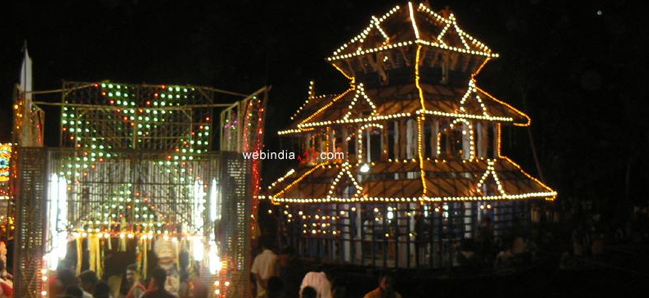
is confined to the temple theatres known as Koothambalams, the performing
artists belong to specific temple dependant communities known as Chakkiars
and Nambiars. The Chakkiars are the actors and the Nangiars of the Nambiar
community undertake female roles to the accompaniment of the Mizhavus
(pot-like drums covered with animal hide) and Edakka (a small drum played
with a stick), Kurumkuzhal (a small wind instrument similar to a Shehnai)
and Kuzhithalam (a small pair of cymbals).
The Koodiyattom as it is presented today was choreographed
some ten centuries ago by King Kulasekhara Varman with the assistance
of his friend Tholan. The form of presentation is highly stylised in Aharya
Abhinaya (make-up, costume and scenic spectacle), Angika Abhinaya (gesture)
and Vachika Abhinaya (oral rendering). The attempt is to present Puranic
characters in a superhuman form, in an epic setting.
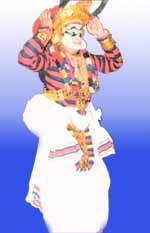
The performers use make-up similar to Kathakali but are
permitted speech, albeit in a stylised manner. The make-up is symbolic
of the nature of the character presented on the stage. At the same time,
there is no typifying of characters as in Kathakali. Koodiyattom
plays are not presented in full. Presentation is so elaborate, nowadays
these plays are presented only in parts - each part being known by a different
name. Each performance is confined itself to one Anka (one act). Since
one Anka of the drama alone is performed at one time, there is a prelude
to this performance called 'Nirvahana' during which one of the characters
sums up the story presented in the earlier acts of the drama and possibly
the earlier stories. This 'Nirvahana' takes many days and if this 'Nirvahana'
is rendered by the Vidushaka, it is an oral exposition. Other characters
use hand gestures for this purpose. |