|
Kee
Kee, the largest monastery in Spiti, situated on the left bank of
Spiti river has the appearance of a hill fort. The monastery was probably
built early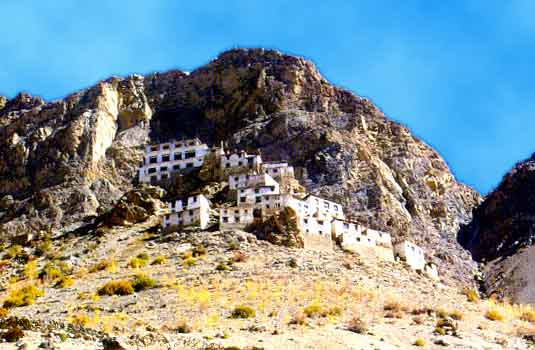 in the eleventh century.
During the Dogra invasion of 1834, the monastery
suffered heavily from fire. The movables were saved by the timely flight
of the monks who carried them to the interior hills. The upper buildings,
house five gompas and a large kitchen beside other rooms. The gompas are
the focal points of the monastery. Each of them is dominated by a statue
of the Buddha. On either side of the statue, there are rows of wooden
pigeon holes where Tibetan scriptures and commentaries are kept. Walls
and books are half covered by Thanka (scroll paintings). These paintings
are the oldest and the most beautiful of all Kee's relic. In the central
hall, there are 2 stucco idols, one of Yum-Chenmo (goddess Thara) and
the other of Shyan rasgzeings (Avalokiteshvara). There are several other
statues in the library opposite the temple.
The monasteries in Spiti represent three different sects
of Lamaism. Kee belongs to the Go-Ing-Pa sect, the Kaza monastery to the
Sa-Skya-Pa sect, while the Pin monastery belongs to the Dr-Ug-Pa sect.
These monasteries are extensive buildings on high ground, away from the
villages. In the centre are the public rooms, temples, refectories and
store rooms. Around them are clustered the separate cells in which the
monks live. In the store rooms are kept, besides public property, the
dresses, weapons and masks, drums, cymbals, robes and hair dresses used
by monks in religious plays, dances and other ceremonies.
Lha-Kun
Lha-Kun near Dhankas is another important monastery. Of the original
9 temples, eight were destroyed by the Mangols in the seventeenth century.
In the centre of the remaining one is a wooden Buddha on a wooden altar.
There are 5 panels of exquisite work showing Buddha and other scenes.
Kanam (Kinnaur) monastery
In Kanam (Kinnaur) monastery there are 7 big and small monasteries built
by Rin-Chan-Sang-Po. The principle one is situated at the top of the village.
There are about 25 rooms in the monastery. They contain copies of Kanjur
and Tanjur, the great encyclopaedia of Lamaism. The image of Buddha in
the shrine is of gilt Bronze with blue hair.
The Pooh monastery
The Pooh monastery built in the 11th century has a stucco statue of a
seated Buddha and two images of his disciples, Sariputra and Maudgallyana.
In front of these are two images of Buddharattana Avalokiteshwara, one
each in stucco and in wood. There are also various illustrated Tibetan
manuscripts.
Guru Ghantal
In Lahaul the largest monastery is that of Guru Ghantal founded by Padma
Sambhava in the 8th century. It has a wooden structure with pyramidal
roofs. It has very fine wood carvings. It has the idols of the Buddha,
laquired Padma Sambhava and Brajeshwari Devi.
The most popular monastery is that of Kardong opposite
Keylong founded some 960yrs ago. It was renovated in 1912 by Lama Noibu.
Chorten or Chaitya is derived from the Stupa and was
introduced in the high hills when Mahayana was fostering new ideas. The
basic structure is a square foundation over which is a dome, then there
are steps leading to a parasol which is topped by the twin symbol uniting
the sun and the moon. These are found near sacred places. The original
function of these buildings was to house relics of the Buddha or great
teachers. Now they are used to shelter any great objects. |



