| Shimla
Shimla, the biggest hill station of the world in the Himalayan foothills,
was 'discovered' by the British in 1817, when 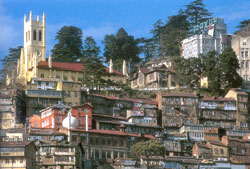 it was just a small village.
Its commanding position on the crest of a
ridge, cool air and lust countryside quickly made it a favourite summer
resort. By 1864, when it was declared the summer seat of the government
of India, the 'Queen of Hill Stations' had become the epitome of everything
British. Shimla then becomes a frost-covered silent city. Shimla's mood
changes with its season. Shimla, now the state of capital of Himachal
Pradesh, is busy, lively and nostalgically "English", with quaint
Raj-era hotels and buildings and beautiful walks through Himalayan mountains
thick with oak, deodar cedar, and pine trees.
Shimla has a pleasant climate throughout the year. The best season
of the year is autumn but the early spring runs a close second. the air
is freshest in these periods, the days warm and bright and the nights
crisp, clear and cool. Autumn welcomes the visitors with calm equanimity
and spring says it with flowers. Here winter is known as the season of
'long moon nights'.
How to get there:Shimla
is connected by road and is 375 km from Delhi. It is 116 km from Chandigarh
and from Kalka 89 km. The closest railhead is at Shimla near bus stand
and is linked with Kalka with the toy train. Kalka is linked with many
big cities through narrow gauge. The airport at Shimla is at a distance
of 23km at Jubbarhati. Taxis/buses are available from these places to
Shimal. Direct flghts from Delhi are available on alternate days.
Christ Church (1844 onwards)
It was designed by Col JT Boileau, consecrated in 1857
and later extended with the addition of a clock (1860) and a porch (1873).
The design of the original chancel window was done by Rudyard Kipling's
father the Lockwood Kipling. A Library (1910) designed by James
Ransome in the Elizabethan style is at next door to the church.
The Town Hall and General Post Office
The town hall (1910) is the reminiscent of the 'Arts
and Crafts style, as well as the timbered General Post Office (1866).
Viceregal Lodge (1888)
This was build for Lord Dufferin who played a prominent
part in its planning and building. The designers H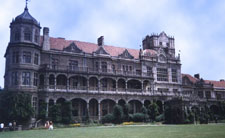 enry
Irwin, who was the designer of famous Madras High Court (Tamil Nadu)
and Mysore's Ambar Vilas Palace at Karnataka and Capt HH Cole designed
it in the Elizabethan style. It includes a indoor tennis court and electric
lights. The lodge also has a botanical garden and a cafe. Towards the
rear is a stone terrace with a view of some major Himalayan peaks. There
are streams running down from top of the hill, flowing into the Sutlej,
Yamuna and Ganga. Now it remains as a Rashtrpati Niwas (The Presidents
House), it houses the Indian Institute of Advanced Study (IIAS). The magnificent
reception hall and corridors are lined from floor to ceiling with heavy
teak panelling. The gate house, a chapel and the meticulously polished
brass fire hydrants imported from Manchester, U.K. still remind us of
its British origin. enry
Irwin, who was the designer of famous Madras High Court (Tamil Nadu)
and Mysore's Ambar Vilas Palace at Karnataka and Capt HH Cole designed
it in the Elizabethan style. It includes a indoor tennis court and electric
lights. The lodge also has a botanical garden and a cafe. Towards the
rear is a stone terrace with a view of some major Himalayan peaks. There
are streams running down from top of the hill, flowing into the Sutlej,
Yamuna and Ganga. Now it remains as a Rashtrpati Niwas (The Presidents
House), it houses the Indian Institute of Advanced Study (IIAS). The magnificent
reception hall and corridors are lined from floor to ceiling with heavy
teak panelling. The gate house, a chapel and the meticulously polished
brass fire hydrants imported from Manchester, U.K. still remind us of
its British origin.
It now houses the Institute of Advanced Studies, and is open only
in some parts to the public. Open 1000 - 1630. Small entry fee to
the house.
Jakhu Temple
This temple (2,455 meter) dedicated to Hanuman, the monkey
god, and surrounded by monkeys is 2 Km from The Ridge near Christ Church.
It is situated in the highest spot on the ridge, with excellent views. It
is best to steer clear of them and keep all eatables well out of reach.
Kamna Devi Temple
This temple is 5 Km from Shimla, a 15 - 20 minutes walk
from Boileauganj and build at Prosoect Hill. Tara Devi is has an
another temple named as Sankat Mochan Hanuman, on the hill top,
7 Km starting from the railway station. You get a grand view of the southern
side of Shimla, the undulating hills and valleys of southern Himachal
and beyond to the plains of Punjab in the distance
State Museum
This museum is a collection of Himachal Pradesh's rich
heritage. Museum has a good collection of archaeological artifacts, carvings,
paintings and sculptures. The ground floor has a gallery with fine Pahari
miniatures, a style developed under the auspices of the Kangra rulers.
Closed on Monday and holidays. |