|
Folk Music and Dance
In Andhra there are nearly thirty-three kinds of foresters,
hill men and tribals. All have, their own dances. These dances can
be broadly classified into three heads (i) Religious dances (ii) Social
dances (iii) Dance as a past time.
Kuchipudi,
one of the classical dance forms of the South had its origin in Andhra
Pradesh.
Peacock Dance of the Khonds
The Khonds, also called Samanlas are the most backward hill men dwelling
in the inaccessible hilly region of Visakhapatnam and Srikakulam districts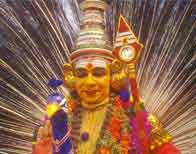 .
During weddings and festival which falls in the month of April,
the Khonds perform the peacock dance. Pirodi, a kind of flute and the
tinkling bells around the ankles are the
only musical accompaniments. All the dancers put on white dhotis, tie
anklets called Muyyangam, wear turbans, made of locally growing grass
and tugged with colourful rags and fasten bunches of peacock feathers
behind at their waists which look like peacock tails whenever they bend
forward. All the dancers stand in two rows in the beginning and .
During weddings and festival which falls in the month of April,
the Khonds perform the peacock dance. Pirodi, a kind of flute and the
tinkling bells around the ankles are the
only musical accompaniments. All the dancers put on white dhotis, tie
anklets called Muyyangam, wear turbans, made of locally growing grass
and tugged with colourful rags and fasten bunches of peacock feathers
behind at their waists which look like peacock tails whenever they bend
forward. All the dancers stand in two rows in the beginning and
imitate the cry of peacock. They form a circle and bend forward from their
knees so as to look like a dancing peacock. After paying obeisance to
mother earth and the Sun god they commence dancing. Putting their palms
to their right legs move their left legs rhythmically, the anklets produce
jingling sounds. They step forward and backward while the pirodi produces
sonorous motes sitting, circling, stepping, bending and waving kerchiefs
in their right hands, they look like dozens of peacocks dancing joyously
in a circle. This includes gestures of the bridegroom going to the bride's
house.
|