|
|

Monday, April 29, 2024
|
|


|
|||||
|
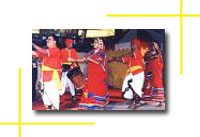
Deepavali is the biggest festival for the Raj Gonds of Adilabad district. As the harvest is over and the season is cool and congenial the Gonds dressed in colourful costumes and decorated with ornaments go to neighbouring villages in troupes, singing and dancing. Such troupes are called Dandari dance troupes. Each troupe consist of twenty to forty members. 'Gusadi' is a part of Dandari and consists of two to five members. This starts on the full moon day and goes on till the fourteenth day of the dark fortnight of Deepavali. Each member puts on a turban of peacock feathers and horns of the deer, artificial beard and moustaches and goatskin to cover the body. Dappu, tudumu, pipri and kalikom are the accompaniments. The Dandari troupe dance accompanied by beats of gumela reaches its climax with regulated steps and rhythm in a circular form. The Dandari dance starts with stepping slowly towards the left side and swinging the right foot on to the left foot at every step. Every dancer has two small sticks in his hands. First everyone strikes the two sticks in his own hands, then strike at the sticks of the person on the right side then strike his own sticks and then the sticks of the person on the left side. In this way, with steps and striking together of sticks held in hands they play kolattam and come back to the original position. Then they bend down and touch the ground with their sticks and step on to the four sides. This is paying obeisance to the gods. After this they put into order their circular form and lay down the sticks. Then they sing and clap their hands. They sing a group song in duet, one group singing the first line and the second group singing the second line of the song. While this is going on, the Gusadi troupe intrudes into the circle with peacock feathered turbans, artificial beards and moustaches, goat skins as covers, strings of cowries and beads around the neck, tinkling bells on wrists, white stripes and dots on the bodies, with modesty pieces around the waists and poles in their hands they enter the circle. After the scattering of the Dandaris, the former raising their hands, and swaying and jerking to the accompanying sounds of the bells and cowries on their bodies. It present a dreadful scene to the on lookers. They jump hither and thither and they utter war cries and with vehement motion and frenzied laughter they frighten the boys and come up on the spectators. They also touch the waists of the spectators with the poles in their hands and tickle them. After some time they dance rhythmically, stepping forward and backward and hither and thither and also zigzag to the accompaniment of instruments. Lastly, the hosting villagers invite them and wash their feet.
Lambadi is the semi - nomadic tribe that is spread all over Andhra. They are also known as Banjaras or Sugalis. Their dances are inspired by the movements associated with daily tasks like harvesting, planting and sowing. The costumes, embroidered with glass-beads and shining discs are picturesque; matched by the abundance of ornate jewellery worn by them. The jingling brass anklets, the hanging cowry bunches and the ivory bangles from wrists to elbows provide a natural rhythm to their dances. Dussehra, Deepavali and Holi are the festive occasions when the Banjaras go from house to house dancing and receiving alms. Twenty to thirty Banjara women dressed in colourful costumes with shining brass vessels filled with water either on heads or waists present a group dance. The graceful movements of their waving hands and supple waists provide a feast to the onlookers. The Siddis present tribal dances during marriages and other festive occasions. Their dances depict the tribal warfare of their home land in all its ferocity. Armed with shining sword and matchlock and dressed in their exotic primitive costumes, they dance with vigour and force. In rural Andhra some folk dance forms are confined to certain regions, some dance forms are common to all the regions.
|
|||||
|
|||||||||||||||||
|
|||||||||||||||||
Related Links |
| ▪ Government |
| ▪ Classifieds |
| ▪ Education |
| ▪ Yellowpages |
| ▪ Jobs |
| ▪ Photo Gallery |
| Last Updated on : 14 March 2018 |