|
|

Tuesday, April 30, 2024
|
|


|
|||
|
Note: A part of Uttar Pradesh mainly tribal areas with the following districts such as Dehradun, Uttarkashi, Tehri Garhwal, Rudraprayag, Chamoli, Hardwar, Pauri Garhwal, Bageswar, Pithoragarh, Almora, Nainital, Champawat and Udham Singh Nagar has been formed into a new state Uttaranchal. So part of the tribal population is now in the state of Uttaranchal.
The tribes live in three well-defined regions - the mountain tracts of Garhwal, Kumaon and Uttrakhand, the terai-bhabhar area extending from Dehra Dun to Bahraich district and the Vindhyan tracts of Mizapur, Allahabad, Varanasi and Bundelkhand. They also live in Pithoragarh, Uttarkashi, Tehri, Banda and Jhansi districts. Garhwal, Kumaon, Pithoragarh, Uttarkashi and Chamoli have the habitats of the Bora, Bhotia and Raji tribes. The Jaunsari type of tribal groups include the Khasas of the Jamuna tract of Dehra Dun district who claim to be Rajputs and Brahmins and the Aujis, Doms and Kolis, Koisor Koltas who are Harijans. The Jaunsari types are also found in the adjoining areas of Rawain (Uttarkashi) and Jaunpur (Tehri). The Bhoksas and the Tharus inhabit the Terai-bhabhar area. The Vindhyan tracts have the largest number of tribes, including Agaria, Bhil, Bhumiyar, Chero, Ghasia, Gond, Kol, Korwaa, Oroan, Parahiya, Panika, Pathari and Sahariya. The Jaunsaris are numerically the largest group. Only five of the states tribal communities have been recognised by the central government as scheduled tribes in terms of the provisions of the constitution. They are the Bhotia, Bhoksa, Jaunsari, Raji and Tharu tribes, inhabiting the sensitive border area. The remaining tribes with the exception of Bhil , Bora and sections of the polyandrous people of Uttarkashi and Tehri, are termed as scheduled castes. Tharus and Bhoksas are of Mongoloid stock and the Khasas of the Himalayan region of Indo-Aryan stock. The remaining Jaunsari types are of mixed descent. Of the Vindhyan tribes, the Gonds and Kols belong to Munda-Dravidian stock. The Bhils and Saharujas are of Indo-Dravidian origin. The tribal areas suffered from poor communications and roads were unsuitable for the major portion of the year. There was extreme scarcity of water during summer, specially in Mirzapur and Banda districts. The Bhotias of the northern frontier suffered a severe setback on account of sudden stoppage of trade with Tibet. The Jaunsaris, had little land of their own and generally worked as labourers on farms or in forests. The problems of Tharus and Bhoksas in the terai areas were quite different. Those lands which were previously defined as fallow land, were captured and developed by this community. The development had already been completed, thousands of outsiders and fortune-seekers were trying to come over and prosper at the cost of local tribes by displacing them from their paternal land. The state governments efforts to meet the situation had met with only partial success.
The tribes have their own separate pantheons but they also worship a few Hindu gods. The Kols of Banda are devotees of Rama, Sita and Lakshmana because of their legendary association with them during their sojourn in exile at Chitrakut. The Sahariyas claim their descent from Shabari, the poor Bhil woman whose hospitality Lord Rama accepted during his wandering in the Chitrakut forests. The tribals follow the patriarchal and patrilineal order of society. Women have a high social status. Among the Tharus of Naini Tal they play a more dominant role than men. Polygamy is a status symbol. Polyandry is prevalent among the Jaunsaris. The Korwas and Bhotias have a custom by which on the death of the elder brother the younger brother can claim the widow. Song and dance are part of the tribal way of life. Among the Jaunsaris and Bhotias, both men and women dance. The Kols have only women dancers. For Bhoksa women dancing is taboo, while Tharu women dance during Holi only. Bhoksas, Tharus and Sahariyas have organized male-dancing parties. |
|||
|
||||||||||
|
||||||||||
Related Links |
| ▪ Classifieds |
| ▪ Education |
| ▪ Yellowpages |
| ▪ Photo Gallery |
| Last Updated on : 20 June 2018 |


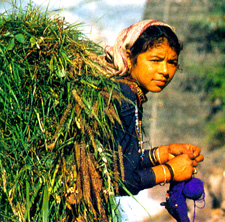 The Khasas are at the top in the Jaunsar tract and the
Gonds in the Mirzapur region. For the Khasas, the Koltas do the tilling
of land while the Bajgis are their tailors and the Lohars and Sonars their
blacksmiths and goldsmiths. The Agarias, Panikas and Ghasias do services
for the Gonds, though the Gonds have now lost their hegemony. All the
tribes love liquor. The Dangwarias and Kathawaras among the Tharus make
their own brand of rice beer. The Korwas and Rajis live on wild fruit
and tree roots. The tribals now wear the same kind of dress as non-tribals
but the tribal women's weakness for gaudy dress, ornaments and finery
is pronounced.
The Khasas are at the top in the Jaunsar tract and the
Gonds in the Mirzapur region. For the Khasas, the Koltas do the tilling
of land while the Bajgis are their tailors and the Lohars and Sonars their
blacksmiths and goldsmiths. The Agarias, Panikas and Ghasias do services
for the Gonds, though the Gonds have now lost their hegemony. All the
tribes love liquor. The Dangwarias and Kathawaras among the Tharus make
their own brand of rice beer. The Korwas and Rajis live on wild fruit
and tree roots. The tribals now wear the same kind of dress as non-tribals
but the tribal women's weakness for gaudy dress, ornaments and finery
is pronounced.